
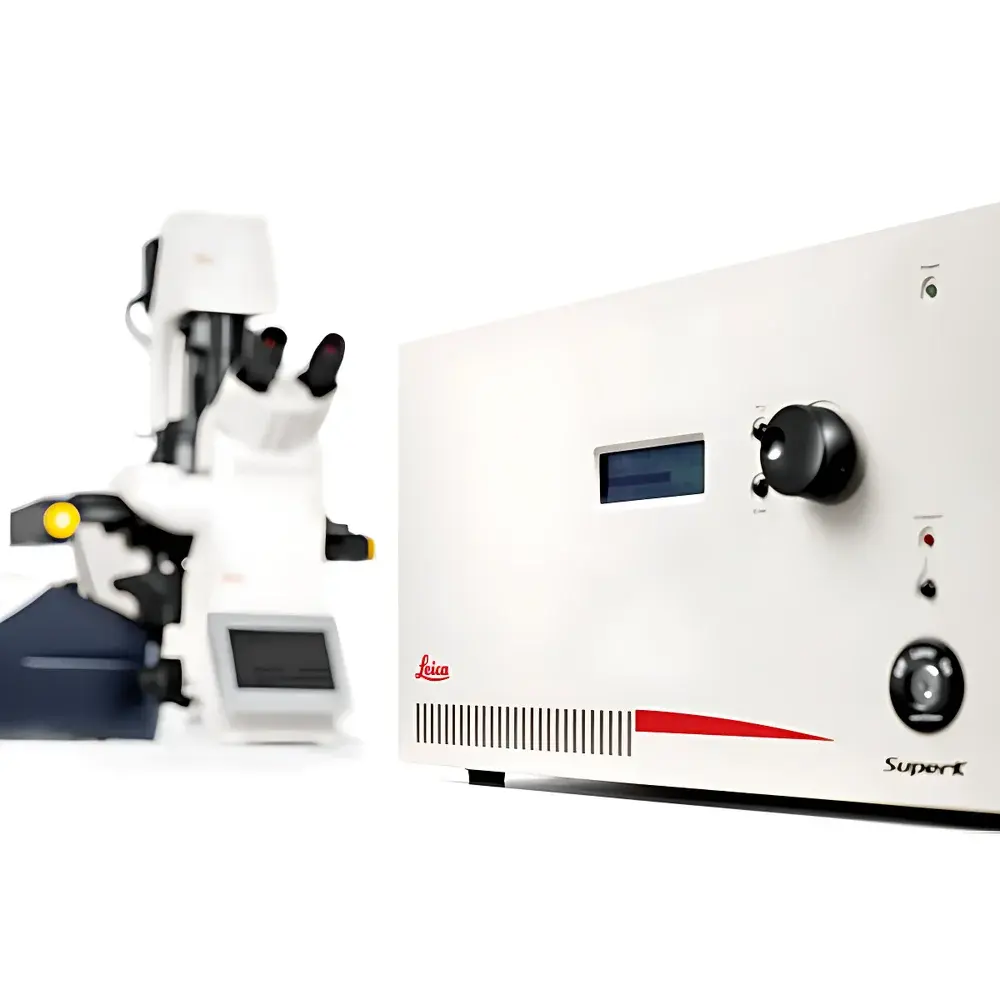
Leica TCS SP8 X Laser Scanning Confocal Microscope
| Brand | Leica |
|---|---|
| Origin | Germany |
| Model | TCS SP8 X |
| Excitation Source | Tunable White Light Laser (WLL), Pulsed |
| Detection | Spectral Detection with Adjustable Bandpass, Up to 8 Simultaneous Excitation Lines |
| Fluorescence Lifetime Imaging (FLIM) Capability | Yes |
| Scan Mode | Galvo + Resonant Scanner |
| Zoom Optics | Continuous Spectral Zoom (λ-Zoom) |
| Microscope Frame | Inverted or Upright Configurable Platform |
| Vibration Isolation | Compatible with Active Damping Optical Tables |
| Software | LAS X Professional Suite with Spectral Unmixing, FLIM Analysis, and GLP-Compliant Audit Trail Modules |
| Compliance | Designed for ISO 13485-aligned workflows |
Overview
The Leica TCS SP8 X is a high-performance laser scanning confocal microscope engineered for quantitative, multi-dimensional fluorescence imaging in life science research and advanced biomedical applications. Built upon Leica Microsystems’ proprietary spectral detection architecture and tunable white light laser (WLL) technology, the system enables precise excitation wavelength selection across the visible and near-UV spectrum (470–670 nm), eliminating reliance on fixed-line lasers and reducing phototoxicity during live-cell imaging. Its core optical design leverages point-scanning confocality combined with spectral unmixing algorithms to resolve fluorophores with overlapping emission profiles—critical for multiplexed labeling in tissue sections, organoids, and primary cell cultures. The integrated time-correlated single-photon counting (TCSPC) module supports fluorescence lifetime imaging (FLIM), delivering quantitative readouts of molecular microenvironment parameters including local pH, ion concentration, protein–protein interactions, and conformational changes—without requiring intensity-based ratiometric calibration.
Key Features
- Tunable White Light Laser (WLL): Continuously adjustable excitation from 470 nm to 670 nm in 1 nm increments; pulse duration <100 ps; repetition rate up to 80 MHz—enabling optimal spectral matching for diverse fluorophores while minimizing photobleaching and cellular stress.
- Spectral Detection Engine: Acousto-optic tunable filter (AOTF)-based spectral detector with 32-channel parallel acquisition; real-time spectral unmixing using linear unmixing or non-negative matrix factorization (NMF) algorithms.
- Hybrid Scanning Architecture: Dual-galvo + resonant scanner combination supports both high-speed (up to 48 fps at 512×512) and high-resolution (up to 8192×8192) acquisition modes; seamless switching between modes without mechanical reconfiguration.
- λ-Zoom Functionality: Continuous spectral zoom allows dynamic adjustment of emission bandwidth during acquisition—ideal for optimizing signal-to-noise ratio in low-expression targets or spectral bleed-through correction.
- FLIM Integration: Fully synchronized TCSPC hardware with picosecond timing resolution; compatible with phasor analysis, bi-exponential decay fitting, and lifetime-based FRET quantification.
- Modular Platform Design: Supports inverted and upright configurations; interchangeable objectives (including water-dipping, silicone-oil, and long-working-distance variants); optional environmental control chamber (37°C, 5% CO₂, humidity regulation).
Sample Compatibility & Compliance
The TCS SP8 X accommodates a broad range of biological specimens—from fixed and live mammalian cells cultured on glass-bottom dishes to thick cleared tissues (e.g., CLARITY, iDISCO), zebrafish embryos, and Drosophila imaginal discs. Its high-sensitivity HyD detectors (hybrid detectors) ensure robust signal capture even under low-light conditions typical of endogenous fluorescent proteins or sparse labeling. For regulated environments, the system’s LAS X software includes electronic signature support, user access levels, full audit trail logging (per FDA 21 CFR Part 11), and instrument calibration history tracking—facilitating compliance with GLP, GMP, and ISO/IEC 17025 laboratory accreditation requirements.
Software & Data Management
LAS X Professional serves as the unified acquisition, processing, and analysis platform. It provides batch processing pipelines for spectral unmixing, colocalization (Manders’ coefficients, Pearson correlation), 3D surface rendering, and time-lapse registration. Raw data is stored in open-format .lif files compliant with Bio-Formats specifications, ensuring interoperability with ImageJ/Fiji, Imaris, and MATLAB. Metadata embedding follows OMERO and FAIR data principles. Optional modules include AI-assisted segmentation (LAS X Deep Learning), multiplexed image registration (LAS X Multi-Sample Alignment), and automated QC reporting for longitudinal experiments.
Applications
- Live-cell dynamics: Mitochondrial membrane potential mapping using TMRE/TMRM with FLIM-based quantification.
- Subcellular protein trafficking: Dual-color FLIM-FRET to monitor conformational changes in biosensors (e.g., Ca²⁺, cAMP).
- Neuroscience: High-resolution dendritic spine morphology and synaptic protein distribution in brain slices.
- Oncology research: Multiplexed tumor microenvironment profiling (CD3, CD8, PD-L1, Ki67) with spectral unmixing and spatial statistics.
- Developmental biology: 4D imaging of morphogenetic movements in live embryos with minimal photodamage.
FAQ
Does the TCS SP8 X support super-resolution modalities such as STED or GSDIM?
No—the TCS SP8 X is a confocal platform optimized for spectral fidelity and FLIM. Super-resolution capabilities require dedicated STED or single-molecule localization systems (e.g., Leica STED 3X or SR GSD 3D), which are separate product lines.
Can I upgrade an existing TCS SP5 or SP8 system to SP8 X specification?
Hardware upgrades are not supported; the SP8 X incorporates a redesigned WLL source, enhanced spectral detector, and updated TCSPC electronics not retrofittable to earlier platforms.
Is remote operation possible for collaborative or core facility use?
Yes—LAS X supports secure remote desktop access via TLS-encrypted connections; multi-user scheduling and queue management are available through optional LAS X Core Facility Manager license.
What maintenance intervals are recommended for the white light laser module?
Leica recommends annual preventive maintenance including WLL power calibration, spectral alignment verification, and detector quantum efficiency validation—documented in the service log per ISO 17025 traceability standards.





