
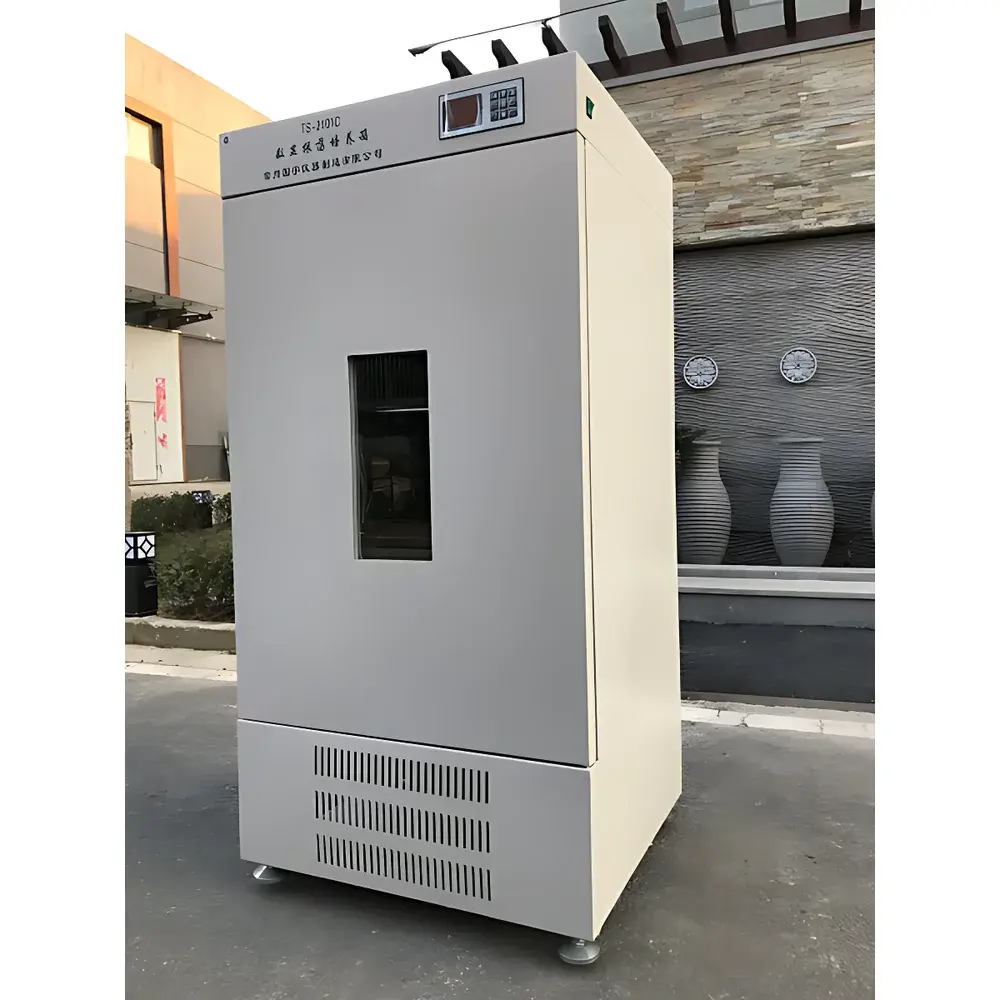
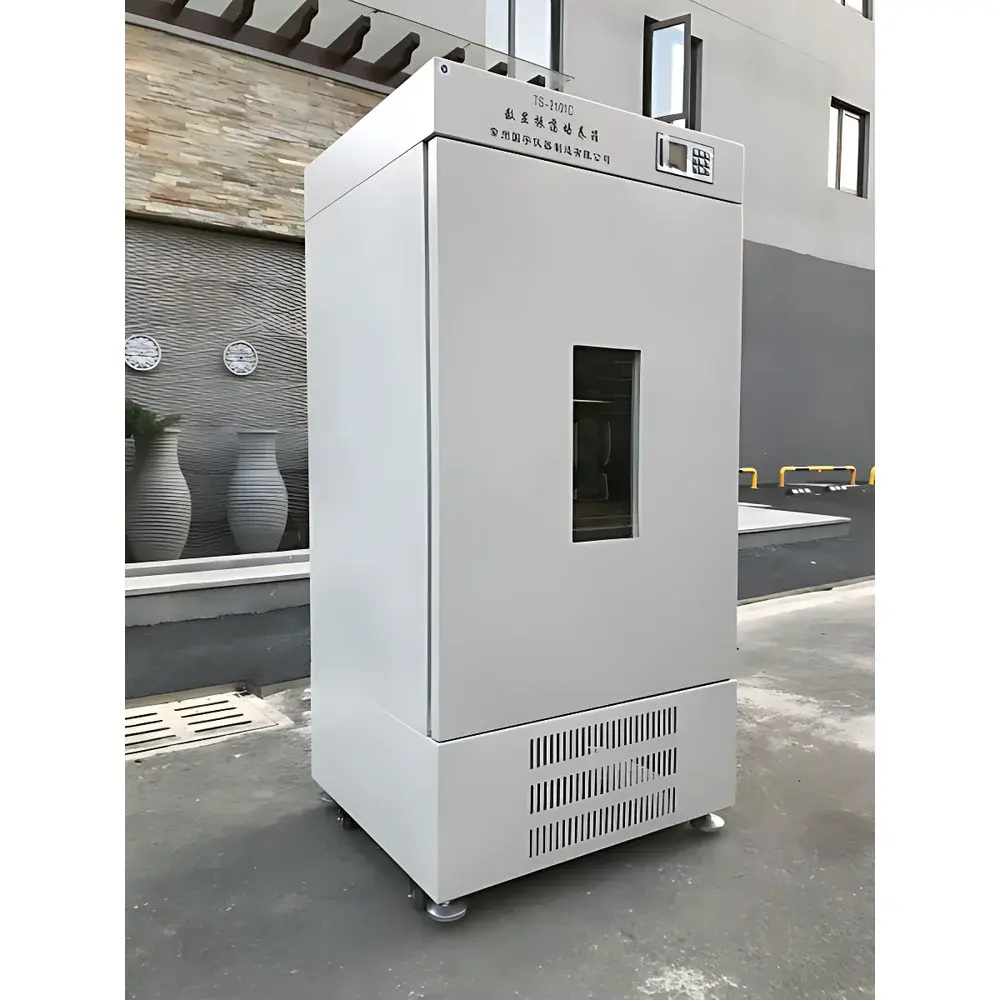
CZGY TS-2101C Digital Display Incubator Shaker
| Brand | CZGY |
|---|---|
| Origin | Jiangsu, China |
| Manufacturer Type | Direct Manufacturer |
| Instrument Category | Domestic |
| Model | TS-2101C |
| Price Range | USD 1,400–2,800 |
| Instrument Type | Full-Temperature Orbital Shaker |
| Timer Range | 0–9999 min |
| Oscillation Frequency | 20–300 rpm |
| Orbit Diameter | 26 mm |
| Temperature Control Range | 0–60 °C |
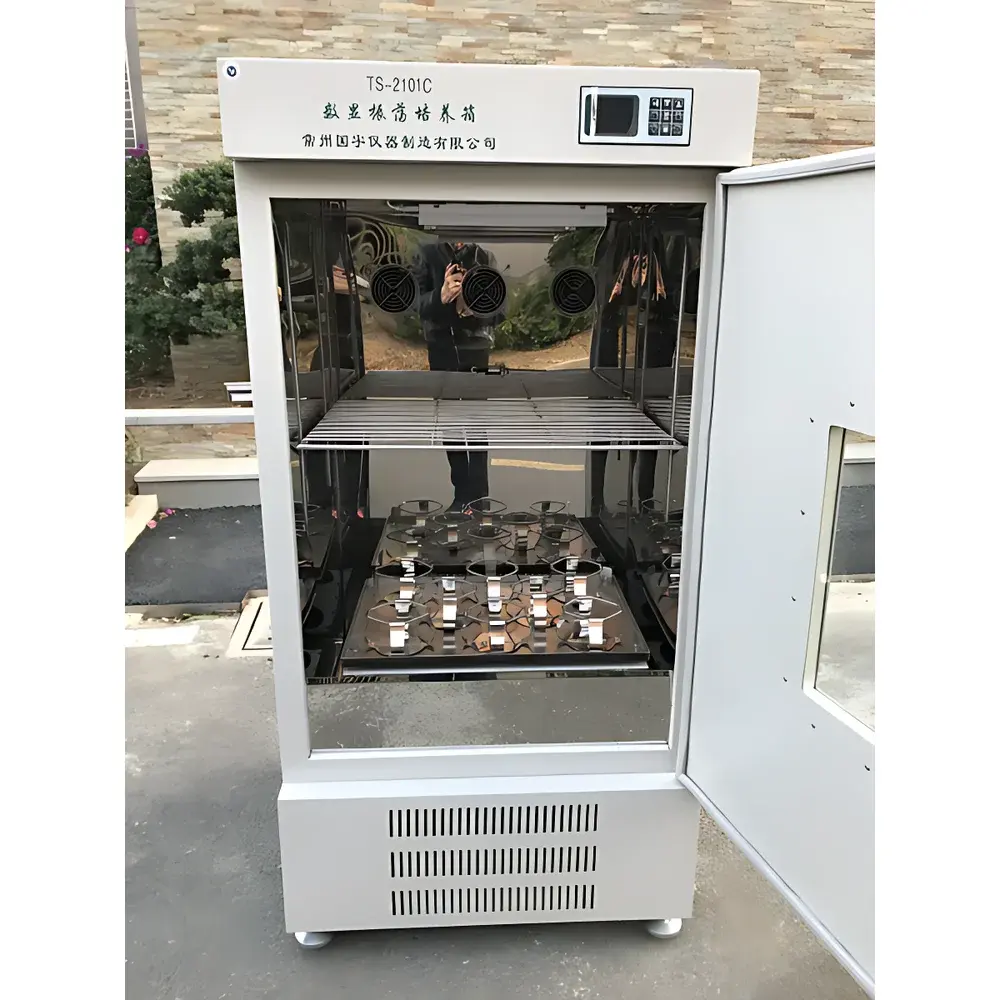
| Shelf Quantity | 1 adjustable stainless-steel shelf |
| Power Supply | 220 V, 50 Hz |
| Heating Power | 900 W |
| Compressor Power | 383 W |
| Circulation Fan Power (×3) | 25 W each |
| Illumination Power | 5 W |
| Shaking Motor Power | 250 W |
| Capacity | Six 2000 mL Erlenmeyer flask clamps |
| Drive System | Brushless DC motor |
| Display | Integrated LCD control panel |
Overview
The CZGY TS-2101C Digital Display Incubator Shaker is a precision-engineered full-temperature orbital shaker designed for controlled microbial culture, cell suspension propagation, enzyme reaction kinetics, and biochemical incubation under simultaneous temperature regulation and mechanical agitation. It operates on the principle of orbital motion with a fixed 26 mm diameter orbit, ensuring uniform mixing and oxygen transfer across heterogeneous liquid cultures. The unit integrates refrigeration (via a 383 W hermetic compressor), resistive heating (900 W), and forced-air convection (three 25 W axial fans) to achieve stable thermal homogeneity within ±0.3 °C across the chamber at setpoints between 0 °C and 60 °C. Its brushless DC drive system delivers high torque at low speeds and exceptional speed stability—critical for sensitive suspension cultures—while eliminating carbon brush wear and electromagnetic interference common in brushed motors.
Key Features
- Integrated LCD control interface with dual independent timers: one for temperature hold duration (0–9999 min), another for oscillation runtime (0–9999 min), supporting unattended overnight or multi-day protocols.
- Single-tier, height-adjustable stainless-steel shelf with reinforced load-bearing capacity—optimized for six 2000 mL Erlenmeyer flasks using standardized universal clamp fixtures.
- Robust thermal architecture combining Peltier-assisted cooling, PID-controlled resistive heating, and triple-fan air circulation ensures ≤0.8 °C internal temperature deviation (measured at five points per IEC 61000-4-30).
- Low-noise operation (<52 dB(A) at 1 m distance) achieved through vibration-dampened compressor mounting, balanced rotor assembly, and acoustic insulation in cabinet walls.
- Modular base with four swivel casters (two with locking brakes) enables safe repositioning and leveling on laboratory floors; adjustable feet provide fine-tuning for horizontal alignment.
- Compliance-ready design: All electrical components meet GB 4793.1–2019 (equivalent to IEC 61010-1) for safety in laboratory equipment; firmware supports audit-trail-capable logging when paired with optional RS-485/Modbus RTU data export.
Sample Compatibility & Compliance
The TS-2101C accommodates standard microbiological and bioprocess vessels—including glass and polycarbonate Erlenmeyer flasks (up to 2000 mL), baffled culture bottles, and deep-well microplates (with adapter trays). Its 26 mm orbit is validated for efficient aeration of viscous media (e.g., 2% w/v agarose suspensions, yeast extract–peptone–dextrose broth) without splashing or foam overflow. The chamber interior features electropolished stainless-steel walls and removable corner gaskets for autoclave-compatible cleaning. While not certified for ISO Class 5 environments, the unit meets GLP documentation requirements for routine QC/QA labs performing ASTM D2088 (microbial growth support testing) and USP microbial enumeration validation protocols.
Software & Data Management
The embedded controller stores up to 10 programmable profiles, each containing temperature setpoint, oscillation speed, ramp rate, and dual timer values. Real-time operational parameters—including actual chamber temperature, measured rpm (±1 rpm resolution), elapsed time, and fault codes—are displayed continuously. Optional RS-485 serial output enables integration into centralized Lab Information Management Systems (LIMS) or SCADA platforms via Modbus RTU. Data export (CSV format) supports 21 CFR Part 11-compliant electronic records when used with validated third-party acquisition software featuring user authentication, electronic signatures, and immutable audit trails.
Applications
- Microbial cultivation of Escherichia coli, Bacillus subtilis, and filamentous fungi under defined O2 transfer rates.
- Seed train expansion for mammalian cell lines (CHO, HEK293) in serum-free suspension media.
- Enzyme immobilization studies requiring precise thermal-kinetic coupling (e.g., lipase-catalyzed transesterification at 37 °C).
- Environmental microbiology: BOD incubation, activated sludge respiration assays, and biodegradation screening per OECD 301 series guidelines.
- Pharmaceutical stability testing per ICH Q1A(R2), including accelerated condition trials at 40 °C/75% RH (when used with external humidity module).
FAQ
What is the maximum load capacity per shelf?
The single stainless-steel shelf supports up to 25 kg distributed evenly—sufficient for six 2000 mL flasks filled to 70% volume.
Does the unit support ramp-and-soak temperature programming?
No; the TS-2101C implements stepwise setpoint control only. Ramp functionality requires external PID controllers or higher-tier models (e.g., TS-2112 series).
Is the compressor oil-free and serviceable in situ?
Yes—the sealed rotary compressor uses synthetic ester lubricant and requires no periodic oil replenishment; field replacement is supported via front-access service panel.
Can the lighting be disabled during dark-phase experiments?
Yes; the 5 W LED illumination is independently switchable via the LCD menu and emits no UV or IR radiation that could interfere with photobiological assays.
What calibration standards are recommended for routine verification?
NIST-traceable PT100 probe (±0.1 °C accuracy) for temperature, and optical tachometer (±0.5 rpm) for speed verification—both aligned with ISO/IEC 17025 internal calibration procedures.
Related Products



