
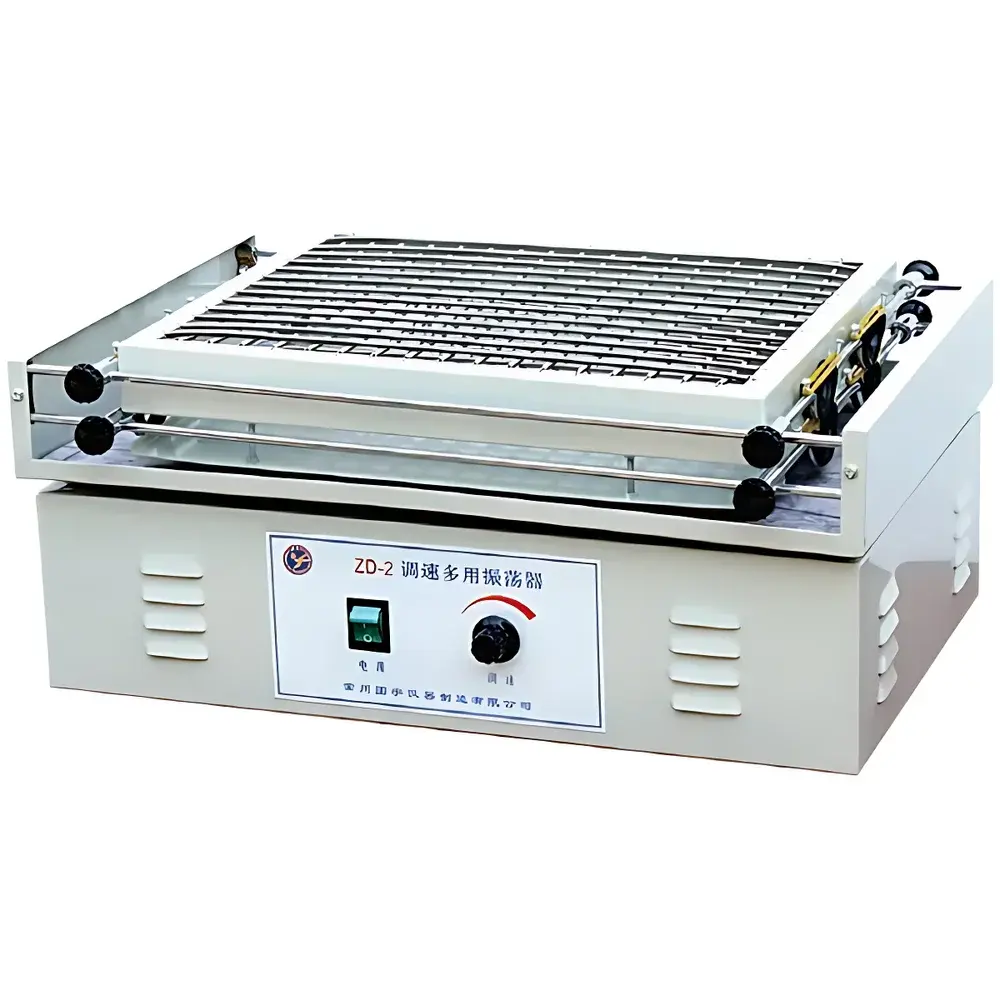
CZGY ZD-2 Variable-Speed Reciprocal Shaker
| Brand | CZGY |
|---|---|
| Origin | Jiangsu, China |
| Manufacturer Type | Direct Manufacturer |
| Instrument Category | Domestic |
| Model | ZD-2 |
| Pricing | USD 135 (FOB) |
| Instrument Type | General-Purpose Reciprocal Shaker |
| Timer Range | 0–120 min |
| Oscillation Frequency | 0–300 rpm |
| Stroke Amplitude | 20 mm |
| Temperature Control | None |
| Platform Quantity | 1 |
| Load Capacity | 20 kg |
| Platform Dimensions | 430 × 260 mm |
| External Dimensions | 500 × 370 × 230 mm |
| Operating Mode | Reciprocating Motion |
| Compatible Vessels | Up to five 250 mL separatory funnels or standard culture flasks/bottles |
Overview
The CZGY ZD-2 Variable-Speed Reciprocal Shaker is an entry-level, mechanically robust benchtop shaker engineered for routine mixing, suspension, and homogenization tasks in life science laboratories. It operates on a reciprocating motion principle—driven by an eccentric cam mechanism—to generate linear back-and-forth oscillation across a fixed stroke amplitude of 20 mm. Unlike orbital or rotary shakers optimized for cell culture, the ZD-2’s reciprocating action provides high-shear agitation ideal for applications requiring vigorous mixing of viscous or particulate-laden samples, including extraction protocols, immunoassay plate washing support, solvent partitioning (e.g., liquid–liquid extraction using separatory funnels), and microbial suspension preparation. Its low center-of-gravity design ensures mechanical stability during continuous operation at speeds up to 300 rpm, minimizing lateral drift and structural resonance—even under full 20 kg load. The instrument complies with IEC 61010-1:2010 safety standards for laboratory electrical equipment and is constructed with a reinforced steel frame and powder-coated chassis for long-term corrosion resistance in humid or reagent-exposed environments.
Key Features
- Infinitely variable speed control (0–300 rpm) via analog dial—enabling precise adjustment without digital interface complexity or calibration dependency
- Mechanical timer with 0–120 minute range and “continuous run” position—designed for repeatable, hands-off operation without software intervention
- Single-platform configuration with 430 × 260 mm stainless-steel tray—compatible with standard Erlenmeyer flasks (up to 1 L), test tubes, Petri dishes, and five 250 mL separatory funnels simultaneously
- High-torque induction motor with sealed ball bearings—rated for uninterrupted duty cycles; pre-lubricated with calcium-sodium grease (NLGI No. 1) per ISO 6743-9
- No external cooling or heating elements—intentionally designed as a non-temperature-controlled platform to reduce thermal drift, power consumption, and maintenance overhead
- Front-panel power switch with LED status indicator and dedicated speed/timer dials—ensuring intuitive operation in glove-compatible or low-light lab settings
Sample Compatibility & Compliance
The ZD-2 accommodates heterogeneous sample formats without adapter requirements: cylindrical vessels (e.g., culture tubes, centrifuge bottles), flat-bottom containers (e.g., microtiter plates placed on secondary trays), and asymmetric glassware such as separatory funnels—provided mass distribution remains symmetrical across the platform. For optimal balance and bearing longevity, users are advised to load vessels symmetrically or counterbalance empty positions with equivalent-mass dummy loads. The device meets CE marking requirements under Directive 2014/30/EU (EMC) and 2014/35/EU (LVD). While not certified for GMP cleanroom use (ISO 14644-1 Class 5+), its sealed motor housing and absence of internal electronics make it suitable for ISO 8 (Class 100,000) environments when operated behind laminar flow hoods. It does not incorporate features required for FDA 21 CFR Part 11 compliance (e.g., electronic audit trails or user authentication), aligning with its role as a general-purpose utility instrument rather than a regulated process tool.
Software & Data Management
The ZD-2 operates exclusively via hardware-based controls—no embedded firmware, USB ports, Bluetooth, or data logging capability is integrated. This architecture eliminates cybersecurity vulnerabilities, firmware update dependencies, and software validation burdens commonly associated with connected lab instruments. All operational parameters (speed, timer setting, power state) are directly observable and manually reproducible without proprietary drivers or vendor-specific applications. For laboratories implementing electronic lab notebooks (ELNs) or LIMS integration, manual entry of ZD-2 operating conditions (e.g., “300 rpm, 45 min, reciprocating mode”) is recommended as part of standardized SOP documentation—consistent with GLP principles for traceability in non-regulated research workflows.
Applications
- Pre-analytical sample homogenization prior to HPLC, GC, or spectrophotometric analysis
- Solvent extraction workflows involving chloroform/methanol/water phase separation
- Suspension of lyophilized reagents, bacterial pellets, or tissue homogenates
- Support for ELISA wash steps when used with custom-designed multi-well plate holders
- Seed germination studies requiring periodic agitation in growth chambers (non-temperature-controlled mode)
- Quality control testing of suspension stability in pharmaceutical suspensions (USP )
FAQ
What is the maximum load capacity—and how should weight be distributed?
The platform supports up to 20 kg total mass. For mechanical longevity and vibration minimization, mass must be distributed symmetrically; unbalanced loads exceeding ±5% deviation across the longitudinal axis may accelerate bearing wear.
Can the ZD-2 be used inside a cold room or incubator?
No. The instrument lacks environmental sealing and is rated for ambient operation only (10–35°C, ≤80% RH, non-condensing). Condensation ingress may compromise motor insulation and timer mechanism integrity.
Is lubrication required—and if so, what specification?
Yes. Every six months under continuous use, inject NLGI Grade 1 calcium-sodium base grease into both drive shaft bearings—filling no more than one-third of bearing cavity volume to prevent overheating.
Does the unit include overload or thermal protection?
Yes. A resettable thermal cutout is integrated into the motor winding circuit, automatically de-energizing the drive at ≥110°C surface temperature. The main fuse (250 V, 2 A slow-blow) provides short-circuit protection.
What maintenance documentation is provided?
Each unit ships with a printed operation manual, warranty card, and maintenance log template—structured to support ISO/IEC 17025-compliant calibration interval tracking and preventive maintenance scheduling.




