
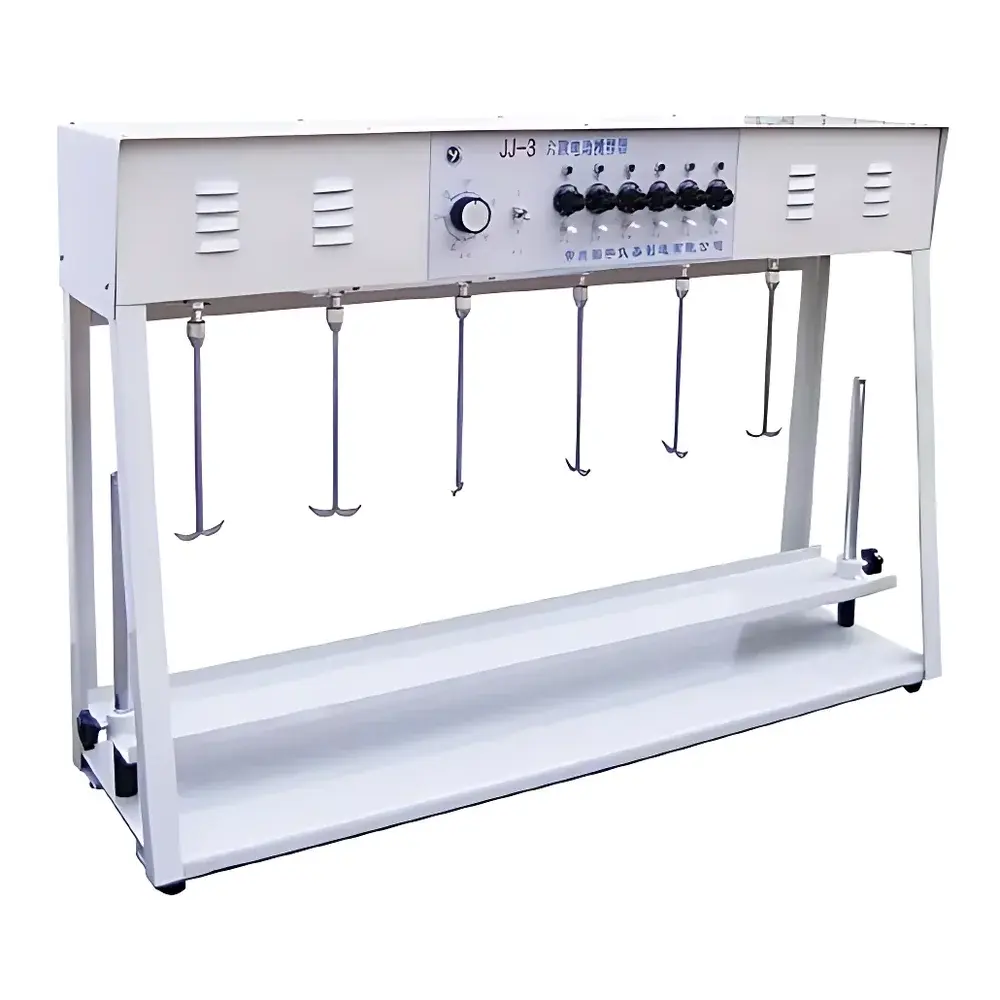
CZGY JJ-3 Six-Station Electric Stirrer
| Brand | CZGY |
|---|---|
| Origin | Jiangsu, China |
| Manufacturer Type | Direct Manufacturer |
| Instrument Type | Electric Stirrer |
| Max. Stirring Volume | 20 L per station |
| Speed Range | 0–3000 rpm |
| Power Supply | 220 V AC, 50 Hz |
| Motor | 6 × 60 W Permanent Magnet DC Motors |
| Timing | Mechanical Timer, 0–120 min |
| Control | Independent Continuous Speed Adjustment per Station |
| Construction | Stainless Steel Stirring Rods |
| Compliance | Designed for GLP-aligned laboratory environments |
| Software | None (standalone analog operation) |
Overview
The CZGY JJ-3 Six-Station Electric Stirrer is a precision-engineered benchtop mixing system designed for reproducible, parallel liquid agitation in research, quality control, and teaching laboratories. It operates on the principle of direct-drive mechanical rotation via six independent permanent magnet DC motors—each delivering stable torque across the full 0–3000 rpm speed range without gear reduction or belt transmission. This architecture ensures minimal speed drift under variable load conditions, particularly critical when handling viscous samples (e.g., polymer solutions, suspensions, or high-concentration colloids) where shear-sensitive homogenization is required. Unlike magnetic stirrers, the JJ-3 employs mechanically coupled stainless steel stirring rods, enabling effective mixing in opaque, non-magnetic, or large-volume containers—including 20 L glass carboys, beakers, and Erlenmeyer flasks—without reliance on stir bars or magnetic fields. Its analog control interface prioritizes operational robustness and long-term reliability in high-throughput routine testing environments.
Key Features
- Six fully independent stirring stations with dedicated continuous-speed control knobs—enabling simultaneous but differentiated agitation protocols across multiple samples.
- Permanent magnet DC motors (60 W each) engineered for low-noise operation (<55 dB at 1 m), consistent torque delivery, and extended service life without brush replacement intervals typical of universal motors.
- Mechanical timer with 0–120 minute range per station; “ON” position bypasses timing for indefinite operation—suitable for unattended overnight mixing under supervision.
- Stainless steel (304 grade) stirring rods resistant to corrosion from aqueous, acidic, alkaline, and mild organic media—compatible with standard lab cleaning agents and autoclaving (rod-only).
- Height-adjustable vertical support column with dual-locking mechanism accommodates vessels from 50 mL test tubes to 20 L cylindrical containers; integrated LED illumination aids visual monitoring of vortex formation and suspension stability.
- Grounded 220 V AC input with internal fuse protection; meets IEC 61010-1 safety requirements for laboratory electrical equipment.
Sample Compatibility & Compliance
The JJ-3 supports a broad range of container geometries and sample types common in analytical chemistry, environmental testing, pharmaceutical formulation, and materials science workflows. It is routinely deployed in ASTM D2196 (viscosity of paints), ISO 787-11 (dispersion stability of pigments), and USP (dissolution apparatus qualification) preparatory steps. While not a regulated device under FDA 21 CFR Part 11, its mechanical design and traceable operation (via timer settings and manual speed recording) support GLP-compliant documentation when integrated into validated SOPs. No software-based audit trail is provided; users are advised to log speed, duration, and vessel configuration manually for regulatory submissions.
Software & Data Management
The JJ-3 operates exclusively via analog controls—no embedded firmware, digital display, or connectivity options (USB, Ethernet, Bluetooth). This architecture eliminates cybersecurity risks, firmware update dependencies, and calibration drift associated with digital encoders. All operational parameters (speed setting, timer value, on/off state) are directly observable and repeatable by trained personnel. For laboratories requiring electronic data capture, external RPM meters (e.g., handheld laser tachometers) and time-stamped video recording may be employed to generate auditable records compliant with ISO/IEC 17025 clause 7.7.
Applications
- Parallel preparation of calibration standards and reference solutions in environmental water analysis (EPA Method 200.7, 300.0).
- Homogenization of cell culture media, buffer stock solutions, and reagent blends prior to filtration or sterilization.
- Accelerated aging studies involving slurry-based catalysts or battery electrode slurries under controlled shear profiles.
- Extraction protocol development (e.g., Soxhlet pre-extraction, leaching tests per TCLP or SPLP).
- Teaching laboratories: demonstration of Newtonian vs. non-Newtonian fluid behavior through systematic viscosity–speed correlation experiments.
FAQ
Is the JJ-3 compatible with corrosive solvents such as concentrated HCl or NaOH solutions?
Yes—stainless steel (304) stirring rods and PTFE-coated shaft couplings resist degradation in pH 1–13 aqueous environments. Avoid prolonged exposure to halogenated organics or hypochlorite solutions.
Can the unit maintain constant speed when stirring highly viscous samples (>10,000 mPa·s)?
Within its 0–3000 rpm range, the permanent magnet DC motors provide high starting torque and minimal speed sag under load; however, maximum effective viscosity is vessel- and rod geometry-dependent. Use wide-blade impellers for optimal performance above 5,000 mPa·s.
Does the JJ-3 meet CE or UL certification requirements?
It complies with IEC 61010-1:2010 for laboratory electrical safety but does not carry CE or UL marks. Customers requiring formal certification should consult local regulatory authorities for equivalency assessment.
What maintenance is required for long-term reliability?
Annual inspection of motor brushes (if accessible), lubrication of height-adjustment threads, and verification of ground continuity using a calibrated multimeter. No scheduled calibration is mandated.
Is custom mounting or OEM integration supported?
CZGY offers mechanical adaptation services—including bracket fabrication, voltage modification (110 V / 60 Hz), and panel-mount configurations—under NDA-bound engineering agreements.



