
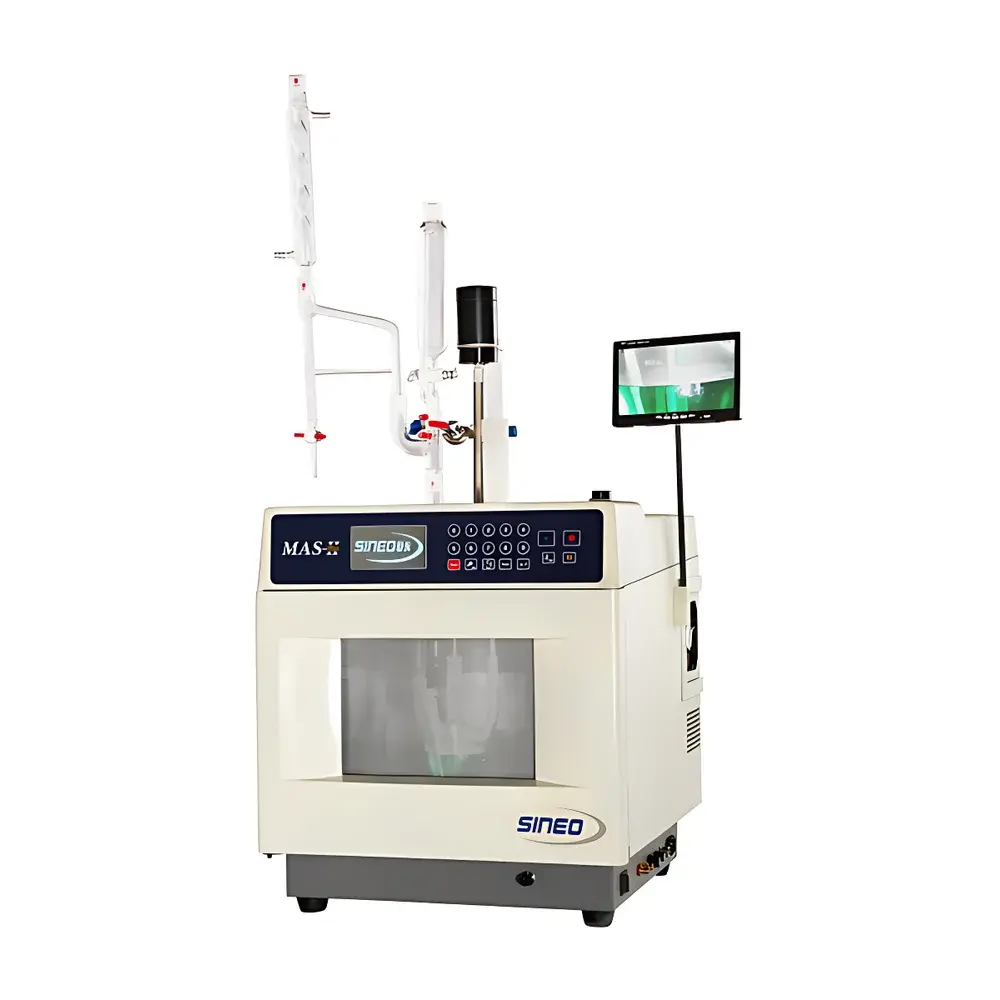
Sineo MAS-II Plus Atmospheric Microwave Synthesis & Extraction Workstation
| Brand | Sineo |
|---|---|
| Model | MAS-II Plus |
| Origin | Shanghai, China |
| Manufacturer Type | Original Equipment Manufacturer (OEM) |
| Power Supply | 220–240 VAC, 50/60 Hz, 9 A |
| Microwave Frequency | 2450 MHz |
| Output Power | 0–1000 W (PID-controlled, programmable ramping) |
| Cavity Material | 316L stainless steel with multi-layer PTFE coating |
| Cavity Volume | Large-capacity industrial-grade cavity |
| Temperature Sensing | Dual-channel DTD system with IR (0–300 °C) and Pt100 RTD (0–300 °C) |
| Stirring | Integrated magnetic stirrer (30–1000 rpm) + digital paddle-type mechanical stirrer (30–1700 rpm) |
| Reaction Vessels | Standard set covering 50–1000 mL with reflux, condensation, and reagent addition accessories |
| Onboard Display | 7″ color TFT-LCD with real-time video feed from integrated cavity camera |
| Preloaded Methods | 50 editable and storable reaction protocols |
| Dimensions (W×D×H) | 450 × 510 × 510 mm |
| Operating Environment | 0–40 °C, 15–80 % RH |
Overview
The Sineo MAS-II Plus Atmospheric Microwave Synthesis & Extraction Workstation is an engineered platform for controlled, open-vessel microwave-assisted chemical synthesis and extraction under ambient pressure conditions. Unlike sealed-vessel high-pressure systems, the MAS-II Plus operates within standard laboratory atmospheric pressure—enabling safe, scalable, and reproducible reactions without specialized pressure-rated vessels or safety interlocks. Its core microwave generation employs a magnetron-based 2450 MHz source with PID-regulated 0–1000 W output, dynamically adjusted in real time to match programmed temperature ramps. The system utilizes Dual-Channel Temperature Detection (DTD) technology, intelligently selecting between non-contact infrared sensing and contact Pt100 resistance thermometry based on vessel type and experimental requirements—ensuring accurate thermal feedback across heterogeneous reaction mixtures. Designed for long-term operational integrity in aggressive chemical environments, the workstation features a robust 316L stainless-steel cavity with multi-layer PTFE coating, resistant to corrosion from acids, bases, and organic solvents commonly used in synthetic organic chemistry, natural product extraction, and materials precursor preparation.
Key Features
- Atmospheric-pressure operation eliminates need for pressure-rated vessels and associated safety certification—reducing consumable cost and procedural complexity.
- Dual-mode stirring: integrated magnetic stirrer (30–1000 rpm) for low-viscosity media; digitally controlled paddle-type mechanical stirrer (30–1700 rpm) for viscous or heterogeneous slurries, ensuring uniform energy distribution and mass transfer.
- Real-time thermal monitoring via dual-sensor DTD architecture—IR sensor (0–300 °C) for rapid surface response; Pt100 probe (0–300 °C) for bulk-phase accuracy—both with ±0.1 °C control precision.
- Onboard 7″ TFT-LCD touchscreen interface with integrated cavity-mounted camera enables visual verification of reaction progress, reflux behavior, and phase separation without opening the cavity.
- Preloaded library of 50 customizable reaction protocols—including temperature ramping, hold steps, power modulation, and stirring synchronization—supports GLP-compliant method documentation and repeatability.
- Industrial-grade 316L cavity construction with multi-layer fluoropolymer coating ensures resistance to halogenated solvents, concentrated mineral acids, and strong oxidants over extended service life.
Sample Compatibility & Compliance
The MAS-II Plus accommodates standard borosilicate glass and quartz reaction vessels ranging from 50 mL to 1000 mL, fully compatible with conventional reflux condensers, dropping funnels, gas inlet adapters, and inert atmosphere manifolds. It supports solvent-based extractions (e.g., plant metabolite isolation), catalytic cross-coupling reactions (Suzuki, Heck), nanoparticle synthesis, and polymerization initiations—all under ambient pressure. While not certified to IEC 61000-4 electromagnetic immunity standards out-of-box, its design aligns with general laboratory equipment safety guidelines per IEC 61010-1. Data logging and method storage meet baseline requirements for internal QA/QC traceability; optional software export supports CSV and XML formats suitable for integration into LIMS environments compliant with ISO/IEC 17025 and FDA 21 CFR Part 11 when paired with validated third-party audit trail modules.
Software & Data Management
The embedded firmware provides full local control of all process parameters—temperature setpoint, ramp rate, hold duration, microwave power profile, stirring speed, and video capture trigger—without requiring external PCs. Each executed run logs timestamped temperature/power/stirring data at 1-second intervals, stored internally for up to 1000 runs. Export is supported via USB flash drive in plain-text CSV format, enabling post-processing in MATLAB, Python (NumPy/Pandas), or commercial statistical analysis tools. Method files (.mth) are editable via the touchscreen interface and support parameter locking for SOP enforcement. No cloud connectivity or remote access functionality is included—preserving data sovereignty and network security in regulated laboratories.
Applications
- Organic synthesis: Accelerated amide bond formation, heterocycle cyclization, and transition-metal-catalyzed couplings with improved selectivity versus conventional oil-bath heating.
- Natural product extraction: Efficient solid–liquid extraction of polyphenols, alkaloids, and terpenoids from botanical matrices using ethanol/water mixtures at sub-boiling temperatures.
- Materials science: Rapid sol-gel synthesis of metal oxide nanoparticles (TiO₂, ZnO, Fe₃O₄) with controlled crystallinity and narrow size distribution.
- Environmental analysis: Microwave-assisted leaching of heavy metals from soil/sediment samples prior to ICP-MS quantification—reducing digestion time from hours to minutes.
- Teaching laboratories: Safe, intuitive platform for demonstrating microwave-specific thermal effects, Arrhenius kinetics deviation, and green chemistry principles (reduced solvent volume, shorter cycle times).
FAQ
Is the MAS-II Plus suitable for reactions requiring inert atmosphere control?
Yes—standard vessel configurations include three-neck flasks with septa ports and Schlenk line compatibility for nitrogen or argon purging.
Can I use my existing round-bottom flasks with this system?
Yes—the workstation accepts standard 14/20, 19/22, and 24/29 ground-glass joints; optional adapter kits support non-standard geometries.
Does the system support temperature ramping during active stirring?
Yes—temperature and stirring speed profiles are independently programmable and synchronized within each method step.
What maintenance is required for long-term reliability?
Annual inspection of waveguide cover integrity and cavity coating adhesion is recommended; no routine magnetron replacement is specified under normal usage (rated lifetime ≥5000 h).
Is calibration traceable to national standards?
Pt100 sensors are factory-calibrated against NIST-traceable reference thermometers; users may perform field verification using certified dry-block calibrators per ASTM E74.



