
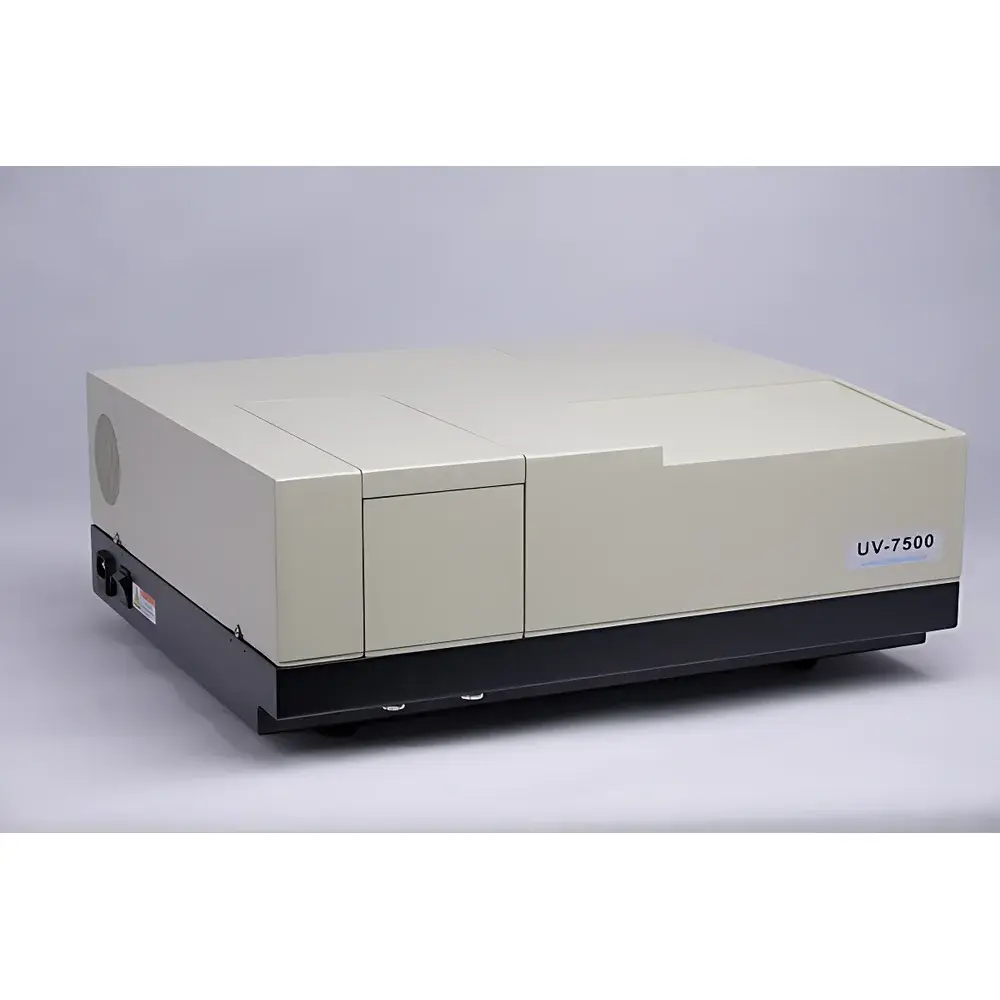
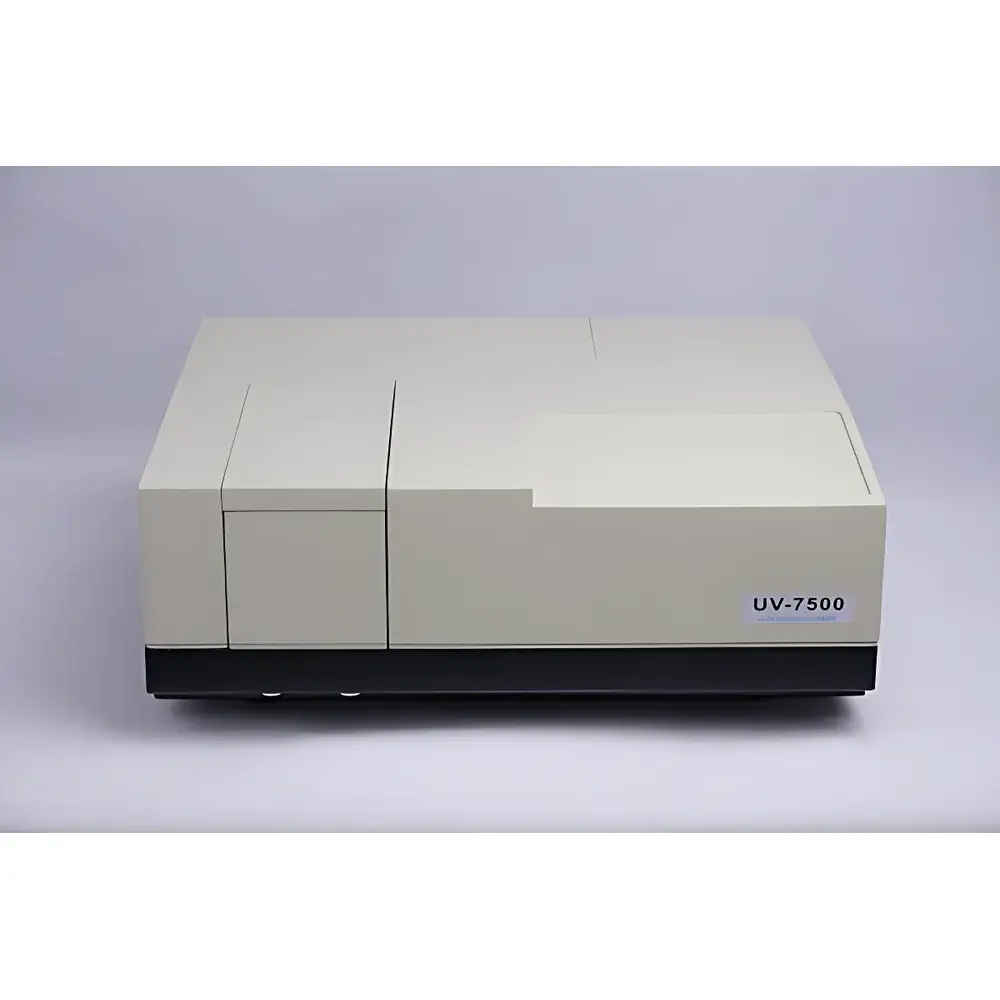
Lengguang Tech. UV7500 Dual-Beam Ultraviolet-Visible Spectrophotometer
| Brand | Lengguang Tech. |
|---|---|
| Origin | Shanghai, China |
| Manufacturer Type | Manufacturer |
| Product Origin | Domestic (China) |
| Model | UV7500 |
| Optical System | Dual-Beam |
| Detector Type | Silicon Photodiode |
| Wavelength Range | 190–1100 nm |
| Automatic Function | Auto Wavelength Scanning |
| Spectral Bandwidth | 0.5 / 1.0 / 2.0 / 4.0 / 5.0 nm (expandable to 0.3 nm) |
| Wavelength Accuracy | ±0.3 nm |
| Stray Light | ≤0.03% |
Overview
The Lengguang Tech. UV7500 Dual-Beam Ultraviolet-Visible Spectrophotometer is an engineered analytical instrument designed for high-precision quantitative and qualitative analysis across the ultraviolet, visible, and near-infrared spectral regions (190–1100 nm). Based on the dual-beam optical architecture, it employs a split-light-path configuration in which the incident beam is divided into sample and reference channels using a rotating mirror or beam splitter—enabling real-time compensation for source intensity drift, lamp aging, and environmental fluctuations. This design significantly enhances photometric stability and measurement reproducibility over extended operational periods. The system integrates a high-efficiency 1200 lines/mm plane holographic grating, coupled with imported deuterium and tungsten-halogen lamps, delivering consistent radiant output and minimal spectral distortion. Its optical path is optimized for high photon throughput, supporting reliable absorbance measurements from –0.5 A to 3.0 A—making it suitable for both dilute and highly concentrated samples without manual attenuation or dilution.
Key Features
- Dual-beam optical design with real-time reference correction ensures long-term baseline stability and minimizes photometric drift (≤0.0005 Abs/h).
- Five selectable spectral bandwidths (0.5, 1.0, 2.0, 4.0, and 5.0 nm), optionally extendable to 0.3 nm for enhanced resolution in narrow-band applications.
- Ultra-low stray light performance (≤0.03% at 220 nm), achieved through precision-aligned optics, high-quality gratings, and optimized baffling—critical for accurate quantitation of low-transmittance samples.
- Integrated silicon photodiode detector with linear response across full photometric range (0–300% T, –3 to +3 A).
- Plug-and-play deuterium and tungsten-halogen lamps; no optical realignment required during lamp replacement.
- Wireless Bluetooth connectivity enables remote instrument control from Windows PCs and Android tablets—supporting flexible lab workflows and mobile data acquisition.
- Three scanning speed modes (high/medium/low: up to ~1200 nm/min) allow optimization between throughput and signal-to-noise ratio depending on application requirements.
Sample Compatibility & Compliance
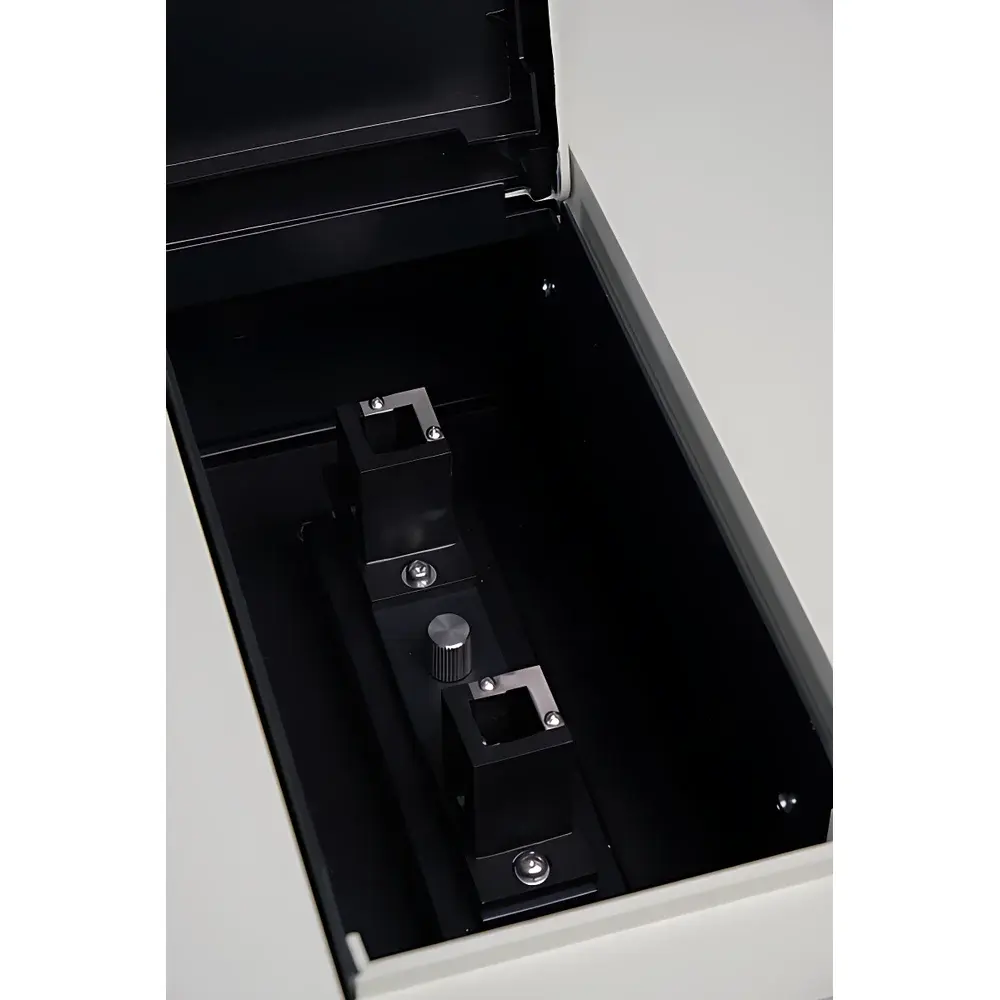
The UV7500 accommodates standard 10 mm pathlength cuvettes (quartz, glass, or plastic), as well as optional microvolume, flow-cell, and solid-sample accessories. It supports routine compliance with internationally recognized analytical standards including ASTM E275, ISO 6425, and USP for spectrophotometric system suitability testing. While not pre-certified for regulated GxP environments, its software architecture supports audit-trail-enabled operation when deployed with validated third-party LIMS or ELN platforms. Data integrity is reinforced by timestamped file logging, user-access controls, and exportable CSV/PDF reports compatible with GLP/GMP documentation workflows.
Software & Data Management
The instrument is operated via Lengguang’s proprietary UVWin software, compatible with Windows OS and Android-based tablets via Bluetooth. The interface provides intuitive access to kinetic, spectrum scanning, multi-wavelength quantitative, and DNA/protein analysis modules. All spectral data are stored in native binary format with embedded metadata (wavelength calibration date, lamp usage hours, bandwidth setting, operator ID). Export options include ASCII, CSV, and image formats (PNG, PDF) for integration into scientific publications or internal QA databases. Software supports customizable report templates—including automatic calculation of molar absorptivity, concentration gradients, and peak identification—with built-in validation tools for wavelength and photometric accuracy checks per ISO/IEC 17025 guidelines.
Applications
The UV7500 serves core functions in pharmaceutical QC (e.g., assay of active ingredients per USP monographs), environmental monitoring (nitrate, phosphate, COD analysis), food safety (colorant quantification, antioxidant capacity), biochemical research (protein A280, nucleic acid purity A260/A280), and materials science (thin-film transmittance, dye degradation kinetics). Its wide dynamic range and low stray light enable trace-level detection in UV-absorbing compounds such as aromatic hydrocarbons, nitroaromatics, and transition-metal complexes. The dual-beam architecture further ensures robustness in teaching laboratories where instrument uptime and ease of use are critical.
FAQ
What is the maximum scan speed of the UV7500?
The instrument offers three scan speed settings: high (~1200 nm/min), medium (~800 nm/min), and low (~500 nm/min), selectable based on required resolution and signal stability.
Is the UV7500 compliant with FDA 21 CFR Part 11?
The base software does not include electronic signature or audit-trail features required for Part 11 compliance; however, it can be integrated into validated third-party systems that provide these capabilities.
Can the spectral bandwidth be reduced below 0.5 nm?
The standard configuration supports five fixed bandwidths down to 0.5 nm; optional firmware and optical upgrades may enable 0.3 nm bandwidth—subject to factory calibration and verification.
What types of cuvettes are supported?
Standard 10 mm square cuvettes (quartz for UV, glass or plastic for visible-only work); custom holders for 5 mm, 20 mm, or microvolume cells are available as accessories.
How often should wavelength calibration be performed?
We recommend annual verification using NIST-traceable holmium oxide or didymium filters; more frequent checks are advised in high-throughput or regulated environments per internal SOPs.



