
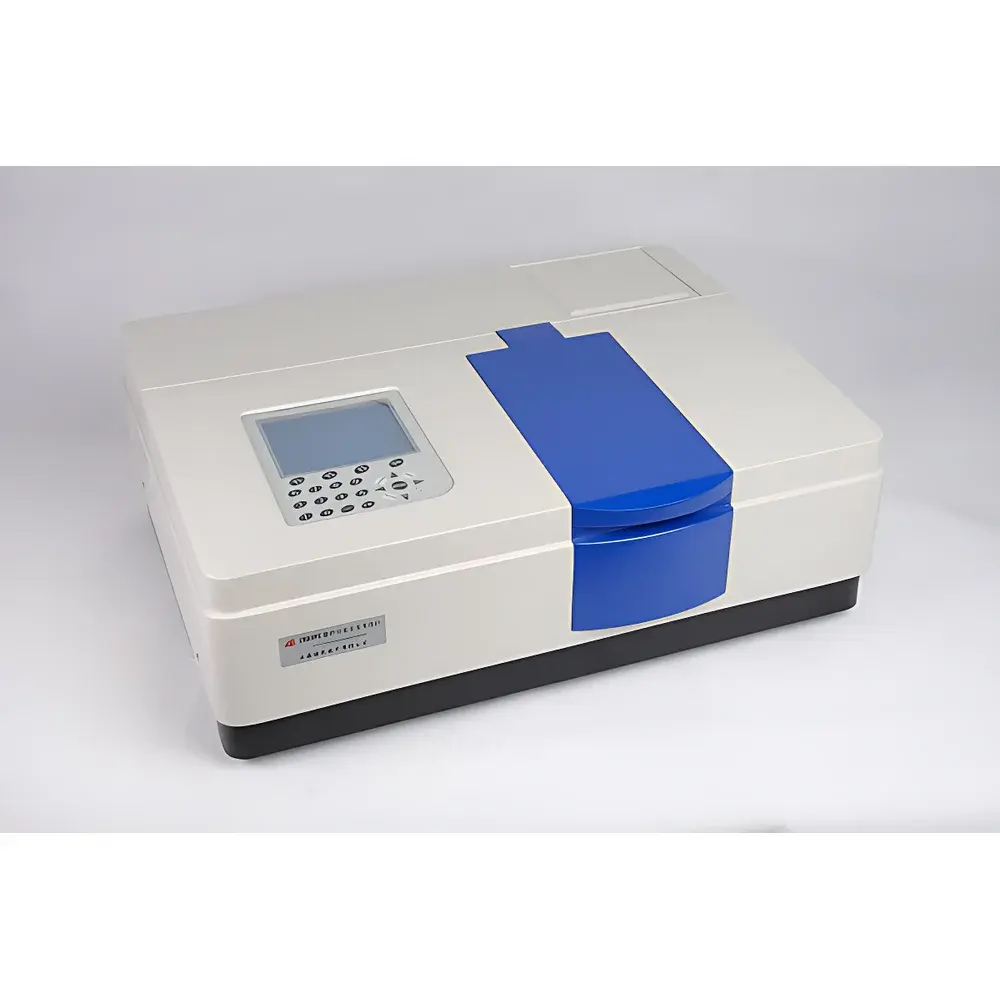
Lengguang Tech UV1901 Dual-Beam Ultraviolet-Visible Spectrophotometer
| Brand | Lengguang Tech |
|---|---|
| Origin | Shanghai, China |
| Manufacturer Type | Direct Manufacturer |
| Product Category | Domestic (China-Made) |
| Model | UV1901 |
| Optical Design | Dual-Beam |
| Detector Type | Photocell |
| Wavelength Range | 190–1100 nm |
| Wavelength Scanning Mode | Automatic |
| Spectral Bandwidth | 1 nm |
| Wavelength Accuracy | ±0.3 nm |
| Stray Light | ≤0.03% T (at 220 nm, using NaI) |
Overview
The Lengguang Tech UV1901 Dual-Beam Ultraviolet-Visible Spectrophotometer is a precision optical instrument engineered for high-fidelity absorbance, transmittance, and reflectance measurements across the ultraviolet, visible, and near-infrared spectral regions (190–1100 nm). Based on the dual-beam optical architecture—where sample and reference beams are simultaneously directed through separate optical paths—the UV1901 compensates in real time for source intensity fluctuations, lamp aging, and environmental drift. This design ensures exceptional baseline stability, photometric accuracy, and long-term measurement reproducibility—critical for quantitative analysis in regulated and research-intensive environments. The system employs a Czerny–Turner monochromator with optimized grating dispersion and precision slit control to deliver a fixed 1 nm spectral bandwidth, enabling resolution of closely spaced absorption features while maintaining compliance with widely referenced analytical standards such as ASTM E275, ISO 6425, and USP . Its robust mechanical construction, thermally stabilized optical bench, and low-noise analog-to-digital conversion pathway collectively support photometric linearity over a dynamic range of –4 A to +4 A (equivalent to 0.0001–10,000% T).
Key Features
- Dual-beam optical configuration with real-time reference compensation for enhanced photometric stability and reduced baseline drift (≤0.0004 A/h).
- High-purity optical components including imported Hamamatsu deuterium lamp and OSRAM tungsten-halogen lamp, pre-aligned and field-replaceable without optical recalibration.
- Fixed 1 nm spectral bandwidth (with optional 2 nm configuration available), optimized for routine QC and research-grade spectral resolution.
- 6-inch backlit LCD display (320 × 240 pixels) supporting intuitive local operation, menu navigation, and real-time spectrum preview without PC dependency.
- Modular sample compartment with removable base plate—enables rapid installation of optional accessories including solid-sample holders, integrating spheres, reflection stages, and multi-cell changers (e.g., 4-position and 7-position cuvette racks).
- Comprehensive photometric performance: stray light ≤0.03% T (measured at 220 nm with sodium iodide solution), wavelength accuracy ±0.3 nm, photometric accuracy ±0.002 A (0–0.5 A range), and baseline flatness ±0.0008 A over full scan range.
Sample Compatibility & Compliance
The UV1901 accommodates standard 10 mm pathlength quartz, glass, or plastic cuvettes (including matched pairs for ratio-based quantitation), as well as custom solid, film, and reflective samples via optional mounting fixtures. Its optical path geometry supports both transmission and diffuse reflectance modes when equipped with appropriate accessories. From a regulatory standpoint, the instrument’s deterministic wavelength calibration, traceable photometric validation protocols, and software-supported audit trail functionality align with GLP and GMP documentation requirements. While the base firmware does not include 21 CFR Part 11-compliant electronic signatures, its RS232 serial interface enables integration into validated laboratory information management systems (LIMS) where user authentication, data integrity logging, and version-controlled method storage are enforced externally.
Software & Data Management
Controlled via Windows-based application software (English/Chinese bilingual UI), the UV1901 supports full-featured spectral acquisition and processing—including kinetic time-scan, multi-wavelength quantitative analysis, DNA/RNA/protein concentration calculation (using built-in extinction coefficients), and derivative spectroscopy. All raw and processed datasets are saved in ASCII-compatible .txt or proprietary .uvp formats, facilitating import into third-party statistical or chemometric platforms (e.g., MATLAB, Origin, SIMCA). Baseline correction routines—including zero-order offset subtraction, linear baseline fitting, and polynomial smoothing—are applied non-destructively and retain original acquisition metadata. Software-generated reports include instrument ID, date/time stamps, operator ID fields, and customizable headers—supporting internal SOPs and external accreditation submissions.
Applications
The UV1901 serves as a foundational analytical tool across diverse sectors requiring reliable UV-Vis quantification. In environmental laboratories, it supports EPA Method 365.3 (phosphate), Method 3500-NO3−, and heavy metal complexation assays. In pharmaceutical QA/QC, it verifies active ingredient concentrations per USP and monitors degradation kinetics under ICH Q1A stress conditions. Academic teaching labs utilize its intuitive interface and modular design for undergraduate spectroscopy instruction, while materials science researchers apply it to bandgap estimation of nanomaterials and thin-film thickness modeling. Additional use cases span food safety (nitrate/nitrite detection), clinical chemistry (enzyme activity assays), and polymer characterization (additive concentration profiling).
FAQ
What is the maximum pathlength supported by the standard sample compartment?
The standard cuvette holder accepts up to 100 mm pathlength cells using optional long-path adapters; default configuration supports 10 mm cells.
Is NIST-traceable wavelength calibration included with the instrument?
Yes—each unit ships with a certified holmium oxide and didymium oxide filter set for periodic verification of wavelength accuracy per ISO 9001 and ASTM E275 Annex A1.
Can the UV1901 be integrated into an automated liquid handling workflow?
Via RS232 command protocol and SCPI-like syntax, the instrument supports remote triggering and data polling from robotic platforms or custom Python/LabVIEW scripts.
Does the software support multi-user permission levels?
No—the standalone application operates in single-user mode; role-based access control requires integration with external LIMS or ELN infrastructure.
What maintenance is required for optimal photometric performance?
Annual lamp replacement (deuterium lamp ~1,000 h lifetime; tungsten lamp ~2,000 h), quarterly cleaning of optical windows with spectroscopic-grade methanol, and biannual verification of stray light and photometric linearity using supplied reference standards.




