
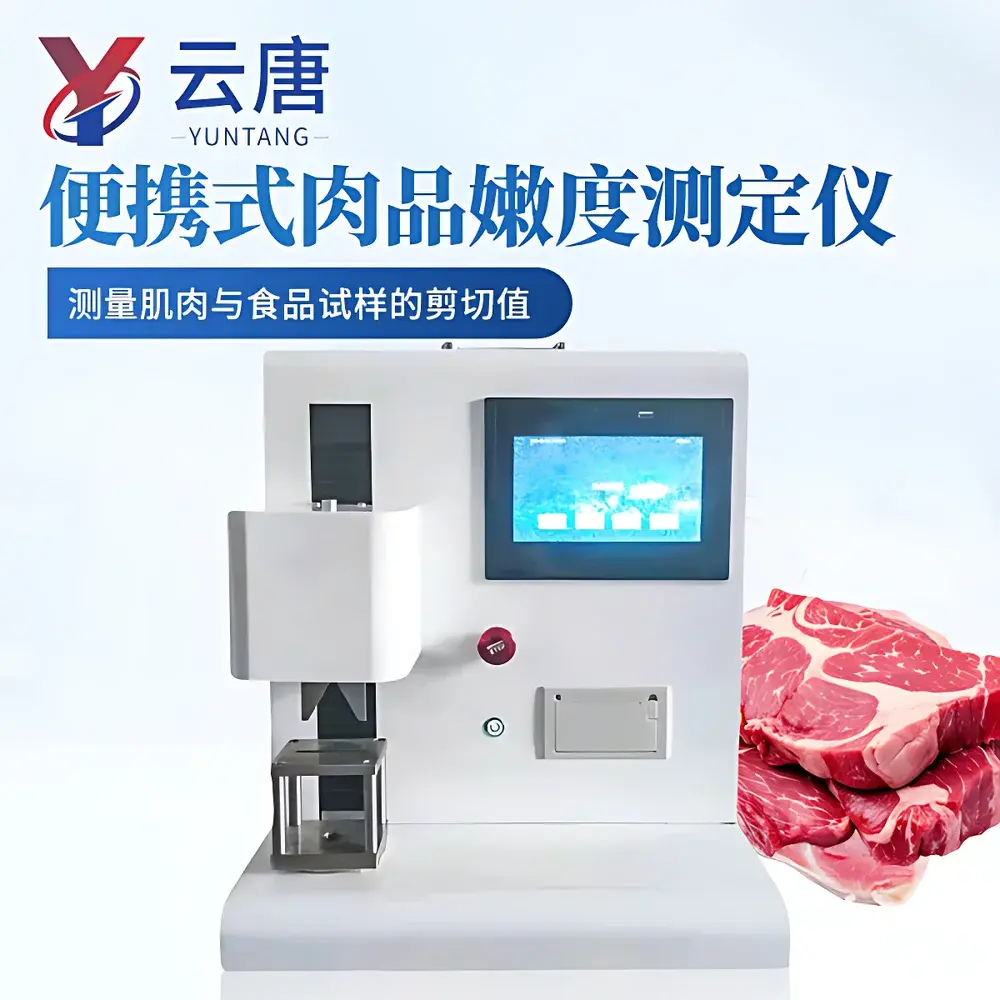
Yuntang YT-RN Portable Meat Tenderness Tester
| Brand | Yuntang |
|---|---|
| Origin | Shandong, China |
| Manufacturer Type | Direct Manufacturer |
| Country of Origin | China |
| Model | YT-RN |
| Measurement Range | 0–250 N (0–25 kgf) |
| Resolution | 0.01 N |
| Accuracy | ±1% FS |
| Shear Speed | 1 mm/s (adjustable: 0–1.3 mm/s) |
| Probe | Stainless Steel Circular Core Sampler (Ø12.7 mm) |
| Blade Thickness | 3.0 mm ± 0.2 mm |
| Blade Edge Included Angle | 60° |
| Triangular Notch Height | ≥35 mm |
| Anvil Slot Width | 4.0 mm ± 0.2 mm |
| Power Supply | 220 V, 50 Hz |
| Dimensions | 40 × 32 × 45 cm |
| Weight | 15 kg |
| Display | Full-color capacitive touchscreen with real-time force–displacement curve visualization |
| Software | Embedded tenderness test control software with automated test sequence, endpoint detection, and position recovery |
| Printer | Integrated high-speed thermal printer |
| Safety | Electromagnetic end-limit switch + emergency stop button |
| Drive System | Precision ball screw driven by geared motor via synchronous timing belt |
| Structural Frame | Reinforced monolithic workbench and thickened upper crossbeam |
Overview
The Yuntang YT-RN Portable Meat Tenderness Tester is a precision-engineered instrument designed to quantify the instrumental shear force of meat and other food matrices using standardized compression-shear mechanics. It operates on the fundamental principle of simulating masticatory action—specifically, the vertical penetration and lateral shearing of muscle tissue by a calibrated stainless-steel blade against a fixed anvil. This method directly reflects the mechanical resistance encountered during oral processing, making it a physiologically relevant proxy for sensory tenderness. The device conforms to established agricultural and food quality standards including NY/T 1180–2006, NY/T 2660–2014, and NY/T 2793–2015, which define the methodology for shear force determination in meat evaluation. Unlike subjective sensory panels, the YT-RN delivers objective, repeatable, and traceable quantitative data—critical for quality assurance, breeding program validation, and process optimization across meat processing, academic research, and regulatory testing environments.
Key Features
- High-resolution load cell with 0.01 N resolution and ±1% full-scale accuracy ensures metrological integrity across the 0–250 N measurement range.
- Programmable shear speed (0–1.3 mm/s, default 1 mm/s) enables compliance with standard protocols while supporting method development for non-bovine or processed meat systems.
- Stainless steel core sampler (Ø12.7 mm) and precision-machined blade (3.0 mm ± 0.2 mm thickness, 60° included edge angle) guarantee geometric consistency between samples—minimizing inter-test variability.
- Integrated anvil with 4.0 mm ± 0.2 mm slot width and ≥35 mm triangular notch height maintains uniform stress distribution during blade penetration, per NY/T-compliant geometry requirements.
- Capacitive touchscreen interface displays real-time force–displacement curves, enabling immediate visual verification of peak shear force, yield point, and post-yield behavior.
- Automated test sequence: one-button initiation triggers controlled blade descent, automatic endpoint detection based on force decay threshold, and return-to-home positioning—eliminating operator-dependent timing errors.
- Reinforced structural architecture—including monolithic steel workbench and thickened upper crossbeam—ensures long-term dimensional stability under repeated loading cycles.
Sample Compatibility & Compliance
The YT-RN supports standardized sample preparation for raw, cooked, or cured muscle tissues from beef, pork, lamb, poultry, and aquaculture species. Its mechanical configuration also accommodates non-muscle food matrices such as fruits (e.g., apples, pears), vegetables (e.g., carrots, potatoes), baked goods (e.g., bread crusts, noodles), and plant-based analogs—enabling comparative texture profiling within a single platform. All test procedures align with Chinese agricultural industry standards (NY/T series) and are methodologically compatible with international equivalents including ASTM E384 (microhardness correlation), ISO 11036 (food texture profile analysis), and AOAC Official Method 952.02 (shear press method). The instrument’s design facilitates GLP-aligned documentation through timestamped digital records and thermal printouts—supporting audit readiness in QA/QC and contract laboratory settings.
Software & Data Management
The embedded control software provides full test lifecycle management: user-defined test protocols, automatic calibration verification prompts, real-time curve overlay for comparative analysis, and export-ready CSV data files. Each test record includes metadata (operator ID, sample ID, date/time stamp, environmental temperature if logged externally), peak force value (N), time-to-peak, and area-under-curve metrics. Data encryption and local storage ensure integrity; no cloud dependency or third-party telemetry is implemented. For laboratories operating under regulated frameworks (e.g., CNAS-accredited facilities), the system supports 21 CFR Part 11–compliant audit trails when paired with validated networked PCs—though standalone operation requires no external software licensing or subscription.
Applications
- Meat science research: Correlation of shear force with collagen solubility, sarcomere length, post-mortem aging kinetics, and enzymatic tenderization efficacy.
- Breeding program support: Objective ranking of genetic lines for tenderness traits using standardized loin or semitendinosus samples.
- Processing validation: Monitoring effects of marination, tumbling, freezing/thawing cycles, and cooking methods (roasting, sous-vide, grilling) on textural endpoints.
- Quality control: In-line or lab-based release testing of commercial cuts against internal specification limits (e.g., ≤35 N for premium beef steaks).
- Food product development: Benchmarking plant-based meat alternatives against animal-derived controls using identical probe geometry and speed parameters.
- Educational use: Hands-on instruction in food physics, muscle biochemistry, and instrumental texture analysis for undergraduate and graduate food science curricula.
FAQ
What standards does the YT-RN comply with?
It adheres to NY/T 1180–2006, NY/T 2660–2014, and NY/T 2793–2015 for meat shear force measurement, with geometric and procedural alignment to ASTM and ISO texture testing conventions.
Can the instrument test non-meat samples?
Yes—it is routinely used for fruits, vegetables, cereals, dairy gels, and plant-based proteins when configured with appropriate probe geometry and speed settings.
Is calibration traceable to national standards?
The load cell is factory-calibrated using NIST-traceable deadweight standards; users may perform routine verification with certified check weights (not supplied).
Does the system support multi-sample batch testing?
While each test is executed individually, the software allows sequential queuing and grouped result export—facilitating throughput for up to 20 samples per session.
What maintenance is required?
Routine cleaning of stainless steel components with food-grade ethanol; annual verification of blade geometry and anvil slot dimensions using calibrated calipers; biannual lubrication of the ball screw assembly with lithium-based grease.





