
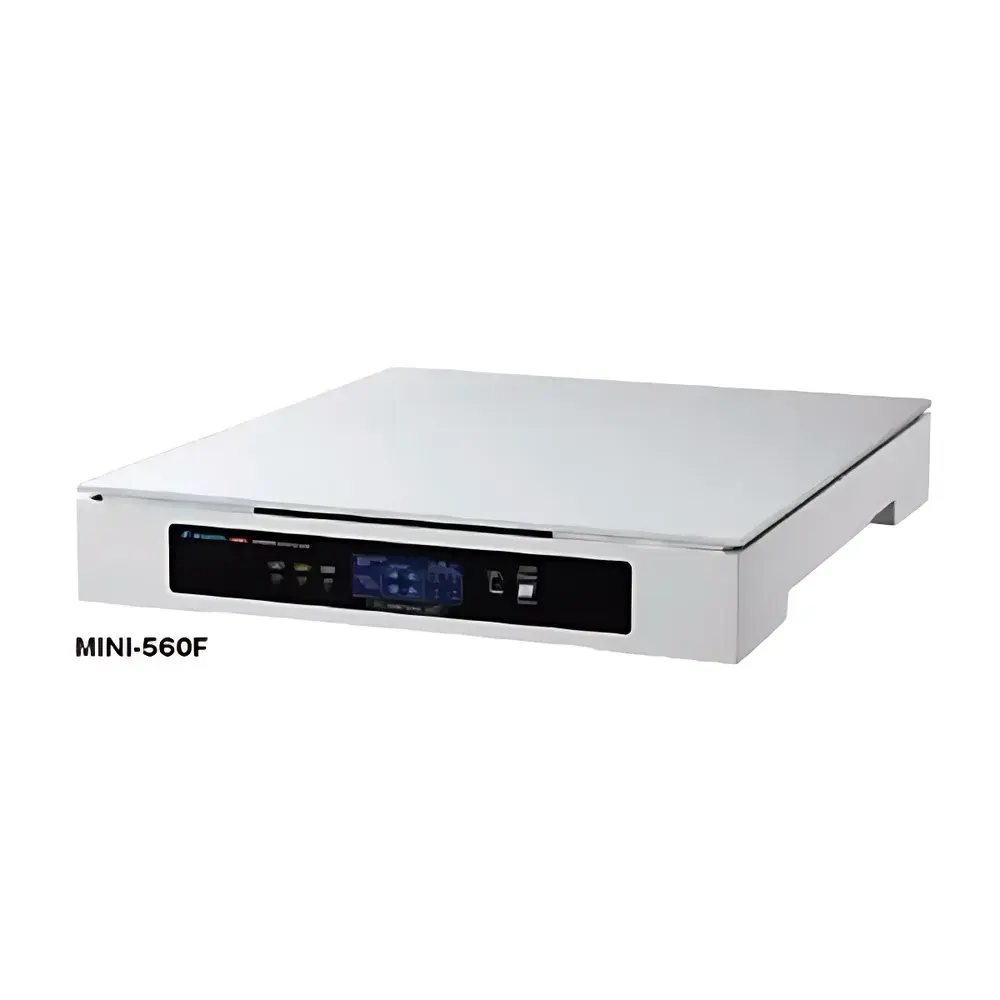
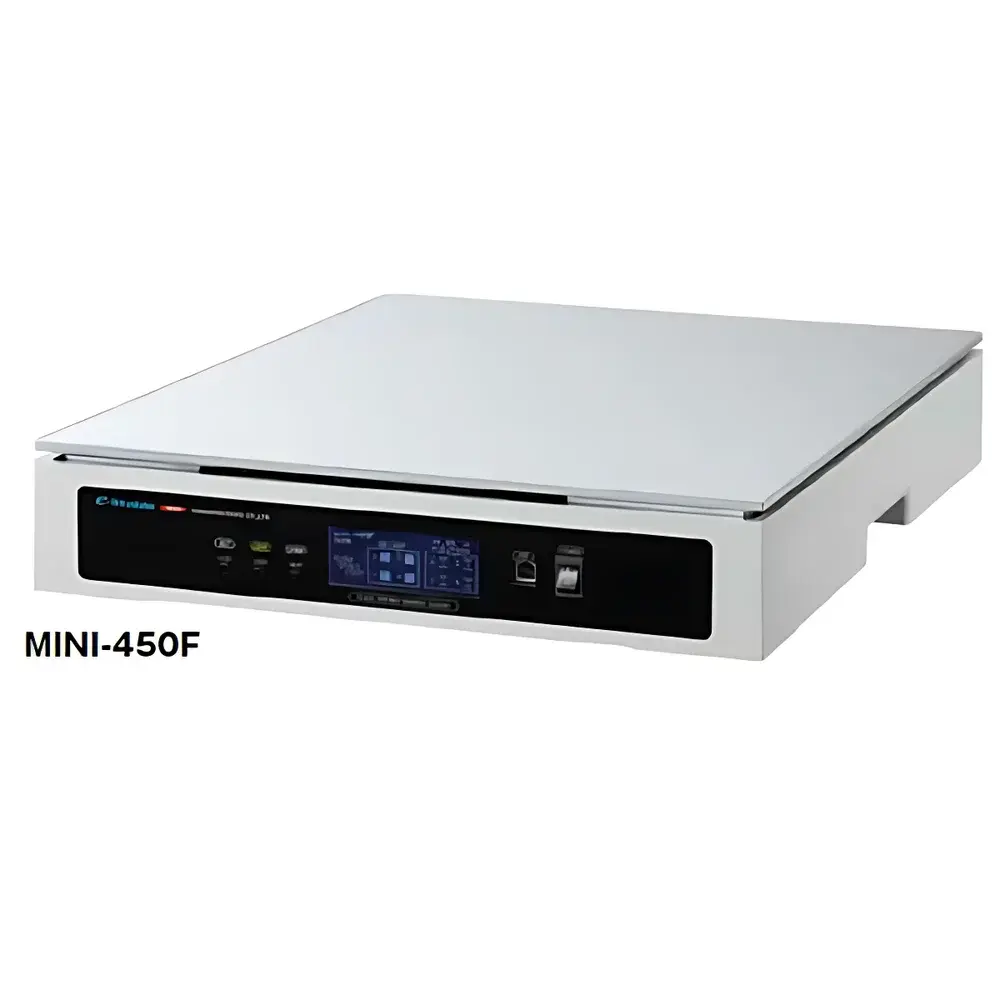
KURASHIKI MINI560F Active Vibration Isolation Table
| Brand | KURASHIKI |
|---|---|
| Origin | Japan |
| Model | MINI560F |
| Type | 6-DOF Active Vibration Isolation Platform |
| Design | Compact Desktop Form Factor |
| Compliance | Cleanroom-Compatible (Sealed Aluminum Enclosure, No Compressed Air Required) |
| Control Interface | USB Communication with Real-Time Acceleration Time-Waveform & FFT Spectrum Display |
| Operation Modes | Auto-Leveling Mode / Transport Lock Mode |
| Typical Applications | Atomic Force Microscopy (AFM), Scanning Probe Microscopy (SPM), Laser Confocal Microscopy, Microhardness Testers, Interferometers |
Overview
The KURASHIKI MINI560F is a compact, high-performance active vibration isolation table engineered for precision metrology and nanoscale imaging applications where sub-nanometer stability is non-negotiable. Unlike passive isolation systems relying on elastomeric or pneumatic elements—which inherently introduce resonance peaks and limited low-frequency attenuation—the MINI560F employs a real-time, closed-loop 6-degree-of-freedom (6-DOF) active control architecture. It continuously senses inertial disturbances via integrated high-sensitivity accelerometers and applies counteracting forces through electromagnetic actuators, achieving broadband suppression from 0.3 Hz to over 100 Hz without introducing mechanical resonances. This principle—rooted in feedback-controlled force cancellation—ensures stable support for instruments requiring <1 nm RMS displacement noise, particularly under challenging floor conditions such as those found near HVAC systems, elevators, or adjacent mechanical laboratories.
Key Features
- True 6-DOF Active Isolation: Simultaneously suppresses translational (X, Y, Z) and rotational (pitch, yaw, roll) vibrations across the full operational bandwidth—critical for maintaining tip-sample stability in AFM and spatial coherence in interferometric measurements.
- Real-Time Diagnostic Display: Integrated LCD panel provides immediate visualization of acceleration time-domain waveforms and frequency-domain spectra (FFT), enabling on-site verification of isolation performance and identification of dominant disturbance sources (e.g., 50/60 Hz line noise, structural harmonics).
- Cleanroom-Ready Construction: Fully enclosed anodized aluminum housing and top plate eliminate particle shedding, conform to ISO Class 5 cleanroom compatibility requirements, and operate without compressed air or external utilities—reducing facility integration complexity and maintenance overhead.
- One-Touch Operational Modes: Dual-mode controller enables seamless switching between Auto-Leveling Mode (for operational stability) and Transport Lock Mode (for safe relocation), with automatic gravity-based leveling within ±0.1° tolerance.
- USB-Based Remote Monitoring & Integration: Standard USB 2.0 interface supports bidirectional communication with host PCs, allowing waveform export, spectral logging, and synchronization with third-party acquisition software (e.g., MATLAB, LabVIEW, or instrument OEM platforms).
Sample Compatibility & Compliance
The MINI560F is designed for direct mounting of sensitive optical and scanning instruments with footprints up to 560 mm × 560 mm and payloads ranging from 10 kg to 45 kg. Its rigid aluminum platform ensures minimal modal coupling and uniform dynamic response across the surface. The system complies with ISO 20483:2020 (Vibration isolation—Performance evaluation methods) and meets the mechanical stability prerequisites outlined in ASTM E2531–21 (Standard Guide for Evaluating Performance of Scanning Probe Microscopes). While not a medical device, its deterministic control architecture and audit-ready operation logs align with GLP and GMP-aligned laboratory practices where traceable environmental control is required for method validation.
Software & Data Management
The MINI560F operates independently via its embedded controller but supports extended functionality through KURASHIKI’s optional PC-based configuration and analysis suite. This software provides time-history logging (sampled at 1 kHz), spectral averaging, user-defined alarm thresholds, and CSV export for post-processing. All configuration changes—including gain adjustments, filter presets, and mode transitions—are timestamped and stored locally, satisfying basic data integrity expectations under FDA 21 CFR Part 11 Annex 11 when deployed in regulated R&D environments. No cloud connectivity or proprietary drivers are required; standard USB CDC ACM class compliance ensures plug-and-play compatibility with Windows, Linux, and macOS hosts.
Applications
The MINI560F delivers measurable performance improvements in applications where ambient vibration directly limits resolution or measurement repeatability. In atomic force microscopy, it extends usable scan range at high magnifications (>1 µm²) by reducing thermal drift and tip crash events. For laser confocal microscopes, it minimizes focus jitter during Z-stack acquisition, improving axial resolution consistency. In microhardness testing, it eliminates spurious indentation variability caused by floor-borne shocks during load application. Interferometric setups benefit from stabilized optical path lengths, yielding higher fringe contrast and reduced phase noise in quantitative surface metrology. Its compact footprint makes it suitable for multi-instrument lab benches where space-constrained deployment is essential.
FAQ
What is the maximum payload capacity of the MINI560F?
The system supports static loads up to 45 kg with optimal performance maintained across the full 6-DOF bandwidth.
Does the MINI560F require external power conditioning or uninterruptible power supply (UPS)?
A stable 100–240 VAC, 50/60 Hz input is sufficient; however, use of a line conditioner is recommended in facilities with high harmonic distortion or voltage fluctuation.
Can the MINI560F be integrated into a larger vibration control network?
Yes—via its USB interface, multiple units can be synchronized using host software for coordinated isolation of multi-axis instrument clusters.
Is firmware update capability available?
Firmware updates are delivered via USB-connected PC using KURASHIKI’s official utility; version history and checksums are provided in release documentation.
How often does the system require calibration or maintenance?
No routine recalibration is required; the accelerometers and actuators are factory-trimmed and sealed. Annual functional verification using supplied test signals is recommended for ISO-compliant labs.



