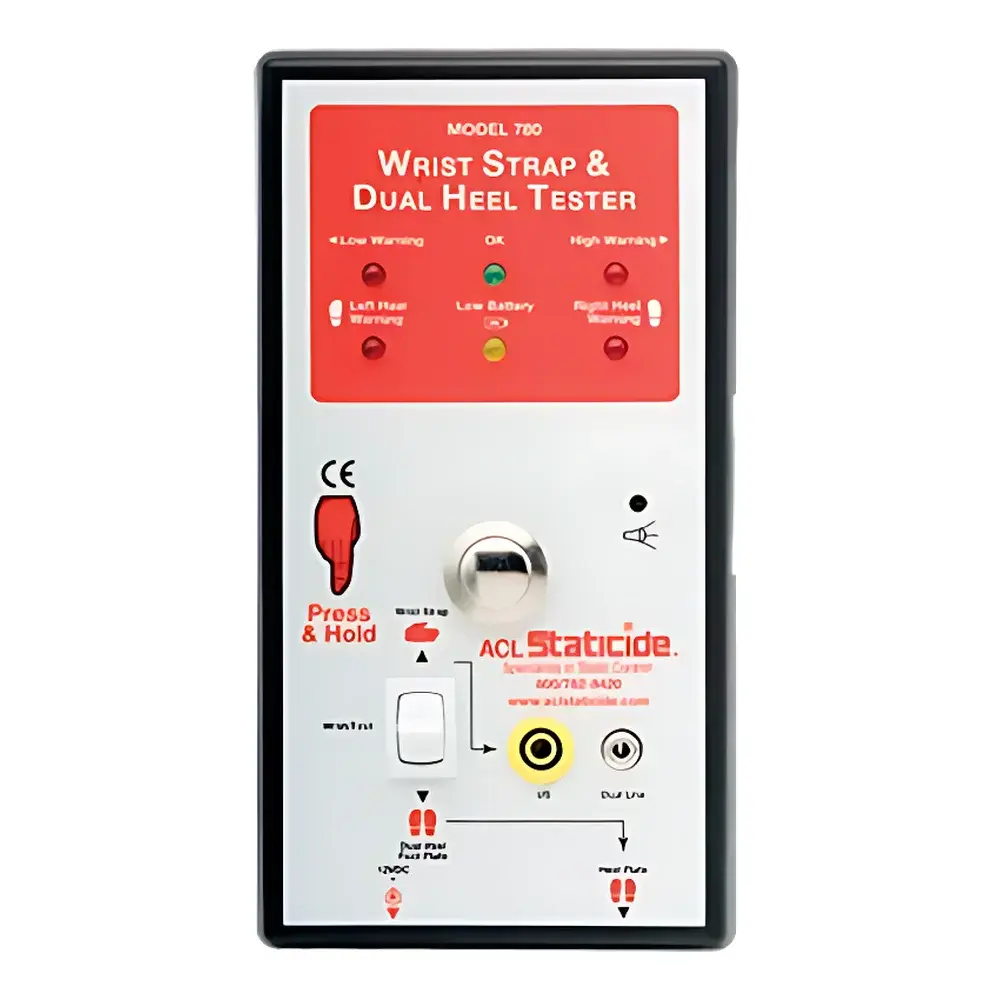
ACL Staticide 780/781 Combined Wrist Strap and Footwear Static Resistance Tester
| Brand | ACL Staticide |
|---|---|
| Origin | USA |
| Model | 780/781 |
| Test Range | 10⁵ – 10⁸ Ω (standard) |
| Accuracy | ±10% |
| Power Supply | 9 V DC battery or AC adapter |
| Operating Environment | 0–38 °C, 15–95% RH |
| Compliance | ESD Association ANSI/ESD S20.20 & STM97.1 |
| Display | Dual-color LED (red/green) with audible tone |
| Test Modes | Simultaneous wrist strap + bilateral footwear |
| Auto-ranging | Yes |
| Certifications | Factory calibration certificate included |
Overview
The ACL Staticide 780/781 Combined Wrist Strap and Footwear Static Resistance Tester is an engineered solution for routine electrostatic discharge (ESD) compliance verification in electronics manufacturing, cleanroom operations, semiconductor fabrication, and aerospace assembly environments. Designed in accordance with the foundational requirements of the ESD Association’s ANSI/ESD S20.20 standard and test method STM97.1, this instrument measures electrical resistance across the human-body-to-ground path—specifically through wrist straps and conductive or dissipative footwear—to ensure personnel grounding systems remain within defined safety and performance thresholds (typically 7.5 × 10⁵ Ω to 1.0 × 10⁹ Ω per IEC 61340-5-1 and ANSI/ESD S20.20). Unlike sequential testers requiring manual mode switching, the 780/781 implements a synchronized three-point measurement architecture: it concurrently evaluates wrist strap continuity *and* bilateral foot-to-ground resistance in a single operator cycle—eliminating procedural ambiguity and reducing test time by over 40% compared to legacy single-channel instruments.
Key Features
- Synchronized dual-path testing: Simultaneously verifies wrist strap resistance and left/right footwear resistance without mode reconfiguration or foot repositioning.
- Bilateral foot discrimination: Independent LED indicators identify which foot (left or right) fails or passes—critical for troubleshooting inconsistent grounding in asymmetric footwear or flooring conditions.
- Auto-ranging resistance measurement: Dynamically selects optimal test voltage and current range across 10⁵–10⁸ Ω (standard), with optional firmware-enabled extension to 10⁹ Ω for high-resistivity footwear validation.
- Fail-safe visual and audible feedback: Red LED + audible tone indicates out-of-spec resistance; green LED confirms compliance—designed for rapid interpretation under noisy factory conditions.
- Dual power flexibility: Operates on standard 9 V alkaline battery (with low-battery warning tone and LED indicator) or regulated AC adapter—ensuring uninterrupted operation during shift changes or extended audits.
- Rugged industrial enclosure: IP54-rated housing with reinforced mounting options (wall-mount for Model 780; freestanding column mount with integrated pedal assembly for Model 781).
Sample Compatibility & Compliance
The 780/781 accommodates all standard ESD wrist straps (snap-on, coiled, or fabric-based) and both conductive and static-dissipative footwear—including heel grounders, toe straps, and full-sole ESD shoes. Its calibrated test voltage (typically 10 V or 100 V DC per STM97.1) ensures non-destructive evaluation of personnel grounding systems without triggering false failures in sensitive components. The instrument meets the functional verification requirements of ANSI/ESD S20.20 Clause 6.2.1 (Personnel Grounding Verification), IEC 61340-5-1 Annex B, and supports GLP/GMP documentation workflows via traceable factory calibration certificates (NIST-traceable where applicable). It is not intended for component-level ESD testing (e.g., device HBM/MM), but strictly for system-level personnel grounding validation.
Software & Data Management
While the 780/781 operates as a standalone pass/fail verifier without embedded data logging, its design supports integration into broader ESD control programs. Each unit ships with a documented calibration certificate indicating date, reference standards used, and measurement uncertainty (±10% at mid-scale). For facilities requiring audit-ready records, the tester can be paired with external barcode-scanned log sheets or integrated into LIMS/CMMS platforms via manual entry protocols aligned with FDA 21 CFR Part 11 principles (electronic signature support requires third-party middleware). Firmware updates—when released—are distributed via ACL Staticide’s authorized service network to maintain alignment with evolving ESD Association technical reports.
Applications
- Electronics assembly lines: Daily pre-shift verification of operator grounding before handling PCBs or ICs.
- Cleanroom gowning checkpoints: Integrated into entry protocols to enforce ESD policy adherence prior to Class 100/ISO 5 access.
- Aerospace MRO facilities: Validating technician grounding integrity during avionics repair where static-induced latent defects pose critical reliability risks.
- Medical device manufacturing: Supporting ISO 13485 clause 7.5.10 (ESD control in sterile processing areas).
- ESD training labs: Demonstrating real-time resistance variation due to sock material, floor finish, humidity, or strap contact quality.
FAQ
Does the 780/781 comply with ANSI/ESD S20.20 and IEC 61340-5-1?
Yes—it implements test methodology and resistance limits fully aligned with ANSI/ESD STM97.1 and supports verification against the 1.0 × 10⁷–1.0 × 10⁹ Ω personnel grounding window specified in both standards.
Can it test wrist straps and footwear independently?
Yes. The instrument offers three operational modes: (1) simultaneous wrist + bilateral foot, (2) wrist strap only, and (3) left/right foot only—selected via front-panel toggle.
What is the difference between Model 780 and Model 781?
Model 780 is wall-mounted with a fixed pedal platform; Model 781 features a freestanding column mount with height-adjustable pedals and integrated cable management—optimized for high-traffic entry vestibules.
Is calibration required after purchase?
Each unit ships with a factory calibration certificate valid for 12 months under normal use. Annual recalibration using NIST-traceable standards is recommended to maintain audit readiness.
Can the 10⁹ Ω extended range be enabled in the field?
No. The 10⁹ Ω capability requires hardware-level modifications (precision current source upgrade) performed exclusively by ACL Staticide-authorized service centers—not user-configurable firmware.
Related Products