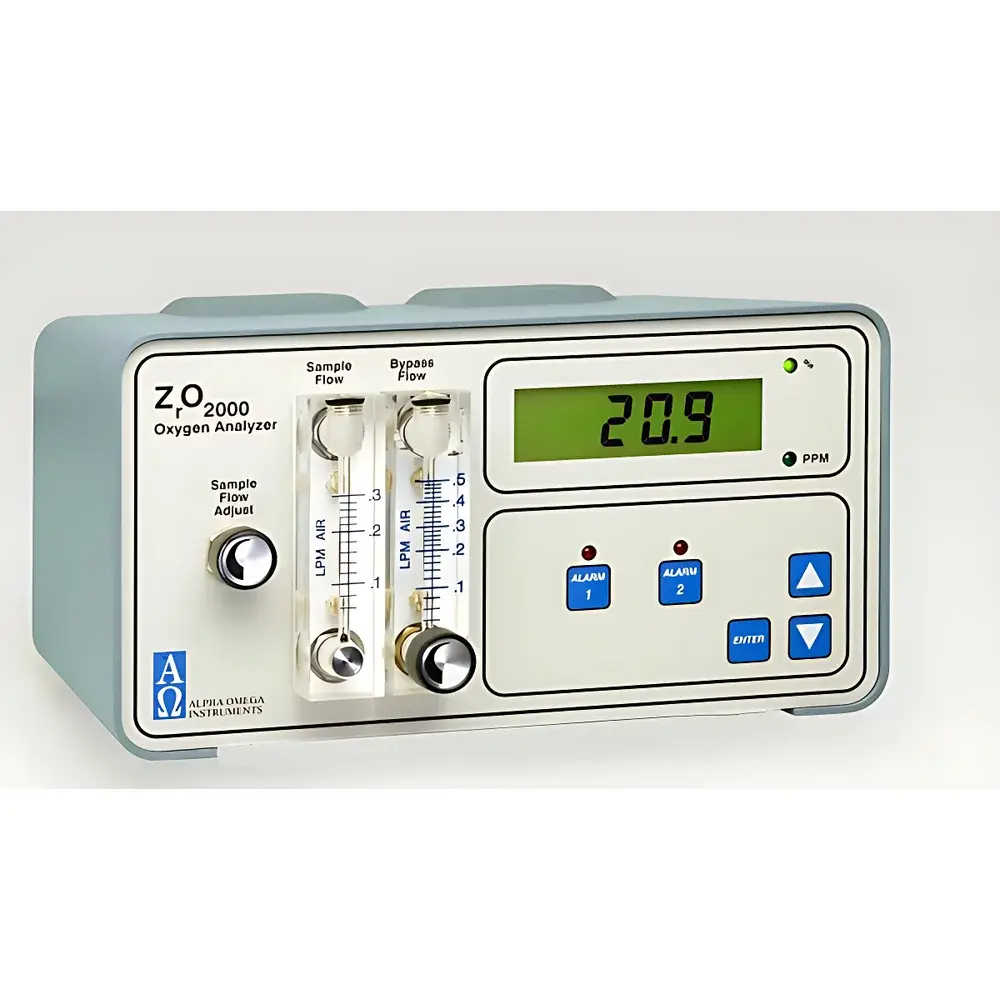
AlphaOmega ZRO 2000 Zirconia-Based Oxygen Analyzer
| Brand | AlphaOmega |
|---|---|
| Origin | USA |
| Model | ZRO 2000 |
| Measurement Range | 0–100% O₂ (ppb–100% trace-to-full scale) |
| Accuracy | ±2% of reading (subject to clean, non-reducing sample gas) |
| Operating Temperature | 10–40 °C |
| Sample Gas Temperature Limit | ≤50 °C |
| Sample Pressure Range | 0.007–0.035 kg/cm² (≈1–5 psig) |
| Relative Humidity Limit | ≤85% RH |
| Power Input | 90–264 VAC, 50/60 Hz |
| Analog Output | Selectable 0–20 mA or 4–20 mA DC |
| Alarm Outputs | Two SPDT relays (10 A @ 30 VDC / 115–230 VAC) |
| Display | 6-digit LCD, 0.7" character height (17.8 mm) |
| Enclosure | Aluminum, NEMA 1-rated |
| Dimensions | 13" H × 10.71" W × 6.3" D |
| Sample Connection | 1/4" stainless steel compression fittings |
| Sensor Type | Heated zirconia electrochemical cell |
| Internal Audible Alarm | Yes, with front-panel mute switch |
Overview
The AlphaOmega ZRO 2000 is a high-stability, zirconia-based electrochemical oxygen analyzer engineered for continuous, real-time measurement of oxygen concentration across an exceptionally wide dynamic range—from sub-ppb levels up to 100% O₂ by volume. It operates on the principle of solid electrolyte potentiometry: at elevated temperatures (typically >650 °C within the sensor element), stabilized zirconium dioxide (ZrO₂) becomes conductive to oxygen ions. When exposed to differing partial pressures of oxygen on either side of the ceramic membrane—reference air (known O₂ activity) and process gas—the resulting electromotive force (EMF) is governed by the Nernst equation, enabling precise quantification of oxygen partial pressure. The ZRO 2000 integrates a temperature-controlled zirconia sensor module with an embedded microprocessor controller, delivering robust performance in demanding industrial environments where reliability, long-term drift stability, and resistance to condensation or particulate ingress are critical.
Key Features
- Zirconia sensor architecture with integrated heater and thermocouple for precise thermal management and stable Nernst potential generation
- True dual-range capability: factory-configurable for either trace-level (ppb–100 ppm) or percent-level (0–100%) O₂ measurement without hardware modification
- Two independently programmable alarm setpoints with SPDT relay outputs rated for 10 A resistive load at 30 VDC or 230 VAC
- NEMA 1 aluminum enclosure providing protection against dust and light splashing; suitable for indoor panel-mount or benchtop deployment
- Intuitive front-panel interface with six-digit LCD display and tactile push-button navigation—no external PC required for basic operation or calibration
- Universal AC power input (90–264 VAC, 50/60 Hz) with optional isolated 4–20 mA or 0–20 mA analog output for integration into DCS, PLC, or SCADA systems
- Internal audible alarm with manual mute function accessible via front-panel switch
Sample Compatibility & Compliance
The ZRO 2000 is validated for use with dry, non-corrosive, non-reducing gas streams—including compressed air, nitrogen blankets, argon purge gases, hydrogen-free synthesis gas, and inert carrier gases. Accurate measurement requires that sample gas be free of hydrocarbons, hydrogen (H₂), carbon monoxide (CO), sulfur compounds, halogens, and other reducing agents, which may polarize the zirconia cell or induce catalytic side reactions. Sample lines must be constructed from electropolished stainless steel or passivated tubing and maintained free of oil, moisture, and particulates. While the analyzer itself does not carry CE or UKCA marking, its electrical design conforms to IEC 61000-6-2 (immunity) and IEC 61000-6-4 (emissions). For regulated environments, the device supports audit-ready operation when paired with external data loggers compliant with FDA 21 CFR Part 11 requirements for electronic records and signatures.
Software & Data Management
The ZRO 2000 operates autonomously without proprietary software. All configuration—including zero/span calibration, alarm thresholds, analog output scaling, and display units—is performed locally via the front-panel interface. Calibration routines follow standard two-point methodology using certified zero gas (e.g., high-purity N₂) and span gas (e.g., 20.9% O₂ in N₂ or user-defined concentration). The microprocessor retains calibration coefficients and operational history in non-volatile memory. For centralized monitoring, the 4–20 mA output can feed into historian systems supporting Modbus RTU or HART protocol via compatible signal conditioners. No firmware updates or driver installations are required during normal service life.
Applications
- Monitoring oxygen breakthrough in nitrogen generators and inert gas blanketing systems for pharmaceutical packaging and semiconductor fabrication
- Control of deoxidation furnaces and heat-treating atmospheres in metallurgical processing
- Verification of residual O₂ in modified atmosphere packaging (MAP) lines prior to sealing
- Leak detection in vacuum chambers and gloveboxes via oxygen ingress rate analysis
- Quality assurance of high-purity bulk gases supplied to analytical laboratories and R&D facilities
- Environmental chamber validation where oxygen depletion or enrichment must be tightly controlled
FAQ
What sample conditioning is required prior to connection?
Sample gas must be filtered to ≤0.3 µm, dried to ≤85% RH, and free of condensables, oil aerosols, and reactive species. A coalescing filter and refrigerated dryer are recommended upstream of the analyzer inlet.
Can the ZRO 2000 measure oxygen in hydrogen-rich streams?
No. Hydrogen reacts electrochemically with the zirconia sensor, causing erroneous readings and accelerated sensor degradation. Alternative technologies—such as paramagnetic or laser-based analyzers—are required for H₂-containing applications.
How often does the sensor require recalibration?
Under stable operating conditions with clean sample gas, annual calibration verification is sufficient. More frequent checks (quarterly or semi-annually) are advised in variable or marginal environments.
Is the analog output isolated?
Yes—the 4–20 mA output is fully galvanically isolated from power supply and relay circuits, minimizing ground-loop interference in distributed control systems.
Does the unit support remote diagnostics or Modbus communication?
Not natively. The ZRO 2000 lacks digital communications ports. Integration with Modbus networks requires an external analog-to-Modbus converter.
Related Products