
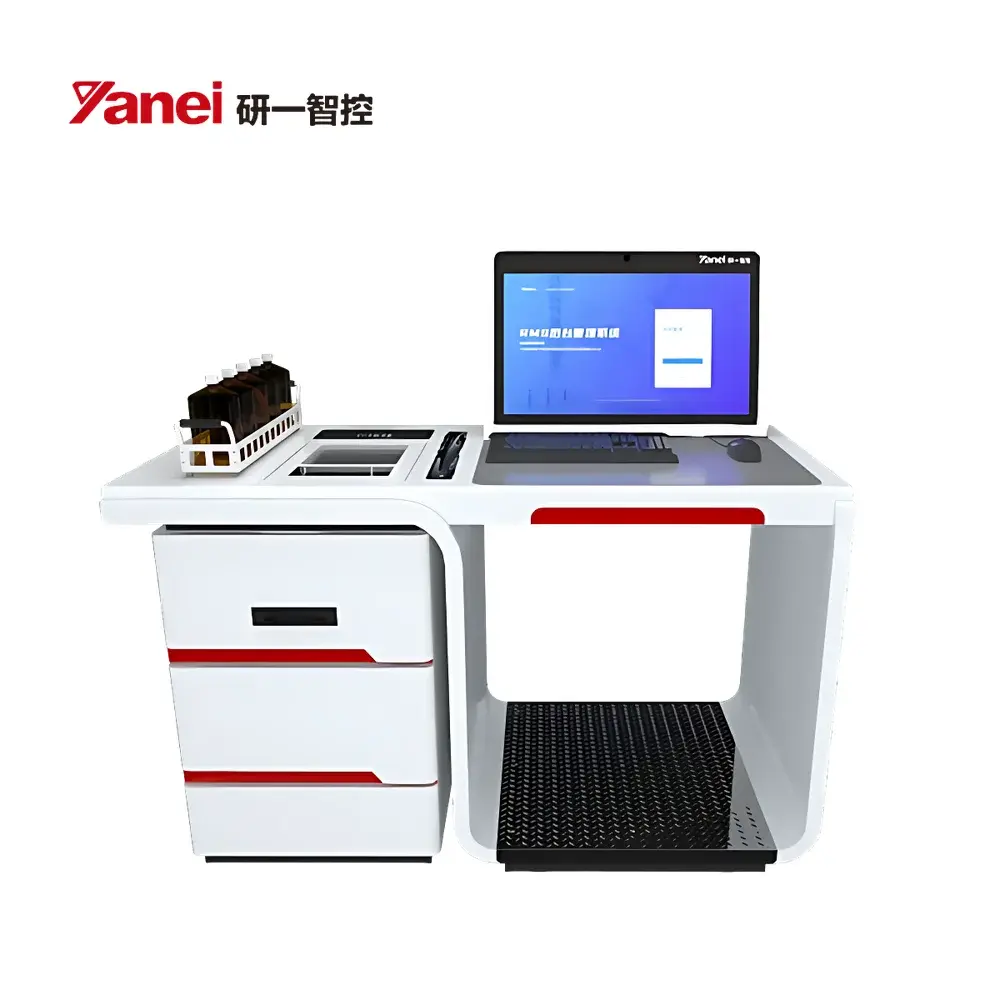
Yanei Smart Terminal Management Platform for Automated Storage and Retrieval Systems in Pharmaceutical R&D Laboratories
| Brand | Yanei |
|---|---|
| Origin | Zhejiang, China |
| Manufacturer Type | Direct Manufacturer |
| Regional Category | Domestic (China) |
| Model | RMST-2 Central Control Platform |
| Pricing | Upon Request |
Overview
The Yanei RMST-2 Central Control Platform is a purpose-built laboratory infrastructure management system engineered for high-integrity pharmaceutical research environments. It functions as the operational nucleus of automated storage and retrieval systems (AS/RS) for reagents, consumables, and controlled substances—integrating hardware peripherals (RFID readers, barcode scanners, precision electronic balances, high-speed document imagers) with a unified software architecture. Built on a deterministic real-time control framework, the platform implements closed-loop inventory governance through deterministic event logging, time-stamped transaction sequencing, and atomic state transitions (e.g., “in-stock”, “in-use”, “expired”, “quarantined”). Its core measurement logic relies on multi-modal identity resolution—cross-referencing RFID UID, 2D barcode metadata, biometric authentication tokens, and mass delta validation—to enforce chain-of-custody integrity across the entire chemical lifecycle. Designed for GLP-compliant laboratories, it supports audit-ready traceability aligned with ISO/IEC 17025, USP <1058>, and FDA 21 CFR Part 11 requirements for electronic records and signatures.
Key Features
- Industrial-grade touch-enabled PC with capacitive 15.6″ display, operating under a hardened Linux-based RTOS for deterministic I/O response and zero unscheduled reboots
- Dual-mode identification engine: simultaneous support for ISO/IEC 15424-compliant 1D/2D barcodes and ISO/IEC 18000-3 Mode 1 HF RFID (13.56 MHz), enabling non-contact, bulk-read capability for nested containers
- Integrated facial recognition module compliant with ISO/IEC 30107-1 liveness detection standards, supporting dual-factor authentication (biometric + PIN) and optional two-person authorization for high-risk operations
- Embedded analytical balance interface (RS-232/USB HID) with auto-zero calibration trigger and gross/net weight reconciliation logic to prevent manual entry errors
- High-resolution (>300 DPI) overhead imager with OCR preprocessing, enabling structured digital archiving of SDS sheets, COAs, and regulatory documentation
- Scalable network topology supporting up to 1,280 distributed smart cabinets via Ethernet (IEEE 802.3) or Wi-Fi 6 (IEEE 802.11ax), with TLS 1.3 encrypted inter-node communication
- Rule-driven alerting engine with configurable thresholds for expiration dates, stock-out conditions, shelf-life decay curves, and cost-per-unit deviation alerts
- Role-based access control (RBAC) schema with 12+ granular permission tiers—including compound-specific restriction matrices tied to GHS hazard codes and UN transport classifications
- Compliance-aware reporting suite generating ISO 15197-compliant audit trails, including user action logs, system configuration changes, and data export events
Sample Compatibility & Compliance
The RMST-2 platform accommodates heterogeneous storage configurations—from ambient reagent cabinets to temperature-controlled (-20°C / +4°C) smart fridges and inert-gas-purged gloveboxes—via standardized Modbus TCP and OPC UA device profiles. All hazardous material handling adheres to NFPA 45, OSHA 1910.1200, and CLP Regulation (EC) No 1272/2008. The embedded MSDS database is updated quarterly via automated NIST Chemistry WebBook API integration and cross-references storage incompatibility rules using the Bretherick’s Handbook logic engine. Physical cabinet interfaces comply with IEC 61000-4 electromagnetic immunity standards and UL 61010-1 safety certification for laboratory equipment.
Software & Data Management
The platform runs Yanei LabOS v4.2—a containerized microservices architecture deployed on Docker Swarm with persistent PostgreSQL 14 backend and TimescaleDB time-series extension. Data retention policies enforce configurable GDPR/CCPA-compliant auto-purge schedules. All exports (CSV, PDF, XLSX) are digitally signed with SHA-256 and timestamped via RFC 3161-compliant TSA. Audit logs record cryptographic hashes of every data modification, satisfying FDA 21 CFR Part 11 §11.10(a) requirements for system validation and electronic signature integrity. RESTful APIs enable bidirectional synchronization with LIMS (e.g., LabVantage, Thermo SampleManager) and ERP systems (SAP S/4HANA, Oracle Cloud).
Applications
Primary deployment contexts include preclinical drug discovery labs managing high-value reference standards (e.g., radiolabeled compounds, chiral enantiomers), QC/QA units performing stability-indicating assays per ICH Q1–Q5 guidelines, and clinical trial supply chains requiring WHO-GMP Annex 9-compliant cold chain visibility. The platform enables dynamic lot-level tracking from synthesis batch to animal study dosing, with built-in statistical process control (SPC) charts for reagent degradation trending. Integration with HPLC/UPLC instrument controllers allows automatic reagent lot attribution to chromatographic runs—enabling full analytical method traceability.
FAQ
Does the RMST-2 platform support integration with existing LIMS or ERP systems?
Yes—via documented REST APIs and certified middleware adapters for major platforms including LabWare LIMS, Thermo Fisher SampleManager, and SAP EWM.
How is data sovereignty maintained for international deployments?
All deployments offer on-premise hosting options with customer-controlled encryption key management; cloud variants use AWS GovCloud or Azure Germany regions compliant with local data residency laws.
Can the system enforce storage segregation based on chemical compatibility?
Yes—the embedded rule engine applies real-time GHS hazard class conflict detection (e.g., oxidizers vs. organics) and dynamically blocks unauthorized cabinet assignments.
What validation documentation is provided for regulated environments?
IQ/OQ/PQ protocols, traceability matrices, and 21 CFR Part 11 compliance reports are delivered as part of the commissioning package.
Is hardware customization available for specialized lab infrastructures?
Yes—custom enclosure designs (IP54/IP65), explosion-proof variants (ATEX Zone 2), and cryogenic-rated sensor interfaces are offered under engineering change order (ECO) process.



