
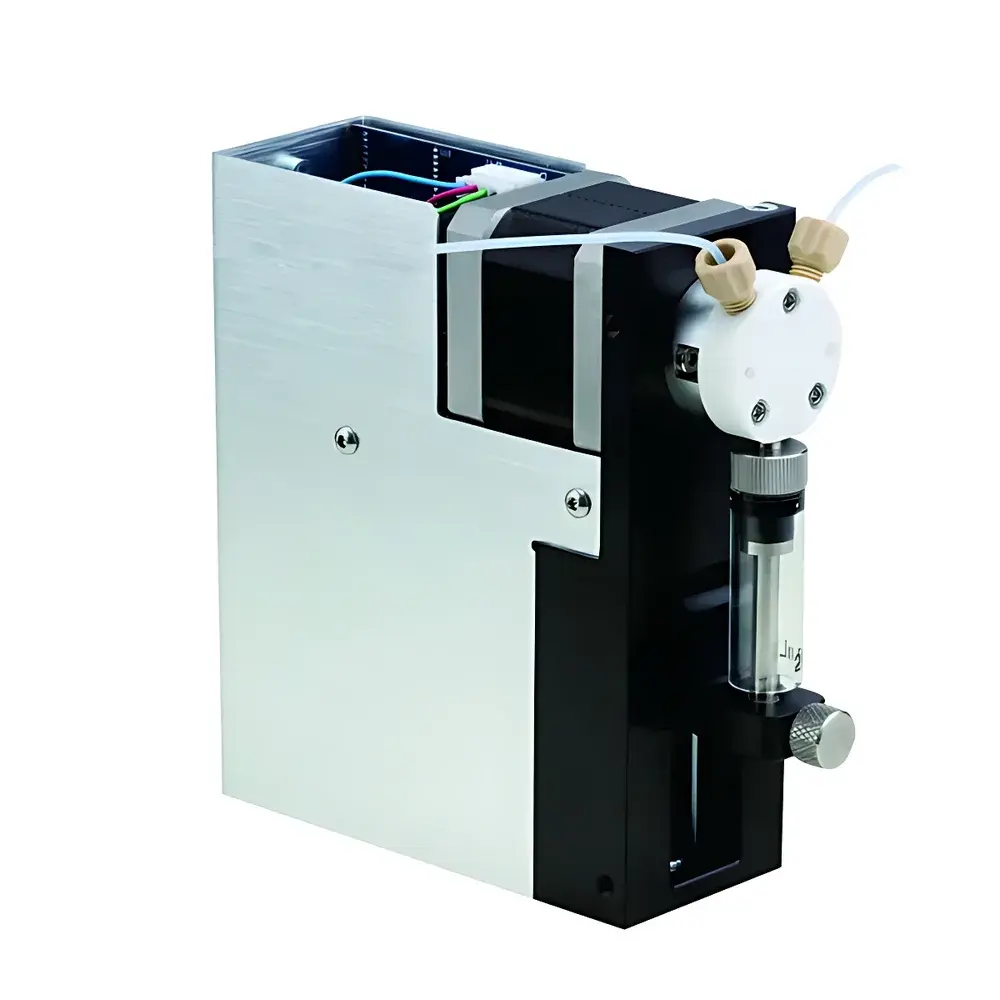
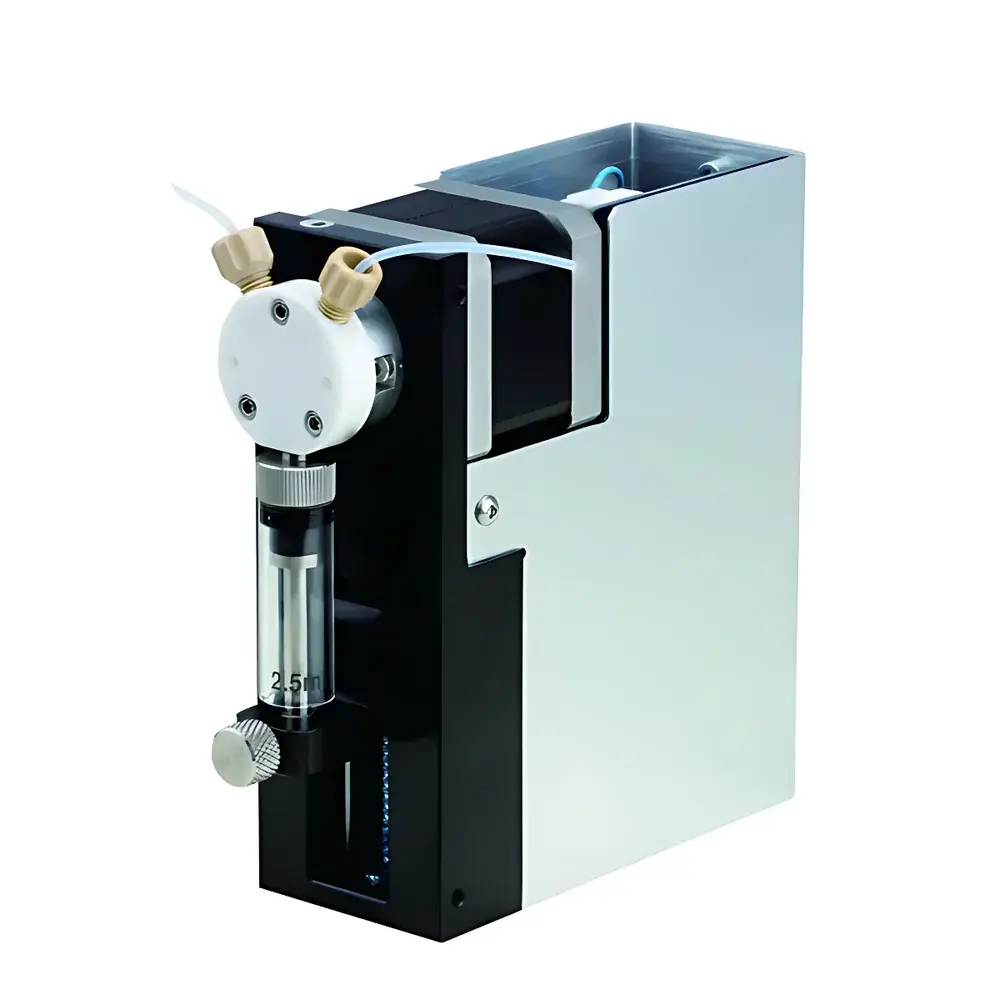
Acmer MSP30 Industrial Syringe Pump
| Brand | Acmer |
|---|---|
| Model | MSP30 |
| Type | Industrial Syringe Pump |
| Stroke Accuracy | ±0.5% |
| Repeatability | ±0.05% |
| Flow Rate Calculation | Linear Speed × Cross-sectional Area of Syringe Barrel |
| Syringe Compatibility | 50 µL to 5 mL |
| Max Pressure Rating | 0.5 MPa |
| Linear Speed Range | 0.025–25 mm/s |
| Step Resolution | 0.01 mm (standard mode) or 0.625 µm (microstepping mode) |
| Valve Switching Time | <280 ms |
| Drive Force | ≥68 N |
| Power Supply | DC 24 V / 1.5 A |
| Dimensions (L×W×H) | 110 × 44.4 × 127 mm |
| Weight | 0.8 kg |
| Operating Temperature | 15–40 °C |
| Relative Humidity | <80% |
| Communication | RS485/USB (auto-detect), 9600/38400 bps |
| Addressing | 4-bit BCD switch (15 addresses) |
| I/O | 2 TTL inputs (resume control), 3 TTL outputs (status indication) |
| Valve | 3-port 120° ceramic valve (PCTFE option available) |
| Fluidic Path Materials | Ceramic, borosilicate glass |
| Port Interface | 1/4"-28 internal thread |
Overview
The Acmer MSP30 Industrial Syringe Pump is a precision-engineered fluid delivery system designed for integration into automated analytical instruments, process control platforms, and industrial laboratory workflows requiring high-reliability, low-maintenance, and chemically inert fluid handling. Based on a closed-loop stepper motor driving a ground-grade ball screw mechanism, the MSP30 delivers deterministic linear displacement with sub-micron positional resolution—enabling accurate volumetric dispensing across a wide range of syringe sizes (50 µL to 5 mL). Its core architecture leverages ceramic components—including the 3-port 120° rotary valve and fluid-contact surfaces—ensuring exceptional resistance to corrosion, abrasion, and thermal degradation under prolonged operation. Unlike consumer-grade syringe pumps, the MSP30 is engineered for continuous duty cycles in instrument OEM applications, where long-term dimensional stability, pressure integrity up to 0.5 MPa, and repeatable actuation are non-negotiable requirements.
Key Features
- Ground-grade ball screw transmission ensures high stroke accuracy (±0.5%) and exceptional repeatability (±0.05%) over extended operational life.
- Ceramic-and-borosilicate-glass fluidic path eliminates metal leaching and provides compatibility with aggressive solvents, acids, bases, and high-purity reagents.
- Programmable microstepping mode achieves 0.625 µm per step resolution (48,000 steps over 30 mm), enabling ultra-fine flow control at low linear speeds (down to 0.025 mm/s).
- Dual communication interface (RS485 and USB) with automatic protocol detection supports seamless integration into SCADA, PLC, or host PC environments; configurable baud rates (9600/38400 bps) and 15-address BCD addressing enable multi-pump daisy-chaining.
- Dedicated TTL I/O lines provide deterministic external control: two inputs accept resume commands after pause events; three outputs deliver real-time status signals (e.g., running, paused, valve position).
- Compact form factor (110 × 44.4 × 127 mm) and lightweight design (0.8 kg) facilitate space-constrained installations in analytical instrumentation chassis or modular process skids.
Sample Compatibility & Compliance
The MSP30 accommodates standard Luer-lock and threaded syringes ranging from 50 µL to 5 mL, including glass and polymer variants compatible with ISO 8537 and ASTM D3720 specifications. Its all-ceramic 3-port 120° valve—optionally available with PCTFE sealing elements—meets USP Class VI biocompatibility criteria for pharmaceutical fluid transfer and satisfies material compatibility requirements outlined in ISO 10993-5 for cytotoxicity testing. The pump’s fluidic path contains no elastomers or adhesives, eliminating risk of extractables and ensuring compliance with GLP/GMP traceability standards when deployed in regulated QC/QA environments. While not certified to IEC 61000-6-2/6-4, its DC24V power architecture and shielded RS485 interface support stable operation in electromagnetically noisy industrial settings.
Software & Data Management
The MSP30 operates via ASCII-based command protocol over RS485 or USB, enabling full remote control without proprietary drivers. Host systems can configure linear speed, target volume, acceleration profile, valve position, and operating mode (standard/microstep) using standardized command sets. All motion parameters are retained in non-volatile memory following power cycle. For audit-ready deployments, timestamped command logs and status transitions (e.g., “valve_switch_start”, “piston_move_complete”) can be captured externally via TTL output triggers—supporting 21 CFR Part 11-compliant electronic record generation when paired with validated host software. Firmware updates are performed via USB using signed binary packages, preserving configuration integrity during version upgrades.
Applications
- OEM integration into HPLC autosamplers, CE systems, and microfluidic assay platforms requiring precise metering of nanoliter-to-milliliter volumes.
- Continuous reagent dosing in water quality analyzers, environmental monitoring stations, and industrial pH/ORP controllers.
- Controlled delivery in electrochemical cells, fuel cell test benches, and catalyst evaluation reactors where chemical inertness and pressure stability are critical.
- Calibration fluid injection in metrology labs performing gravimetric verification of flow meters per ISO 4064-2.
- Automated sample preparation workflows in clinical chemistry analyzers and IVD instruments compliant with IEC 62304 software lifecycle requirements.
FAQ
What syringe sizes are supported by the MSP30?
The pump is calibrated for syringes ranging from 50 µL to 5 mL, including common glass and polypropylene models with Luer or threaded interfaces.
Can the MSP30 operate under vacuum or backpressure conditions?
Yes—the ceramic valve and sealed drive train support bidirectional operation and maintain rated accuracy up to 0.5 MPa positive pressure; vacuum compatibility is limited only by syringe plunger seal integrity.
Is firmware update capability available in the field?
Yes—USB-based firmware updates use cryptographically signed binaries and preserve user-configured parameters across versions.
Does the pump support synchronized multi-axis coordination?
While the MSP30 itself is single-axis, its TTL synchronization signals and RS485 timing resolution (sub-10 ms command latency) allow tight coordination with external motion controllers or other MSP30 units in master-slave configurations.
What documentation is provided for regulatory submissions?
Acmer supplies technical specifications, material declarations (RoHS/REACH), electrical safety test reports, and ASCII command protocol documentation—sufficient for inclusion in 510(k), CE Technical Files, or ISO 13485 QMS dossiers.



