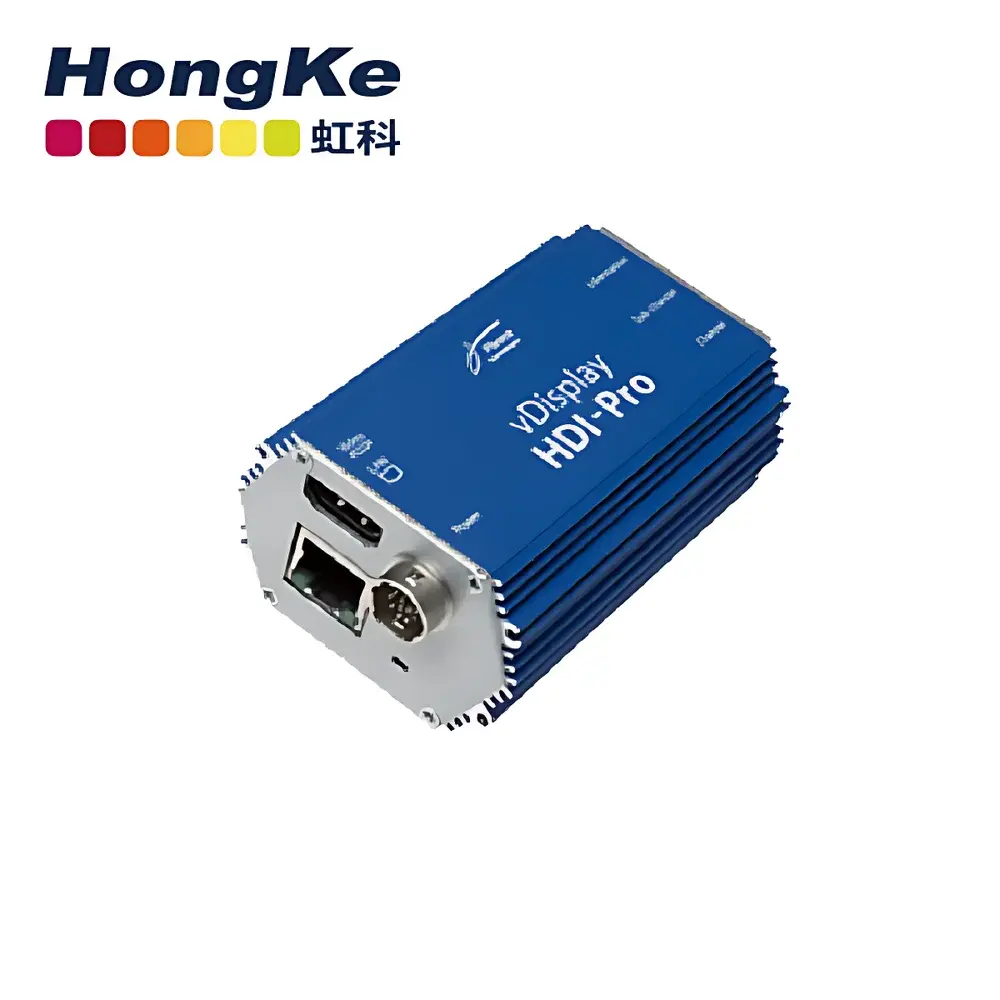
HKvDisplay HDI-Pro HDMI/DVI Video Output Capture Card
| Brand | HongKe (HONGKE) |
|---|---|
| Origin | Canada |
| Manufacturer Type | Authorized Distributor |
| Product Origin | Imported |
| Model | HKvDisplay HDI-Pro |
| Price Range | USD 1,400 – 4,200 (FOB Canada) |
| Interface | GigE Vision Input / HDMI 1.4 & DVI-D Output |
| Latency | < 35 ms end-to-end (typical, 1080p60) |
| Form Factor | PCIe Gen2 x4 Low-Profile Card |
| Power | +12 V DC via SATA-style connector |
| SDK Support | eBUS SDK v5.0+ (Windows/Linux x64) |
| Compliance | RoHS 3, CE, FCC Class B, GigE Vision 2.0, GenICam 3.x |
Overview
The HKvDisplay HDI-Pro is a high-integrity, low-latency video output capture card engineered for industrial machine vision and embedded imaging systems requiring deterministic real-time display of GigE Vision camera streams. Unlike conventional frame grabbers or software-based rendering pipelines, the HKvDisplay HDI-Pro implements hardware-accelerated pixel pipeline processing to convert standardized GigE Vision image data directly into synchronized HDMI 1.4 or DVI-D video signals—bypassing CPU-intensive software decoding and eliminating variable OS-level scheduling delays. This architecture ensures sub-35 ms end-to-end latency (measured from camera sensor exposure trigger to pixel illumination on display) under nominal 1080p60 operation, making it suitable for closed-loop visual inspection, operator-in-the-loop monitoring, and human-in-the-loop validation workflows where temporal fidelity and jitter stability are critical. The device operates as a passive GenICam-compliant consumer node within a GigE Vision network, requiring no firmware modification on connected cameras and supporting all standard pixel formats (Mono8/10/12/16, RGB8/10/12, Bayer RG8/10/12/16) without transcoding loss.
Key Features
- Direct GigE Vision-to-HDMI/DVI hardware conversion with zero CPU offload—no driver-dependent software rendering stack required
- Configurable output resolution and refresh rate via GenICam XML feature control (e.g., 1920×1080@60 Hz, 1280×720@120 Hz, custom ROI scaling)
- Hardware-based color space conversion (YUV422, RGB, sRGB gamma correction) with programmable LUT support for calibration alignment
- PCIe Gen2 x4 interface with DMA-capable memory mapping; compatible with Windows 10/11 (x64) and Linux kernel 5.4+ (via open-source eBUS kernel module)
- Industrial-grade thermal design: passive heatsink with aluminum alloy chassis; operating temperature range: 0 °C to 55 °C ambient
- Robust electrical isolation: 1500 V RMS galvanic isolation between GigE port and host PCIe bus per IEC 61000-4-5
Sample Compatibility & Compliance
The HKvDisplay HDI-Pro supports all GigE Vision 2.0–compliant cameras certified under the AIA (Automated Imaging Association) conformance test suite, including models from Basler, FLIR, Allied Vision, and JAI. It fully implements GenICam 3.x SFNC (Standard Feature Naming Convention), enabling seamless integration with third-party configuration tools such as Vimba, HALCON’s GenICam Explorer, or MATLAB Image Acquisition Toolbox. Regulatory compliance includes RoHS 3 Directive 2015/863/EU, CE marking under EMC Directive 2014/30/EU and RED Directive 2014/53/EU, and FCC Part 15 Subpart B Class B emissions certification. For regulated environments, the eBUS SDK provides audit-ready logging APIs compliant with FDA 21 CFR Part 11 requirements when deployed with validated timestamped metadata recording.
Software & Data Management
The included eBUS SDK (v5.0 or later) delivers comprehensive C/C++ and .NET API access for low-level register control, real-time status polling (link status, buffer underrun detection, HDCP handshake state), and asynchronous event notification (e.g., hot-plug detection, format change interrupt). SDK binaries ship with full source examples for Windows and Linux, including a reference Qt-based GUI application demonstrating dynamic resolution switching and frame synchronization verification. All SDK components undergo static code analysis (MISRA C:2012, CERT C) and are delivered with SBOM (Software Bill of Materials) in SPDX 2.2 format. Firmware updates are performed via signed binary images verified using ECDSA-P256 signatures, ensuring supply chain integrity.
Applications
- Real-time visualization of high-speed inspection lines (e.g., PCB solder joint verification, pharmaceutical blister pack defect review)
- Embedded HMI integration in medical endoscopy or surgical navigation systems requiring deterministic display timing
- Calibration and validation of multi-camera stereo rigs using synchronized HDMI output for human observer assessment
- Factory-floor operator dashboards displaying live feeds from multiple GigE Vision sources with configurable tiling and overlay annotation
- Academic research platforms for vision-based robotics where display latency must be decoupled from host OS scheduling variability
FAQ
Does the HKvDisplay HDI-Pro support HDR or HDMI 2.0 bandwidth modes?
No. It implements HDMI 1.4 specification only, supporting up to 1080p60 or 720p120 with 8-bit RGB/YUV444. HDR metadata injection and deep color (10/12-bit) are not supported.
Can it drive multiple displays simultaneously?
No. The card provides one HDMI and one DVI-D output, electrically multiplexed—only one may be active at a time. Dual-output functionality is not implemented.
Is GenTL transport layer support included in the eBUS SDK?
No. The HKvDisplay HDI-Pro operates exclusively as a GenICam-compliant consumer device and does not expose a GenTL producer interface. Integration occurs via direct register access or eBUS-specific API calls.
What is the maximum cable length supported for the GigE Vision interface?
When used with Category 6A shielded twisted-pair cabling and proper grounding, the card maintains stable link negotiation up to 100 meters—consistent with IEEE 802.3ab specifications for 1000BASE-T.
Does the card support hardware-triggered frame capture synchronization with external encoders or PLCs?
Yes. It accepts TTL-compatible external trigger input (opto-isolated, 3.3 V logic) mapped to GenICam’s TriggerSource and TriggerActivation features, enabling precise alignment with motion control events.