
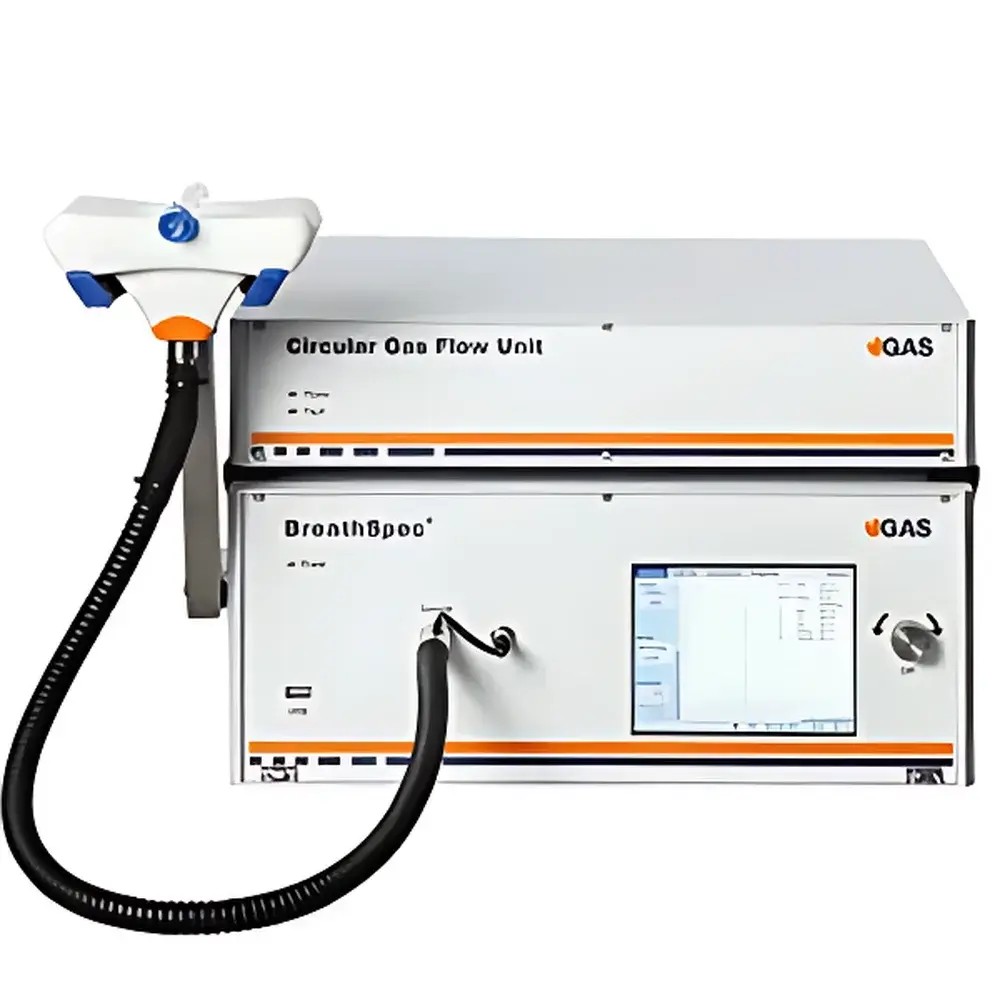
G.A.S. BreathSpec® GC-IMS Breath Analysis System
| Brand | G.A.S. |
|---|---|
| Origin | Germany |
| Model | BreathSpec® |
| Sample Introduction | 6-port valve direct injection |
| Sensitivity | sub-ppb (pptv–ppbv range) |
| Spectral Library | Volatile Organic Compounds (VOCs) |
| Ionization Source | ³H beta emitter (300 MBq, exempt per IEC 61017 & GB 18871-2002 Annex A) |
| Drift Voltage Polarity | Switchable positive/negative mode |
| Detection Principle | Coupled Gas Chromatography–Ion Mobility Spectrometry (GC-IMS) |
| Data Acquisition | High-speed ADIO board with X-scale real-time processing |
| Display | 6.4″ TFT VGA screen |
| Connectivity | RS232 / USB-A ×2 / Ethernet (RJ45) |
| Power Input | 100–240 V AC, 50–60 Hz |
| Dimensions | 449 × 375 × 177 mm (W × D × H) |
| Weight | 15.5 kg |
| Enclosure | 19″ rack-mountable chassis, IP20 rated, EMC compliant |
| Cooling | Thermally regulated axial fan (max. 5.5 m³/h) |
| Gas Fittings | 3 mm stainless steel Swagelok® for drift gas, sample inlet/outlet, carrier gas, and IMS exhaust |
Overview
The G.A.S. BreathSpec® GC-IMS Breath Analysis System is a benchtop analytical platform engineered for rapid, label-free detection and identification of volatile organic compounds (VOCs) in humid, complex biological headspace matrices—primarily human exhaled breath. It integrates two orthogonal separation and detection technologies: high-resolution capillary gas chromatography (GC) and high-sensitivity ion mobility spectrometry (IMS). Unlike conventional mass spectrometry-based breath analyzers, the BreathSpec® operates without vacuum systems or cryogenic cooling, enabling true field-deployable operation while maintaining analytical rigor. The system employs a tritium (³H) beta radiation source (300 MBq) for soft, non-thermal ionization—ensuring minimal fragmentation and high reproducibility across repeated measurements. Its detection principle relies on the differential drift time of ionized VOC adducts under a defined electric field in a controlled drift gas environment (e.g., purified nitrogen or synthetic air), following GC elution. This dual-dimension separation yields highly resolved 2D chromatographic–mobility spectra (retention time vs. drift time), forming compound-specific “fingerprints” essential for biomarker discovery and clinical pattern recognition.
Key Features
- Direct breath sampling via disposable mouthpiece and temperature-controlled transfer line—no pre-concentration, derivatization, or drying required.
- Integrated Circulating Gas Function Unit (CGFU) eliminates dependency on external compressed gas cylinders; enables autonomous operation with only mains power (100–240 V AC).
- Modular GC column selection: interchangeable capillary columns (e.g., DB-5ms, MXT-1, or custom phases) allow method optimization for targeted VOC classes (aldehydes, ketones, sulfur compounds, terpenes).
- Real-time data acquisition at up to 50 Hz frame rate using proprietary high-speed ADIO board and X-scale signal processing architecture.
- Rugged 19″ industrial enclosure (IP20) with active thermal management, EMI-shielded electronics, and CE/EMC compliance—suitable for laboratory, mobile clinic, or ICU environments.
- Full polarity switching capability (positive/negative ion mode) enhances compound coverage and structural insight for redox-active or proton-affinity–diverse VOCs.
Sample Compatibility & Compliance
The BreathSpec® is validated for direct analysis of untreated human breath, static headspace from oral/nasal cavities, dermal wound emissions, and other low-volume biological gas matrices (<5 mL). Its tolerance for >90% relative humidity and particulate-laden samples eliminates the need for Nafion™ dryers or filter traps that may adsorb polar analytes. All hardware and software components comply with ISO/IEC 17025:2017 requirements for analytical instrument qualification. The ³H ionization source meets exemption criteria under IEC 61017 and GB 18871-2002 Annex A, requiring no radiation safety licensing in most jurisdictions. Data integrity adheres to ALCOA+ principles; audit trails, electronic signatures, and user-access controls are fully implemented in LAV and GC×IMS Library Search software to support GLP/GMP and FDA 21 CFR Part 11 readiness.
Software & Data Management
Two core software suites provide end-to-end workflow support: Laboratory Analytical Viewer (LAV) and GC×IMS Library Search suite. LAV serves as the primary visualization and comparative analytics engine, supporting native .mea file import and export to CSV/ASCII for third-party statistical packages (e.g., R, Python, SIMCA). Its “Reporter” plugin enables pairwise spectral comparison between reference and unknown samples, highlighting statistically significant VOC intensity differences. The “Gallery-plot” module generates intuitive heatmaps of normalized peak intensities across sample cohorts—facilitating cluster analysis and classification of disease phenotypes. GC×IMS Library Search leverages dual-database correlation: retention index (RI) values mapped against NIST GC-MS libraries and experimentally calibrated drift times referenced to the G.A.S.-curated IMS database. Users may extend this library via GC×IMS Library Edit, importing in-house standards or literature-derived parameters to build domain-specific spectral repositories—critical for longitudinal clinical studies or regulatory submission dossiers.
Applications
- Non-invasive biomarker discovery in pulmonary diseases (COPD, asthma, lung cancer) and systemic conditions (diabetes, liver dysfunction, renal failure).
- Real-time monitoring of intraoperative anesthetic metabolism and post-anesthesia recovery kinetics.
- Rapid triage of ICU patients with suspected toxic inhalation or drug overdose via breath VOC profiling.
- Differentiation of bacterial vs. fungal wound infections through characteristic volatile metabolic signatures (e.g., geosmin, 2-aminoacetophenone, dimethyl disulfide).
- Pharmacokinetic assessment of drug metabolism by tracking time-resolved breath VOC metabolites (e.g., isoprene for statin activity, acetone for ketogenic status).
- Large-scale population breathomics initiatives requiring standardized, portable instrumentation compliant with ISO 16000-6 and ASTM D6196 protocols.
FAQ
Is the ³H ionization source subject to regulatory licensing?
No—the 300 MBq tritium foil source falls below the exemption threshold defined in IEC 61017 and national regulations including GB 18871-2002 Annex A. No radiation safety officer or facility license is required.
Can the system operate without external gas supplies?
Yes—when equipped with the optional Circulating Gas Function Unit (CGFU), the BreathSpec® recirculates and purifies drift gas internally, eliminating dependence on compressed gas cylinders.
What sample volumes are required for reliable detection?
For breath analysis: 5 mL of end-tidal exhalate collected via syringe; for static headspace: 1–10 mL depending on cavity volume and VOC concentration.
Does the software support multivariate statistical analysis?
LAV exports fully annotated 2D peak tables compatible with PCA, PLS-DA, and OPLS-DA in open-source (R, Python scikit-learn) or commercial (SIMCA, Unscrambler) platforms.
How is method transfer ensured across instruments?
Retention indices (RI) and normalized drift times (K₀) are instrument-independent parameters. GC×IMS Library Search enforces RI/K₀ dual-matching, ensuring cross-platform compound identification reproducibility.





