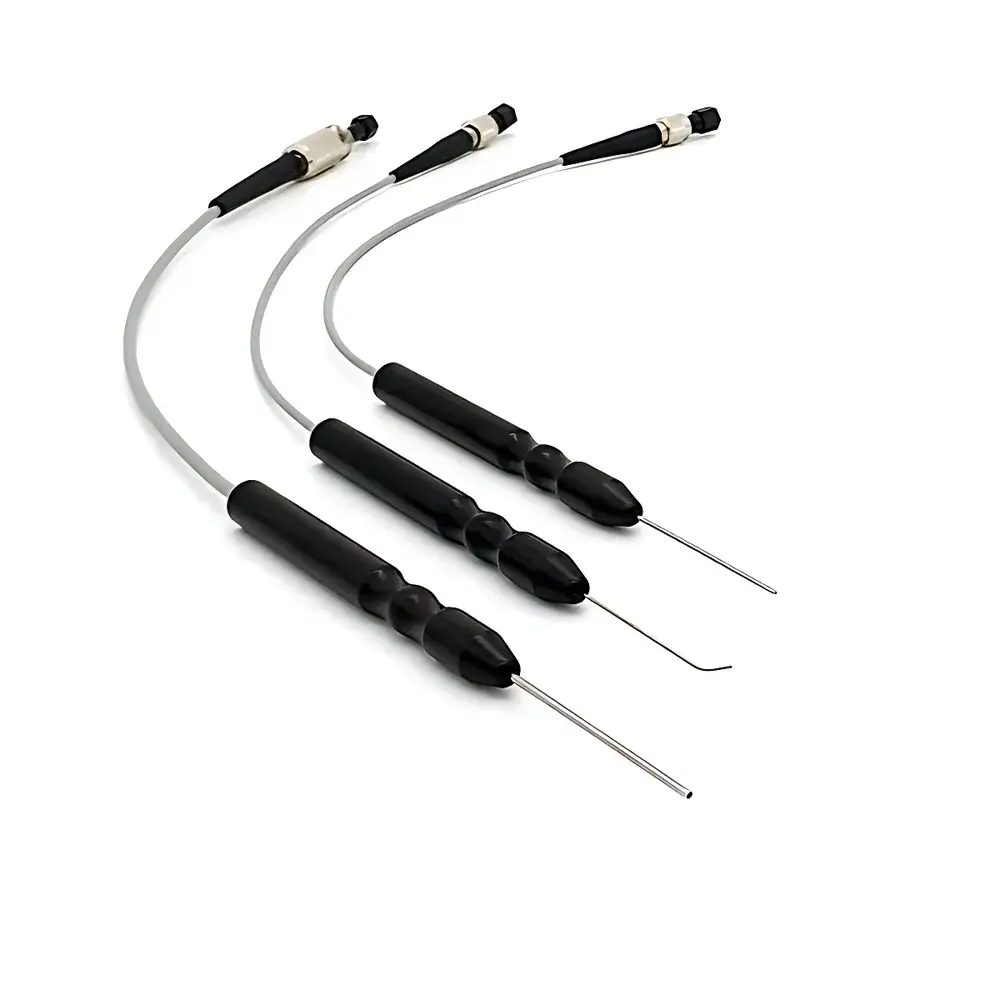
Advanced Fiber Tools GmbH Ophthalmic Laser Probes – Bare Fibers Series
| Brand | Advanced Fiber Tools |
|---|---|
| Origin | Germany |
| Product Type | Sterilizable Reusable Bare Optical Fibers for Ophthalmic Laser Delivery |
| Core Material | Low-OH Fused Silica Fiber |
| Standard Connector | SMA905 |
| Compatible Wavelengths | 532 nm & 810 nm |
| Core Diameters | 100 µm, 200 µm, 400 µm, 600 µm |
| Numerical Aperture (NA) | 0.22 |
| Operating Temperature Range | Body temperature (37 °C) |
| Storage | −40 °C to +80 °C |
| Sterilization Compatibility | Ethylene Oxide (EO) and Gamma Irradiation (per ISO 11135 / ISO 11137) |
| Outer Diameter Options | 20G (0.9 mm), 23G (0.6 mm), 25G (0.5 mm) |
| Working Lengths | 200 mm, 300 mm, 400 mm, 500 mm |
| Fiber Cladding | Polymer-coated or metal-sheathed variants available |
Overview
Advanced Fiber Tools GmbH’s Ophthalmic Laser Probes – Bare Fibers Series are precision-engineered medical-grade optical fiber components designed for reliable, low-loss delivery of therapeutic laser energy in ophthalmic microsurgery. These probes operate on the principle of total internal reflection within high-purity fused silica waveguides, enabling efficient transmission of collimated or focused laser beams across the visible and near-infrared spectrum. Specifically optimized for 532 nm (frequency-doubled Nd:YAG, green) and 810 nm (diode, infrared) wavelengths, they serve as critical interface elements between ophthalmic laser systems and intraocular targets—including retinal tissue, ciliary body, posterior capsule, and iridial structures. Unlike integrated handpieces, bare fibers provide maximum flexibility for integration into custom surgical platforms, OEM devices, or modular endoscopic workstations. Each fiber is fabricated from ultra-low hydroxyl (OH⁻) silica, minimizing absorption at key ophthalmic wavelengths and ensuring long-term photostability under repeated clinical use.
Key Features
- Medical-grade low-OH fused silica core with controlled numerical aperture (NA = 0.22) for predictable beam divergence and coupling efficiency
- Standard SMA905 termination—mechanically robust, repeatable alignment, compliant with IEC 61753-1 insertion loss specifications
- Multiple core diameters (100–600 µm) to balance power handling capacity, spatial resolution, and depth of focus per application
- Biocompatible polymer or stainless-steel jacketing options for enhanced torque resistance and tactile feedback during intraocular manipulation
- Validated compatibility with EO sterilization (ISO 11135) and gamma irradiation (ISO 11137-1), supporting reuse under institutional reprocessing protocols
- Traceable lot documentation including spectral attenuation data (dB/m @ 532/810 nm), proof testing records, and dimensional inspection reports
Sample Compatibility & Compliance
All bare fiber probes comply with ISO 10993-1 (biological evaluation of medical devices) for cytotoxicity, sensitization, and irritation. Materials contacting ocular tissue meet USP Class VI requirements. The optical performance adheres to EN 60601-2-22 (particular requirements for basic safety and essential performance of laser equipment for medical applications), and mechanical design aligns with ISO 13485:2016 quality management system standards. Traceability supports FDA 21 CFR Part 820 and EU MDR Annex II documentation requirements. No device classification is implied; final regulatory status is determined by the integrating manufacturer’s intended use and system-level validation.
Software & Data Management
As passive optical components, these bare fibers do not incorporate embedded electronics or firmware. However, their performance parameters—including measured insertion loss, back-reflection (<−40 dB), and damage threshold—are fully documented in Certificates of Conformance supplied with each batch. Integration into laser systems requiring audit trails (e.g., GLP/GMP environments) is supported via standardized calibration logs and maintenance records aligned with ISO/IEC 17025 traceability frameworks. Users may map individual fiber IDs to laser output settings in hospital asset management systems to ensure consistent energy delivery across procedures.
Applications
- Transpupillary thermotherapy (TTT) and panretinal photocoagulation (PRP) for diabetic retinopathy and retinal vein occlusion
- Transscleral cyclophotocoagulation (TCP) using 810 nm–optimized fibers with specialized distal geometry
- Posterior capsulotomy following cataract surgery using Q-switched Nd:YAG lasers coupled through high-damage-threshold fibers
- Iridotomy in angle-closure glaucoma, where precise spot size control enables reproducible peripheral iris perforation
- OEM integration into robotic-assisted vitreoretinal platforms requiring miniaturized, sterilizable light delivery pathways
FAQ
Are these fibers compatible with pulsed or continuous-wave (CW) ophthalmic lasers?
Yes—designed for both nanosecond-pulsed (e.g., Q-switched Nd:YAG) and CW diode lasers operating at 532 nm or 810 nm, provided peak power density remains below the specified damage threshold.
Can I request custom core/cladding configurations or non-standard lengths?
Yes—Advanced Fiber Tools offers engineering support for bespoke geometries, including tapered tips, ball-lensed terminations, and hybrid illumination/therapy dual-fiber assemblies, subject to minimum order quantities and design review.
Do you provide laser-induced damage threshold (LIDT) test reports?
Yes—certified LIDT values (expressed in J/cm² for pulsed and W/cm² for CW operation) are included in the technical dossier for each fiber variant, measured per ISO 21254-1.
Is re-sterilization validated beyond a single cycle?
Multiple-cycle EO and gamma reprocessing validation data are available upon request; typical recommended maximum reuse cycles are defined per institution’s reprocessing SOPs and fiber handling history.
How is fiber alignment maintained during repeated coupling to laser sources?
SMA905 connectors feature precision-ground ferrules and torque-specification tightening (typically 6–8 N·cm), ensuring axial repeatability within ±2 µm over ≥500 mating cycles when used with calibrated mating adapters.