
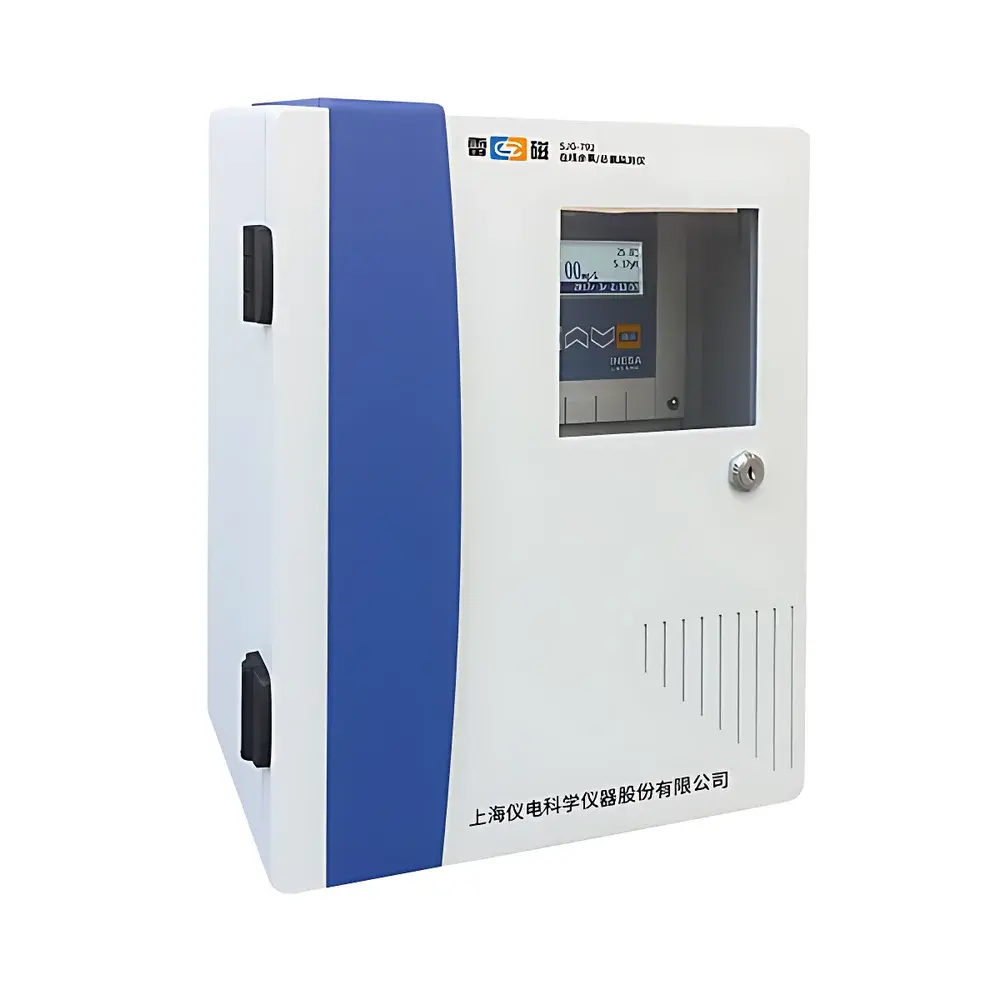
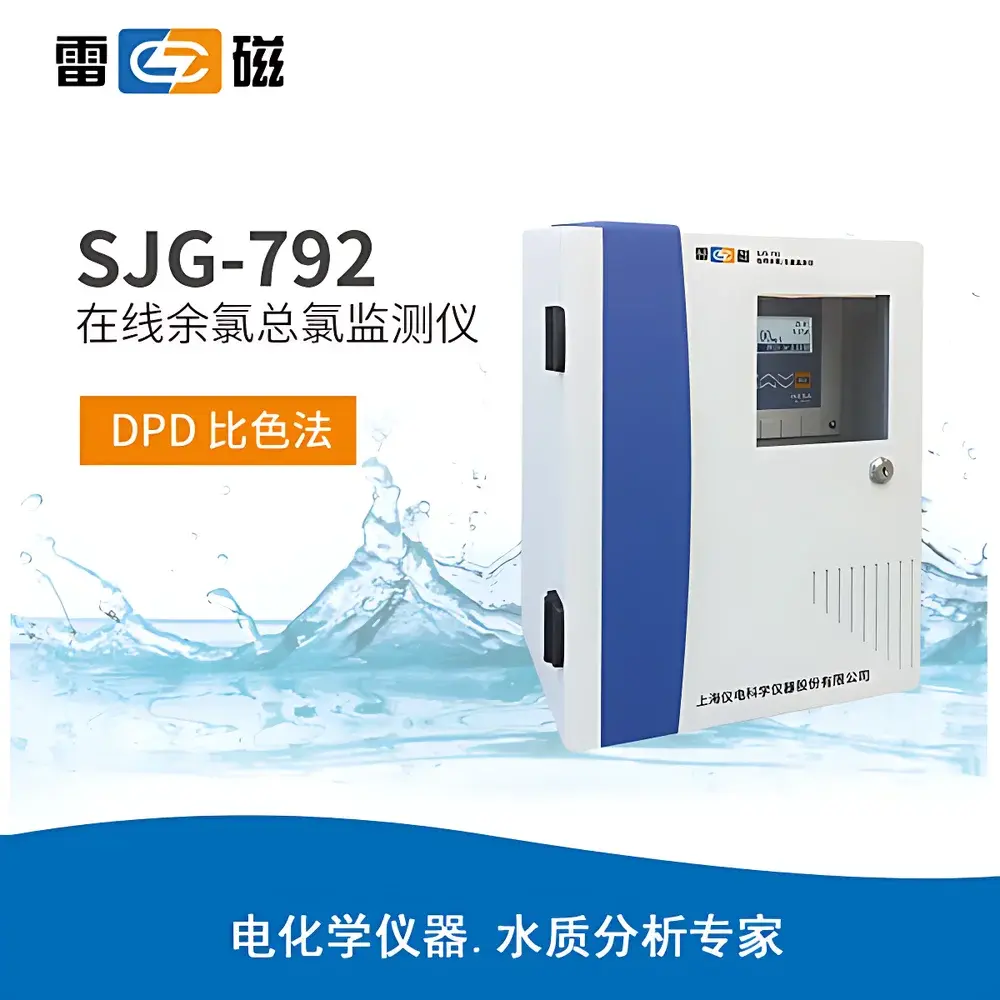
Leici SJG-792 Online Residual and Total Chlorine Analyzer
| Brand | Leici |
|---|---|
| Origin | Shanghai, China |
| Manufacturer Type | OEM Manufacturer |
| Regional Classification | Domestic (China) |
| Model | SJG-792 |
| Instrument Type | Online Analyzer |
| Measurement Principle | Electrochemical Amperometric Sensor |
| Measured Parameters | Residual Chlorine, Total Chlorine |
| Range | 0.00–5.00 mg/L |
| Accuracy | ±5% (for values >1 mg/L) or ±0.05 mg/L (for values ≤1 mg/L) |
| Repeatability | ±0.025 mg/L (≤1 mg/L) |
| Resolution | 0.01 mg/L |
| Detection Limit | ≤0.05 mg/L |
| Display | Dot-matrix LCD |
| Data Storage | Up to 700 records with SD card export |
| Output | Isolated 4–20 mA DC (configurable span), RS-232/RS-485 (Modbus RTU) |
| Enclosure Rating | IP65 |
| Power Supply | AC 220 V ±10%, 50 Hz ±1% |
Overview
The Leici SJG-792 Online Residual and Total Chlorine Analyzer is an industrial-grade electrochemical amperometric instrument engineered for continuous, real-time monitoring of free residual chlorine and total chlorine concentrations in potable water, wastewater effluent, cooling tower systems, and disinfection process streams. Based on Clark-type amperometric sensor technology, the analyzer operates via selective reduction of hypochlorous acid (HOCl) and hypochlorite ion (OCl⁻) at a polarized working electrode under controlled potential, generating a current proportional to analyte concentration. This principle ensures stable, drift-resistant response in variable pH and temperature conditions typical of municipal and industrial water networks. Unlike colorimetric or DPD-based methods, the SJG-792 eliminates reagent consumption, optical path fouling, and interferences from turbidity or colored organics—making it suitable for unattended, long-term deployment in harsh ambient environments.
Key Features
- High-stability electrochemical sensor with integrated temperature compensation (PT1000) and automatic zero-point drift correction
- Configurable measurement modes: continuous real-time output, programmable interval sampling (1–3600 s), or manual trigger acquisition
- Onboard calibration management: preloaded NIST-traceable calibration curves; user-accessible two-point calibration (zero + one or two standard points); in-situ process calibration without sensor removal
- Robust data handling: internal non-volatile memory stores up to 700 timestamped measurement records; SD card slot supports CSV export for audit-ready traceability
- Dual-output interface: isolated 4–20 mA analog output with fully configurable lower/upper range mapping; optional RS-232 or RS-485 serial port supporting Modbus RTU protocol for SCADA/DCS integration
- Comprehensive diagnostics: real-time sensor status monitoring (response time, offset, slope), fault logging with event timestamps, and power-loss recovery with retained configuration and last valid reading
- IP65-rated polycarbonate enclosure rated for outdoor wall or pipe-mount installation; operating ambient temperature range: 0–45 °C; humidity tolerance: ≤90% RH non-condensing
Sample Compatibility & Compliance
The SJG-792 is validated for aqueous matrices with pH 4.0–8.5 and conductivity < 2000 µS/cm. It maintains accuracy across common water treatment conditions—including chloraminated systems—without requiring chemical reagents or flow-cell modifications. The analyzer complies with ISO 7888 (water quality — determination of residual chlorine), ASTM D1253 (standard test method for residual chlorine in water), and supports alignment with regulatory reporting frameworks such as US EPA Method 334.0 and EU Drinking Water Directive (98/83/EC). Its firmware architecture includes configurable alarm thresholds (high/low limit triggers), event logging, and system health indicators—all essential for GLP-compliant operations and routine QA/QC verification in water utilities and pharmaceutical facility utilities.
Software & Data Management
No proprietary PC software is required for basic operation; all configuration, calibration, and diagnostic functions are accessible via the front-panel keypad and dot-matrix LCD interface. For centralized monitoring, the Modbus RTU interface enables seamless integration into existing PLCs, HMI systems, or cloud-based IIoT platforms. Data logs exported to SD card include full metadata: date/time stamp, measured value (mg/L), sensor status flag, temperature reading, and calibration history ID. All stored data adhere to ALCOA+ principles (Attributable, Legible, Contemporaneous, Original, Accurate, Complete, Consistent, Enduring, Available) to support FDA 21 CFR Part 11 readiness when deployed within validated GMP environments.
Applications
- Real-time monitoring of chlorine residual at drinking water treatment plant final effluent points
- Process control in membrane filtration and UV disinfection bypass loops
- Automated dosing feedback for sodium hypochlorite or chlorine gas injection systems
- Compliance verification at distribution system entry points and booster station outlets
- Wastewater disinfection validation prior to environmental discharge (e.g., NPDES permit requirements)
- Pharmaceutical purified water (PW) and water-for-injection (WFI) loop surveillance per USP
FAQ
Does the SJG-792 require daily reagent addition or membrane replacement?
No. As an amperometric sensor-based analyzer, it operates without consumable reagents, optical filters, or replaceable membranes—reducing lifecycle maintenance cost and operator intervention frequency.
Can the instrument differentiate between free chlorine and total chlorine automatically?
Yes. The SJG-792 supports dual-channel measurement via sequential sample conditioning: free chlorine is measured directly; total chlorine is determined after on-line addition of potassium iodide (KI) via optional external dosing module (sold separately), enabling fully automated speciation.
Is the 4–20 mA output intrinsically safe for hazardous area installation?
The standard output is non-IS; however, it may be connected to a certified intrinsically safe barrier (e.g., Pepperl+Fuchs KFD2-ST2-Ex2) for Zone 2/Class I Div 2 deployments. A dedicated IS-certified variant is available upon request.
How often should calibration be performed in continuous operation?
Initial commissioning requires two-point calibration; thereafter, quarterly verification against certified standards is recommended. Automatic drift compensation and built-in zero-check routines extend calibration intervals without compromising data integrity.
What is the expected service life of the electrochemical sensor under typical municipal water conditions?
With proper installation (avoiding air exposure during shutdowns and mechanical abrasion), the sensor demonstrates ≥18 months of stable performance before sensitivity decay exceeds specification limits—verified through accelerated aging tests per IEC 61511 Annex C.
Related Products







