
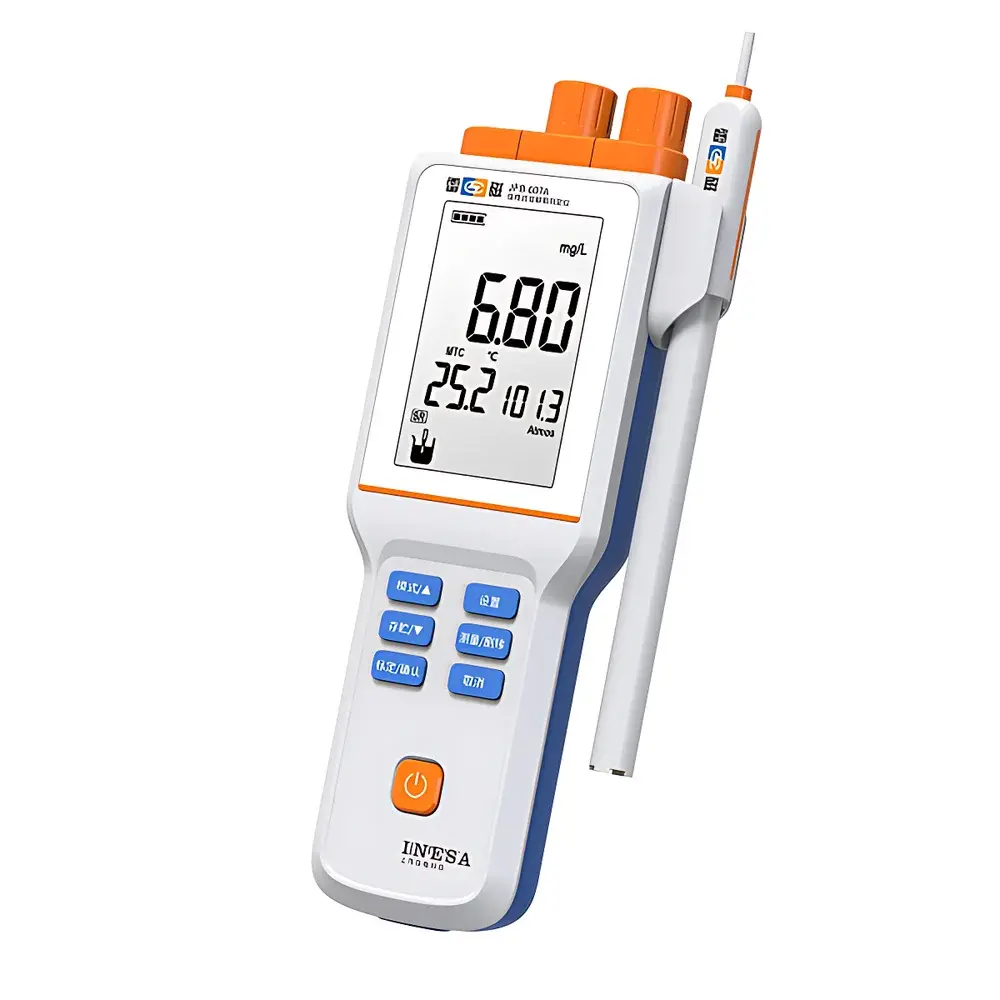
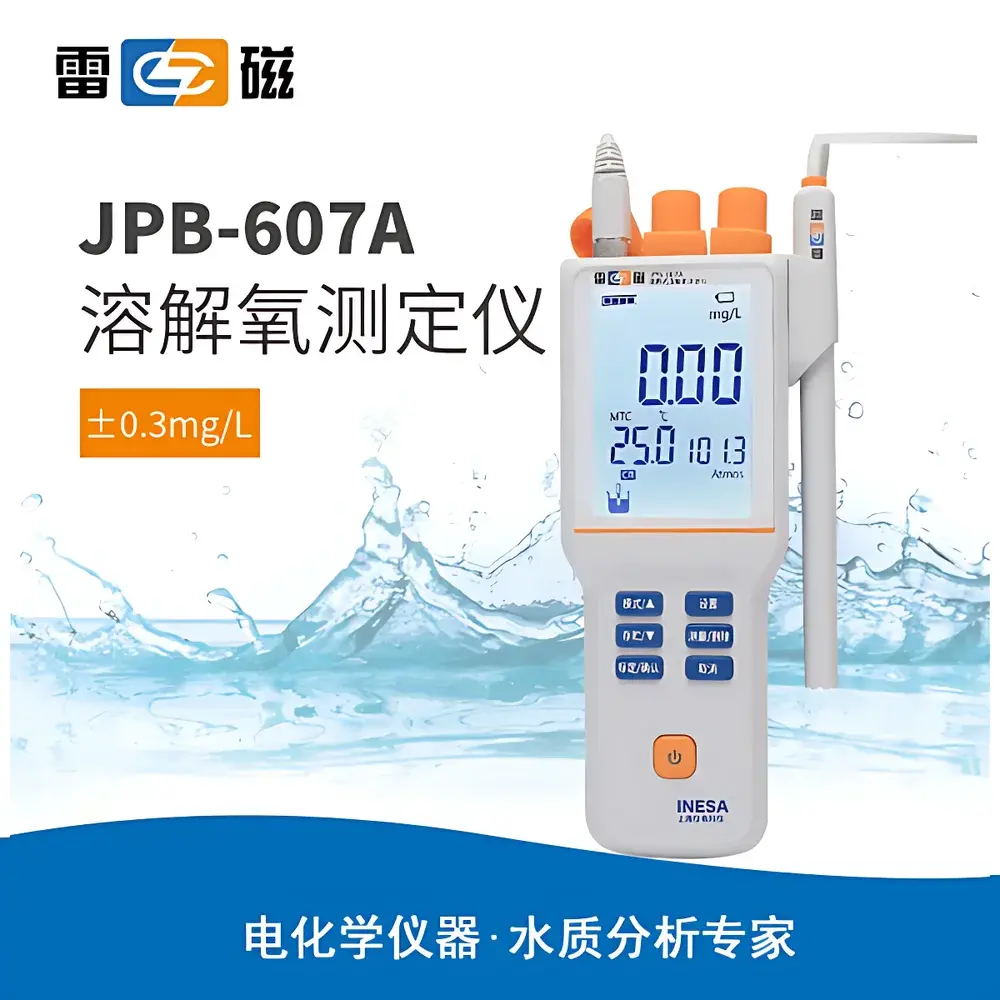
Leichi JPB-607A Portable Dissolved Oxygen Analyzer
| Brand | Leichi |
|---|---|
| Origin | Shanghai, China |
| Manufacturer Type | Direct Manufacturer |
| Country of Origin | China |
| Model | JPB-607A |
| Instrument Type | Portable |
| Measurement Principle | Electrochemical (Clark-type Polarographic Sensor) |
| Dissolved Oxygen Range | 0.00–20.00 mg/L |
| Resolution | 0.01 mg/L |
| Accuracy (DO) | ±0.30 mg/L |
| Response Time (90% at 20.0 °C) | ≤45 s |
| Saturation Range | 0.0–200.0 % |
| Temperature Range | −5.0–110.0 °C |
| Temp. Accuracy | ±0.4 °C (0.0–60.0 °C), ±1.0 °C (other) |
| Salt Compensation Error | ±2% |
| Atmospheric Pressure Compensation | Manual |
| IP Rating | IP65 |
| Data Storage Capacity | 200 sets |
| Power Supply | Rechargeable Li-ion battery (DC5V input compatible) |
| Dimensions | 80 × 225 × 35 mm |
| Weight | 0.4 kg |
Overview
The Leichi JPB-607A Portable Dissolved Oxygen Analyzer is an engineered field instrument designed for rapid, reliable quantification of dissolved oxygen (DO) in freshwater, wastewater, aquaculture systems, and environmental surface waters. It operates on the Clark-type polarographic principle—utilizing a gas-permeable membrane, cathode, and silver/silver chloride anode to generate a diffusion-limited current proportional to the partial pressure of molecular oxygen in solution. This electrochemical transduction method ensures stable baseline performance, low drift, and high reproducibility across variable field conditions. The analyzer integrates automatic temperature compensation (ATC) based on a built-in NTC thermistor, enabling real-time correction of oxygen solubility according to water temperature. Its compact, ergonomic form factor—weighing only 0.4 kg and measuring 80 × 225 × 35 mm—is optimized for single-hand operation during stream surveys, regulatory inspections, or routine plant monitoring.
Key Features
- IP65-rated enclosure for dust resistance and protection against low-pressure water jets—suitable for outdoor use in rain, humidity, or splashing environments.
- High-contrast backlit LCD display with adjustable brightness; supports both metric (mg/L) and saturation (%) readouts simultaneously.
- Smart endpoint detection algorithm that distinguishes between equilibrium and dynamic measurement modes—enabling both stabilized spot checks and continuous trend logging.
- Integrated dual-point calibration workflow: zero-oxygen (sodium sulfite) and full-saturation (air-saturated water) procedures are guided step-by-step on-screen.
- Manual atmospheric pressure and salinity compensation inputs—critical for accurate DO reporting in estuarine, coastal, or high-altitude applications per ISO 5814 and ASTM D888 standards.
- Rechargeable lithium-ion battery with state-of-charge indicator, low-voltage warning, and USB-compatible DC5V charging—supports >12 hours of continuous operation on a single charge.
Sample Compatibility & Compliance
The JPB-607A is validated for use with natural waters (rivers, lakes, reservoirs), treated effluents, process streams, and recirculating aquaculture systems. Its polarographic sensor is compatible with turbid, colored, or mildly fouling matrices when used with routine membrane cleaning and electrolyte replenishment. The instrument complies with fundamental metrological requirements outlined in ISO/IEC 17025 for field-deployable analyzers and supports audit-ready documentation through timestamped data storage. While not certified for GLP or GMP environments out-of-the-box, its data integrity features—including non-volatile memory, no user-editable timestamps, and factory-reset traceability—align with preparatory workflows for EPA Method 360.1 and ISO 5815-1 validation protocols.
Software & Data Management
All measurements are stored locally in non-volatile memory (200 datasets maximum), each containing DO concentration, saturation %, temperature, atmospheric pressure, salinity setting, date/time stamp, and calibration status flags. Data export is supported via USB-C interface to standard PC platforms using Leichi’s optional DataLink software (Windows/macOS compatible), which generates CSV reports compliant with laboratory information management system (LIMS) ingestion requirements. No proprietary drivers or cloud dependencies are required. Audit trail functionality includes automatic logging of calibration events, power-on cycles, and parameter changes—facilitating internal QA review and external regulatory readiness under frameworks referencing FDA 21 CFR Part 11 principles.
Applications
- Field-based compliance monitoring for municipal wastewater discharge permits (e.g., NPDES).
- Biochemical oxygen demand (BOD) incubation verification and sample pre-screening.
- Aquaculture pond management—tracking diurnal DO fluctuations to prevent hypoxia-induced mortality.
- Drinking water distribution system integrity assessment (e.g., stagnation zones, dead ends).
- Educational laboratories requiring rugged, entry-level DO instrumentation for environmental science curricula.
- Emergency response deployments following chemical spills or algal bloom events where rapid DO profiling informs mitigation strategy.
FAQ
What calibration standards are required for routine operation?
Sodium sulfite solution (zero-oxygen) and air-saturated distilled water (100% saturation) are recommended per ISO 5814. Calibration frequency depends on usage intensity; daily calibration is advised for regulatory field work.
Can the instrument compensate for salinity beyond freshwater conditions?
Yes—manual salinity input (0–50 g/kg) adjusts solubility calculations using the Garcia-Bradshaw equation, supporting estuarine and brackish water measurements.
Is the sensor replaceable by the end user?
The integrated polarographic probe is field-serviceable: membranes, cathodes, and electrolyte can be replaced using Leichi’s OEM maintenance kit (Part No. JPB-ELK-01).
Does the device support Bluetooth or wireless data transfer?
No—data exchange is conducted exclusively via wired USB-C connection to ensure deterministic transfer integrity and eliminate RF interference risks in industrial settings.
How is temperature measured and compensated?
An embedded NTC thermistor measures sample temperature concurrently with DO; ATC applies the Benson-Krause solubility model to correct readings across −5.0 °C to 110.0 °C.







