
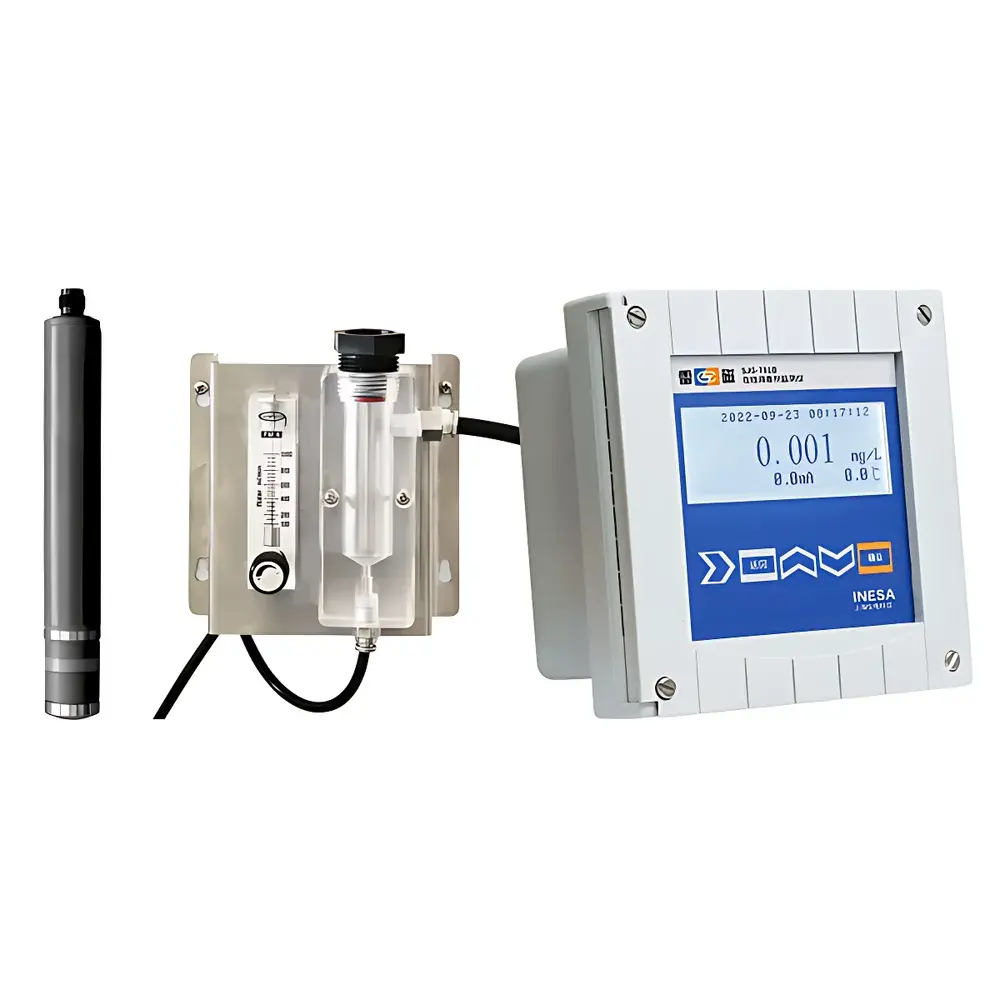
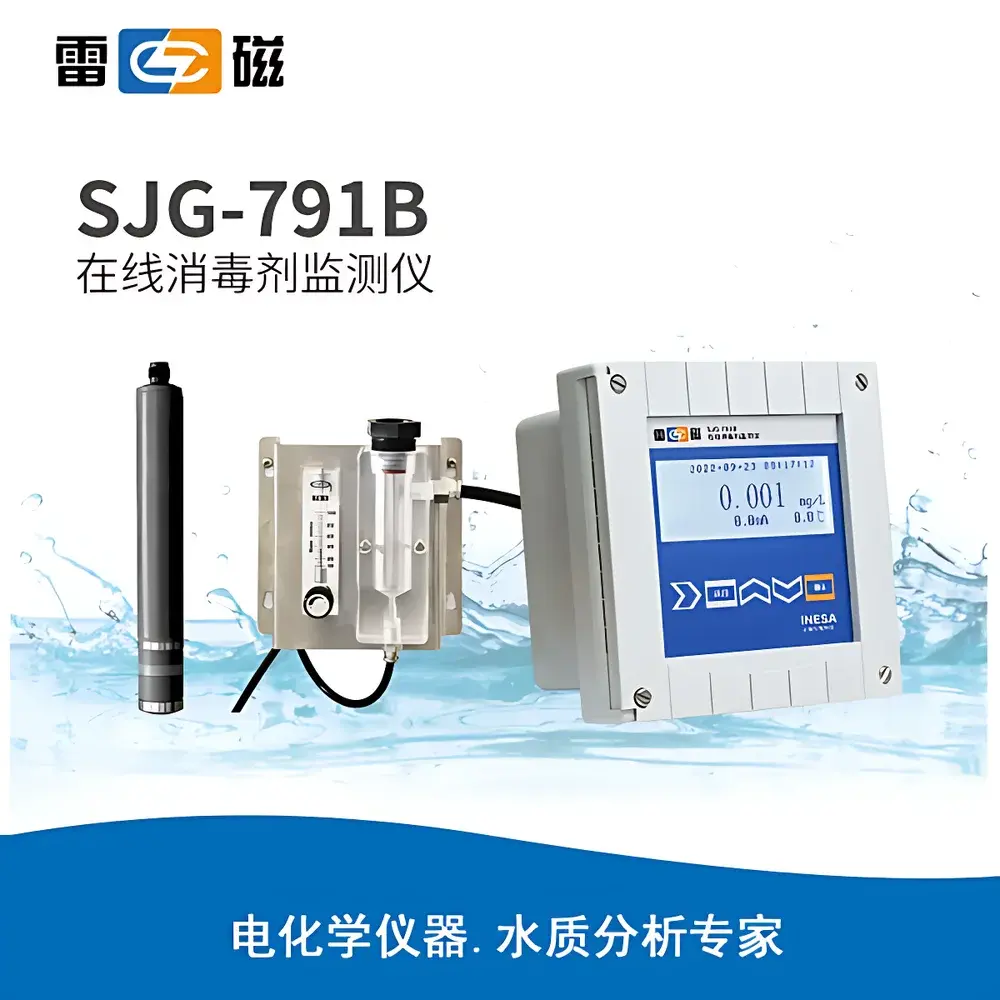
Leici SJG-791B Online Residual Chlorine and Chlorine Dioxide Analyzer
| Brand | Leici |
|---|---|
| Origin | Shanghai, China |
| Manufacturer Type | Manufacturer |
| Product Category | Domestic |
| Model | SJG-791B |
| Instrument Type | Online Analyzer |
| Measurement Principle | Electrochemical Amperometric Sensor Method |
| Measured Parameters | Residual Chlorine / Total Chlorine / Chlorine Dioxide / Ozone (selectable single parameter) |
| Measurement Range | 0.005–2.000 mg/L (standard range) |
| Accuracy | ±1% FS (for residual chlorine with DCS4H-M0c electrode) |
| Resolution | 0.001 mg/L |
| Output Signal | Isolated 4–20 mA DC (max. load 600 Ω) |
| Digital Interface | RS-485 |
| Temperature Compensation | Automatic (5–40 °C sample range) |
| Enclosure Rating | IP65 |
| Power Supply | AC 220 V ±10%, 50 Hz |
| Installation | Wall-mounted console with flow-through sensor housing |
| Sensor Cable Length | 5 m (standard) |
| Sample Flow Rate | 0.3–0.5 L/min |
Overview
The Leici SJG-791B Online Residual Chlorine and Chlorine Dioxide Analyzer is an industrial-grade electrochemical monitoring system engineered for continuous, real-time measurement of disinfectant residuals in water distribution and treatment applications. It operates on the amperometric principle—utilizing selective membrane-covered electrodes that generate a current proportional to the concentration of oxidizing species (Cl₂, ClO₂, O₃, or total chlorine) diffusing across the sensing interface. This method ensures high specificity, minimal interference from common water matrix constituents (e.g., pH fluctuations, turbidity, or non-oxidizing ions), and stable long-term performance under variable hydraulic conditions. Designed for deployment at critical control points—including municipal drinking water intake stations, distribution network pressure zones, secondary water supply tanks, wastewater disinfection contact basins, hospital effluent streams, and recreational pool circulation loops—the SJG-791B delivers trace-level quantification down to 0.005 mg/L with sub-milligram resolution, supporting compliance with national and international regulatory thresholds (e.g., WHO Guidelines for Drinking-water Quality, EPA Method 334.0, ISO 7393-2, and GB/T 5750.11–2023).
Key Features
- Multi-parameter configurability: User-selectable measurement mode for residual chlorine, total chlorine, chlorine dioxide, or ozone—each optimized via dedicated electrode chemistry and calibration protocols.
- Triple-electrode architecture for chlorine species (DCS4H-M0c/DCS4N-M0c and DCP4H-M0c/DCP4N-M0c): Includes working, reference, and auxiliary electrodes to minimize polarization drift and enhance signal stability during extended unattended operation.
- Dual-electrode amperometric sensors for ClO₂ (DCD10.1H-M0c/N-M0c) and O₃ (DOZ10.1H-M0c/N-M0c): Engineered with gas-permeable membranes and catalytic cathodes to ensure rapid response (< 90 s T₉₀) and low cross-sensitivity to free chlorine.
- Integrated temperature compensation algorithm: Automatically adjusts readings based on real-time sample temperature (5–40 °C), eliminating manual correction and improving inter-laboratory reproducibility.
- Robust IP65-rated enclosure: Sealed front panel with vandal-resistant keypad and backlit LCD display enables reliable outdoor or semi-outdoor wall mounting in humid, dusty, or splash-prone environments.
- Configurable operational modes: Supports both continuous measurement (for process feedback control) and programmable interval sampling (e.g., every 1, 5, or 15 minutes) to conserve sensor lifetime and reduce maintenance frequency.
- Intelligent alarm management: Dual independent setpoints with hysteresis logic prevent relay chatter; relay outputs rated at 2.5 A / 250 V AC (resistive load) are suitable for direct integration with SCADA PLCs or chemical dosing controllers.
Sample Compatibility & Compliance
The SJG-791B is validated for use in potable water, treated wastewater, cooling tower makeup, and swimming pool recirculation systems with typical conductivity < 2000 µS/cm and suspended solids < 10 mg/L. Its electrochemical sensors exhibit negligible interference from nitrite (< 0.5 mg/L), bromide (< 1 mg/L), and hydrogen peroxide (< 0.2 mg/L) under standard operating conditions. The analyzer complies with electromagnetic compatibility requirements per IEC 61326-1 (industrial environment) and meets functional safety expectations for Class A water quality instrumentation under ISO 9001-certified manufacturing. While not intrinsically safe, its design supports installation in non-hazardous zones per IEC 60079-0. Data integrity features—including timestamped internal logging and non-volatile memory retention—align with GLP documentation practices for routine monitoring records.
Software & Data Management
The device stores up to 2000 measurement records locally, each tagged with date/time stamp, measured value, temperature, and sensor status flag. Storage interval is user-configurable from 1 minute to 24 hours. Raw data export is supported via RS-485 Modbus RTU protocol (slave ID configurable, baud rate 9600–115200 bps), enabling seamless integration into existing plant-wide SCADA, DCS, or cloud-based water intelligence platforms (e.g., OSIsoft PI, Ignition, or Siemens Desigo CC). The isolated 4–20 mA analog output allows direct connection to legacy PLC analog input modules, with full span and zero adjustment via front-panel menu. All configuration changes—including calibration coefficients, alarm thresholds, and communication parameters—are logged with audit trail timestamps.
Applications
- Municipal drinking water utilities: Real-time verification of disinfectant residual at entry points, booster stations, and zone boundary valves to maintain CT compliance per regulatory mandates.
- Hospital wastewater treatment: Monitoring post-disinfection ClO₂ or ozone levels prior to discharge to ensure pathogen inactivation without exceeding environmental discharge limits.
- Food & beverage processing plants: Verification of sanitizing rinse water efficacy in CIP circuits where precise oxidative potential must be maintained without over-dosing.
- Swimming pool & spa facilities: Closed-loop control of chlorine or ozone dosing to sustain target residual while minimizing chloramine formation and user irritation.
- Industrial cooling water systems: Detection of biocide carryover from upstream treatment to prevent microbiologically influenced corrosion (MIC) in heat exchangers.
FAQ
What electrode configurations are supported for different disinfectants?
The SJG-791B accepts four interchangeable sensor families: DCS4x-M0c (residual chlorine), DCP4x-M0c (total chlorine), DCD10.1x-M0c (chlorine dioxide), and DOZ10.1x-M0c (ozone); ‘H’ denotes high-sensitivity (0.005–2.000 mg/L) and ‘N’ denotes normal-range (0.05–20.00 mg/L) variants.
Is field calibration required, and how often?
Yes—calibration using NIST-traceable standard solutions (e.g., DPD colorimetric standards for chlorine, iodometric titration for ClO₂) is recommended before initial commissioning and at intervals no longer than 30 days under continuous operation; automatic zero-check routines are available between calibrations.
Can the instrument operate without external power backup?
It includes non-volatile memory with power-loss protection: all settings and the last 100 measurements are retained during AC interruption; however, continuous measurement ceases until power resumes.
Does it support remote firmware updates?
Firmware upgrades require local physical access via USB-to-RS485 adapter and proprietary configuration software; over-the-air updates are not implemented.
What is the expected service life of the amperometric sensors?
Under typical municipal water conditions (pH 6.5–8.0, temperature < 35 °C), DCS4H-M0c and DCD10.1H-M0c sensors demonstrate ≥12 months of stable performance before recalibration or replacement becomes necessary.







