
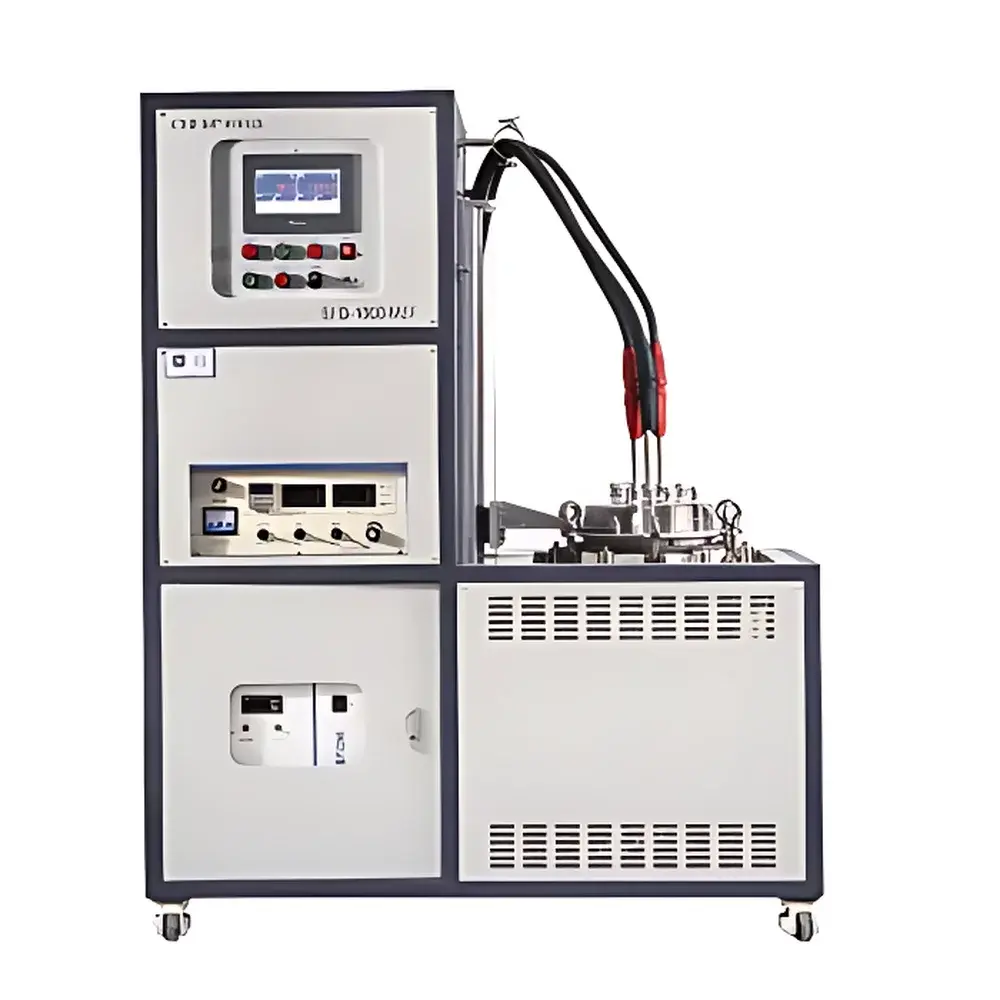
Chemn BFD-1000-MSF Molten Salt Electrolysis Furnace
| Brand | Chemn |
|---|---|
| Origin | Anhui, China |
| Model | BFD-1000-MSF |
| Max Temperature | 1000 °C |
| Temperature Control Accuracy | ±1 °C |
| Max Power | 1.5 kW |
| Heating Rate (to Max Temp) | 10 °C/min |
| Furnace Type | Crucible Furnace |
| Internal Dimensions | Customizable |
Overview
The Chemn BFD-1000-MSF Molten Salt Electrolysis Furnace is a purpose-engineered high-temperature thermal system designed for controlled molten salt electrolysis processes in materials science research laboratories. Unlike conventional muffle furnaces, this unit integrates precise thermal regulation with electrical feedthrough compatibility to support electrochemical surface modification under molten salt conditions. It operates on the principle of high-temperature electrochemical diffusion—where a molten eutectic salt bath (e.g., 75 wt% Na₂B₄O₇ + 25 wt% Na₂CO₃) serves as both electrolyte and boron source—and enables pulse-current-assisted electrolytic boriding of metallic substrates. The furnace maintains stable isothermal zones up to 1000 °C, facilitating reproducible formation of hard, wear-resistant Fe₂B or Ni₂B intermetallic layers via solid-state diffusion kinetics governed by Fick’s second law.
Key Features
- Stable high-temperature operation up to 1000 °C with ±1 °C control accuracy over full range, achieved via PID-controlled silicon carbide heating elements and dual thermocouple feedback (type K, embedded and external)
- Dual-purpose chamber design: accommodates standard crucibles (Al₂O₃ or BN-lined) while providing insulated electrical feedthroughs (rated to 60 V/10 A DC or pulsed) for integration with external power supplies
- Programmable ramp-soak profiles with up to 10 segments; heating rate adjustable from 1 to 10 °C/min, enabling kinetic studies of boride nucleation and growth
- Robust refractory insulation architecture minimizes thermal gradient across working zone (<5 °C deviation at 950 °C), critical for uniform layer thickness in diffusion-controlled treatments
- Front-loading horizontal configuration with reinforced ceramic fiber door seal and integrated over-temperature cut-off (OTC) circuit per IEC 61000-6-2
Sample Compatibility & Compliance
The BFD-1000-MSF supports sample geometries up to Ø80 mm × 100 mm (custom internal dimensions available upon specification), compatible with stainless steel, low-alloy steels, nickel-based superalloys, and titanium substrates. Crucible options include high-purity α-Al₂O₃ (for ≤1000 °C in oxidizing atmospheres) and hot-pressed boron nitride (for reducing or inert gas environments). The system complies with general laboratory safety standards (EN 61000-3-2, EN 61000-3-3) and is suitable for use in GLP-compliant environments when operated with validated temperature mapping protocols (per ASTM E220, ISO/IEC 17025 Annex A.4). While not intrinsically rated for hazardous atmosphere use, it may be deployed inside ventilated fume hoods during salt handling per OSHA 1910.1200 (HCS) requirements.
Software & Data Management
Temperature profiling and logging are managed via the optional Chemn TControl Pro software (v3.2+), which provides real-time graphing, CSV export, and audit-trail-enabled session records compliant with FDA 21 CFR Part 11 when paired with user authentication and electronic signature modules. Data points are timestamped with millisecond resolution and stored locally with SHA-256 checksum verification. For standalone operation, the built-in 3.5-inch TFT display supports manual setpoint entry, alarm history review (last 100 events), and calibration offset adjustment (traceable to NIST-certified reference thermocouples).
Applications
- Electrolytic boriding of ferrous and non-ferrous alloys for enhanced surface hardness (>1500 HV), oxidation resistance, and tribological performance
- Kinetic modeling of boride layer growth under variable pulse duty cycles (e.g., 10–50% duty, 10–100 Hz frequency) and current densities (0.1–2.0 A/cm²)
- Thermochemical treatment process development for aerospace bearing steels (e.g., M50, 440C) and nuclear-grade zirconium alloys
- In-situ monitoring of salt bath decomposition behavior via post-run XRD/SEM-EDS of residue and crucible cross-sections
- Validation of diffusion coefficients in ternary Na–B–O systems using parabolic layer-thickness measurements (x² vs. t plots)
FAQ
What types of molten salts are compatible with the BFD-1000-MSF?
The furnace is validated for use with neutral-to-basic eutectics including Na₂B₄O₇–Na₂CO₃, NaCl–KCl, and LiF–NaF–KF (FLiNaK), provided crucible material is chemically matched and operating temperature remains within salt stability limits.
Can the unit operate under protective gas or vacuum?
Yes—gas-tight modifications (stainless steel flange ports, Viton or Kalrez seals) and vacuum-rated versions (≤10⁻² mbar base pressure) are available as factory options.
Is third-party calibration documentation included?
A factory-as-delivered temperature uniformity report (per ASTM E220 Annex B) and thermocouple calibration certificate (NIST-traceable) are supplied standard.
What maintenance intervals are recommended?
Heating element resistance checks every 200 operational hours; refractory lining visual inspection every 500 hours; thermocouple recalibration annually or after 100 thermal cycles above 900 °C.



