
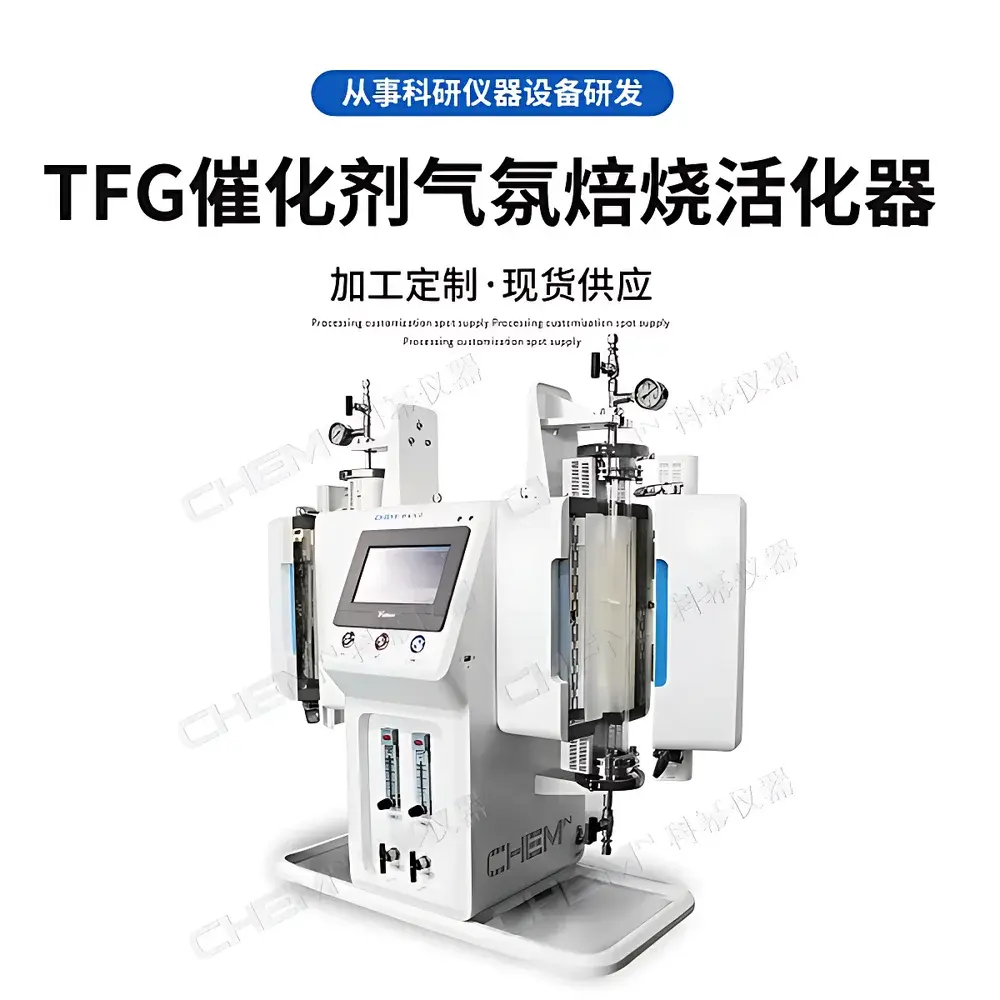
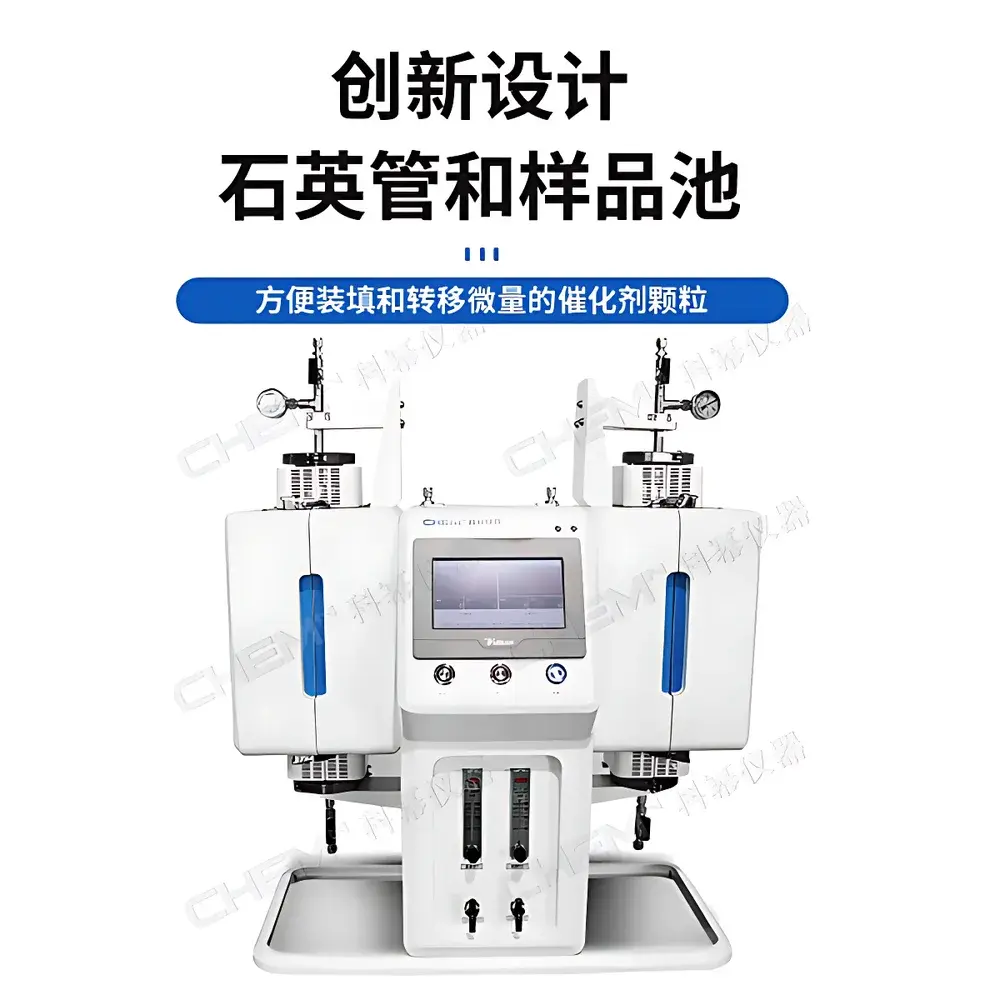
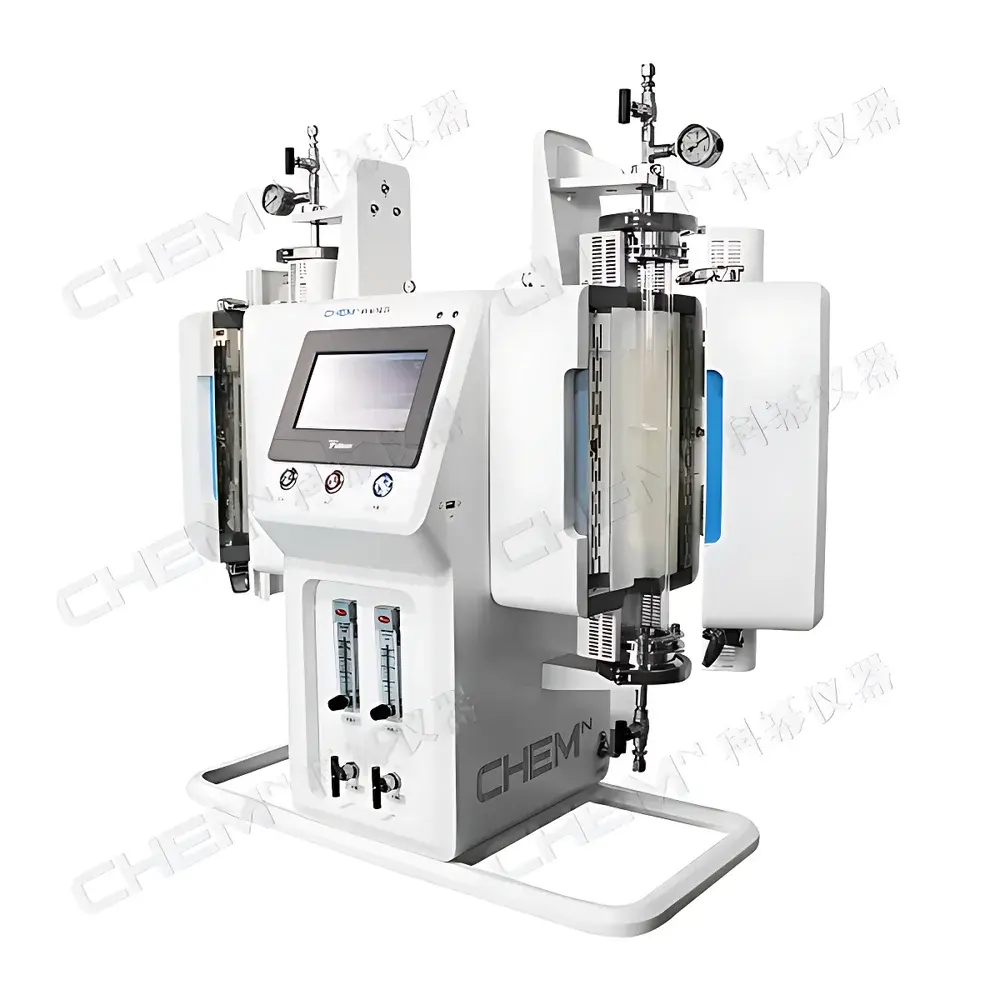
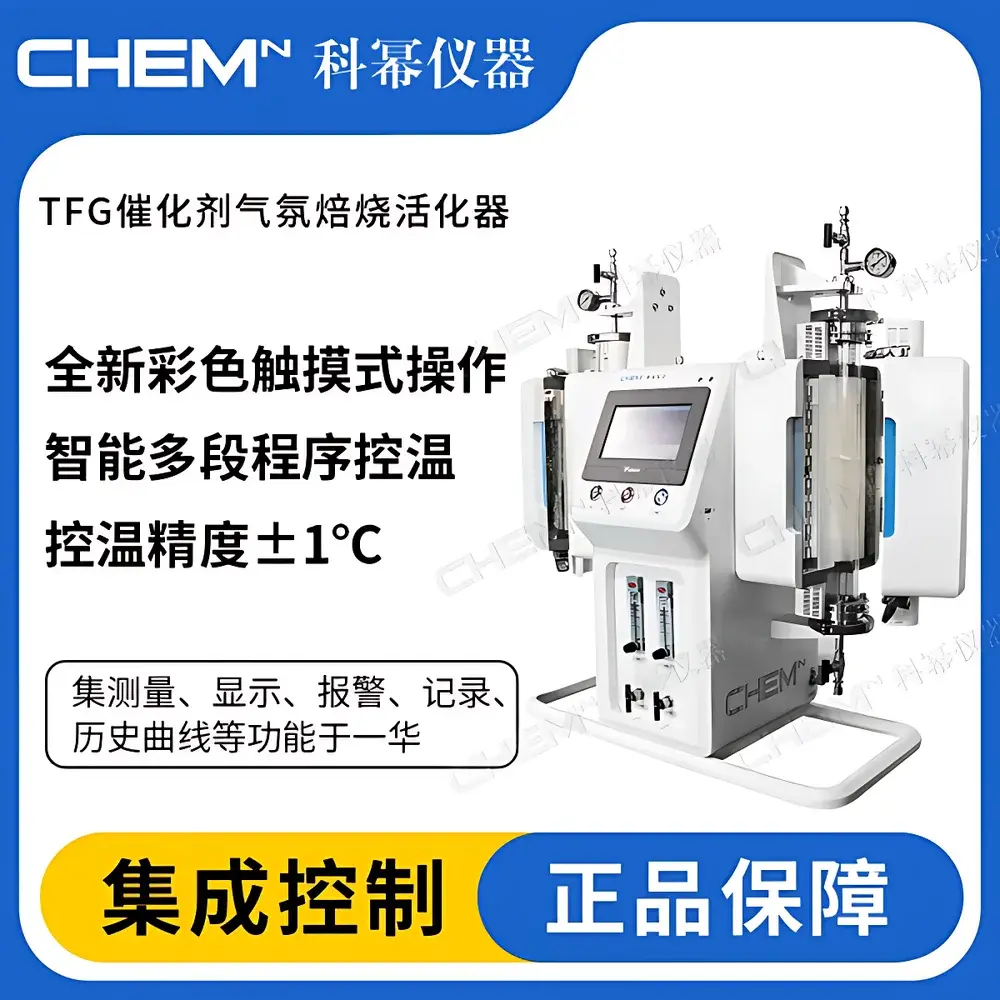
Chemn TFG-1200-50-220 Catalytic Atmosphere Calcination & Activation Furnace
| Brand | Chemn |
|---|---|
| Origin | Anhui, China |
| Model | TFG-1200-50-220 |
| Instrument Type | Vertical Tube Furnace |
| Max. Temperature | 1100 °C |
| Temperature Control Accuracy | ±1 °C |
| Max. Power | 2.0 kW |
| Heating Rate (to Max Temp) | ≤10 °C/min |
| Heating Method | Resistance Wire |
| Internal Chamber Dimensions | 660 × 320 × 580 mm |
| Tube Diameter | 30 mm |
| Sample Boat Capacity | 10 mL (customizable) |
| Heating Zone Length | 220 mm |
| Mass Flow Range (Rotameter) | 30–200 mL/min (customizable) |
| Control System | Dual-Channel Intelligent Programmable Controller with Color Touchscreen |
| Power Supply | AC 220 V, 50/60 Hz |
| Weight | 35 kg |
Overview
The Chemn TFG-1200-50-220 Catalytic Atmosphere Calcination & Activation Furnace is a vertically oriented, programmable tube furnace engineered specifically for controlled thermal treatment of heterogeneous catalysts under defined gas atmospheres. Unlike conventional muffle furnaces or horizontal tube systems, this instrument integrates a precisely dimensioned quartz reaction tube (30 mm ID), a dedicated low-volume ceramic or quartz sample boat (standard 10 mL capacity), and an integrated dual-channel control architecture to ensure uniform thermal exposure and consistent gas residence time across the entire catalyst bed. Its design addresses critical process limitations in catalyst R&D—including thermal gradient-induced heterogeneity, poor gas-solid contact efficiency, particle entrainment during heating, condensate accumulation, and inter-batch reproducibility—by enabling stable, laminar gas flow through a narrow, vertically aligned reaction zone where temperature uniformity is maintained within ±1 °C over the 220 mm active heating length. The furnace operates on resistive heating via high-stability Kanthal A1 wire elements and is rated for continuous use up to 1100 °C.
Key Features
- Vertical orientation with gravity-assisted sample loading and minimal powder dispersion risk during insertion/removal
- Optimized 30 mm ID fused quartz tube with high thermal shock resistance and inert surface, minimizing catalytic residue adhesion and simplifying post-run cleaning
- Dual-channel intelligent controller featuring color touchscreen interface, multi-segment ramp-soak programming, real-time temperature/flow monitoring, and built-in data logging with timestamped curve export (CSV)
- Integrated Super OMEGACLAD™ XL thermocouple (Type K) with documented long-term drift stability: <2.8 °C deviation over 25 weeks—validated per ASTM E230/E230M calibration traceability protocols
- Dwyer RATE-MASTER rotameter with monolithic fluid guide rod and polycarbonate shield, delivering repeatable mass flow control (30–200 mL/min range) under N₂, Ar, H₂, NH₃, or air-based atmospheres
- Compact footprint (660 × 320 × 580 mm) suitable for standard fume hood integration or benchtop deployment in QC/QA and catalysis laboratories
- Compliance-ready architecture: audit trail support, password-protected parameter editing, and configurable alarm thresholds align with GLP/GMP documentation requirements
Sample Compatibility & Compliance
The TFG-1200-50-220 accommodates powdered, pelleted, or extruded catalyst samples ranging from 0.1 mL to 10 mL in volume, with optimal performance observed for particles sized 20–500 µm. Its vertical configuration ensures even settling and eliminates stratification effects common in horizontal tubes. Quartz tube compatibility extends to oxidative (air/O₂), reductive (H₂/N₂ mixtures), and inert (Ar, He) environments up to 1100 °C. All wetted components meet USP Class VI biocompatibility standards; the furnace enclosure conforms to IEC 61010-1:2010 for laboratory electrical safety. Optional accessories include quartz wool plugs, gas inlet/outlet adapters with Swagelok® fittings, and vacuum-rated flanges for low-pressure activation protocols.
Software & Data Management
The embedded controller supports up to 32 programmable temperature segments with independent ramp rates, soak times, and gas flow setpoints per segment. Real-time data—including furnace zone temperature, thermocouple reference junction temperature, and rotameter output—is recorded at user-selectable intervals (1–60 s) and stored internally for ≥30 days. Export functionality enables direct CSV transfer via USB port for post-processing in MATLAB®, Python (pandas), or LIMS platforms. Firmware supports optional RS485 Modbus RTU communication for integration into centralized lab automation systems. Audit logs record operator ID, parameter changes, alarm events, and system startup/shutdown cycles—fully compliant with FDA 21 CFR Part 11 requirements when paired with validated electronic signature modules.
Applications
- Thermal decomposition of metal-organic frameworks (MOFs) and layered double hydroxides (LDHs) under controlled O₂ partial pressure
- Reductive activation of Ni/Al₂O₃, Co/Mo/Al₂O₃, and Pt/C catalysts using dilute H₂/N₂ mixtures
- Calcination of sol-gel-derived TiO₂, CeO₂, and ZrO₂ precursors under flowing air
- Pre-sulfidation of hydrotreating catalysts via H₂S/N₂ co-flow
- Stability testing of supported catalysts under cyclic oxidation-reduction conditions
- Method development for ASTM D7213 (catalyst thermal aging) and ISO 11348 (heterogeneous catalyst characterization)
FAQ
What is the maximum recommended operating temperature for continuous use?
The furnace is rated for continuous operation at 1100 °C. Prolonged exposure above this temperature may accelerate heating element degradation and compromise thermocouple accuracy.
Can the sample boat be customized for larger volumes or alternative materials?
Yes—quartz, alumina, and silicon carbide boats are available in capacities from 5 mL to 50 mL; custom geometries (e.g., perforated trays, multi-well inserts) can be fabricated upon request with lead-time confirmation.
Is the system compatible with vacuum or negative pressure operation?
The standard configuration supports atmospheric and positive-pressure gas flow only. Vacuum-compatible variants (with reinforced flanges and vacuum-rated seals) are available as TFG-VAC options.
How is temperature uniformity verified across the heating zone?
Uniformity is characterized per ASTM E220 using a calibrated 5-point thermocouple array; typical axial uniformity is ±3 °C over the central 150 mm of the 220 mm heating zone at 900 °C.
Does the controller support remote monitoring via Ethernet or Wi-Fi?
The base model includes USB and RS485 interfaces. Ethernet/Wi-Fi connectivity requires the optional Chemn Connect Module (CCM-ETH), which enables secure HTTP/HTTPS access and SNMP-based system health reporting.



