
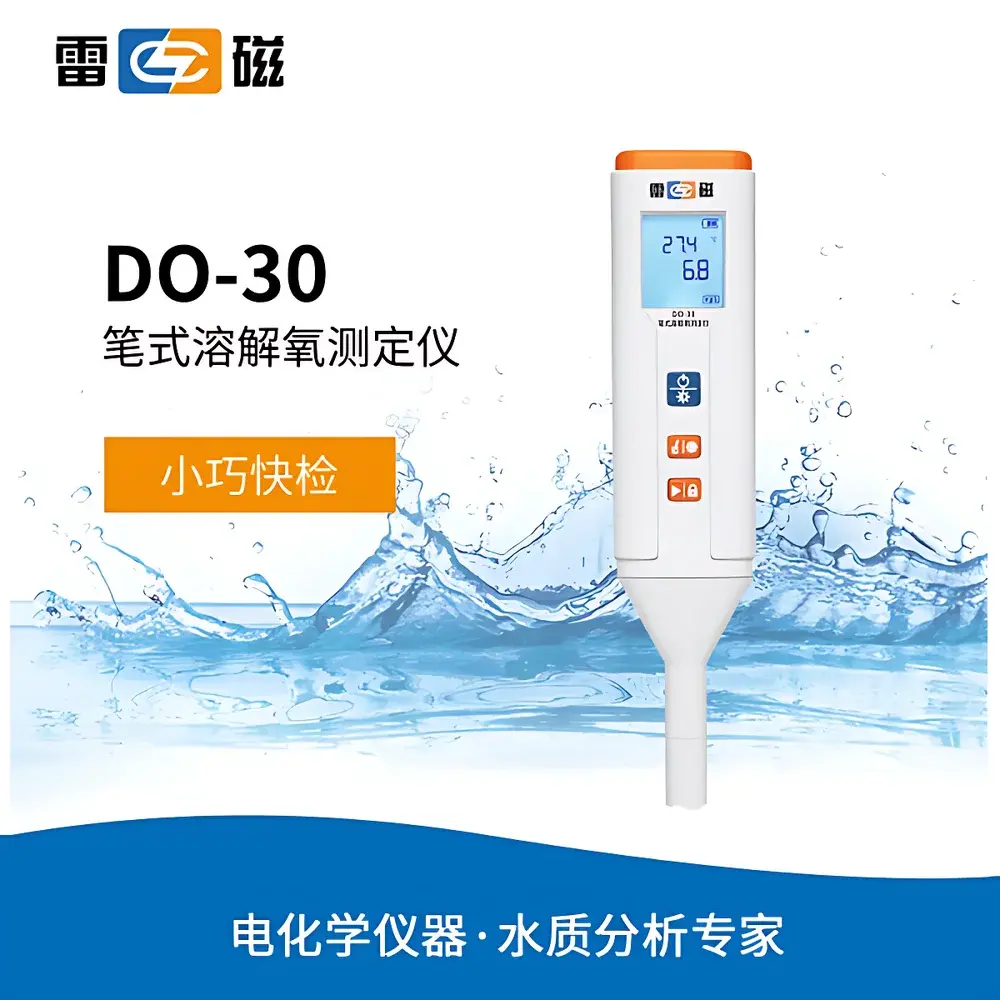
Leichi DO-30 Portable Dissolved Oxygen Pen Meter
| Brand | Leichi |
|---|---|
| Origin | Shanghai, China |
| Manufacturer Type | Direct Manufacturer |
| Country of Origin | China |
| Model | DO-30 |
| Instrument Type | Portable |
| Measurement Principle | Electrochemical (Clark-type Polarographic Sensor) |
| Dissolved Oxygen Range | 0.0–20.0 mg/L |
| Resolution | 0.1 mg/L |
| Accuracy | ±0.3 mg/L |
| Repeatability | ≤0.2 mg/L |
| Temperature Range | 0.0–60.0 °C |
| Temp. Resolution | 0.1 °C |
| Temp. Accuracy | ±0.3 °C |
| Auto Temperature Compensation | Yes (0–50.0 °C) |
| IP Rating | IP67 |
| Power | 4 × AAA batteries |
| Battery Life | >200 h |
| Dimensions | 40 × 30 × 188 mm |
| Weight | ~0.15 kg |
| Enclosure Material | ABS |
Overview
The Leichi DO-30 Portable Dissolved Oxygen Pen Meter is an engineered field-deployable instrument designed for rapid, reliable measurement of dissolved oxygen (DO) concentration in aqueous environments using the Clark-type polarographic electrochemical principle. This method relies on a diffusion-limited oxygen reduction reaction at a noble metal cathode (typically gold or platinum), separated from the sample by a gas-permeable membrane and electrolyte gel—ensuring stable zero-current polarization and high signal-to-noise ratio. The DO-30 integrates a temperature-compensated sensor module with real-time automatic compensation across 0–50.0 °C, enabling accurate DO quantification in natural waters, wastewater effluents, aquaculture systems, and process streams where ambient thermal variability is common. Its pen-form factor, combined with robust ABS housing and IP67 ingress protection, supports operation in humid, dusty, or splash-prone conditions typical of environmental sampling sites, municipal treatment plants, and educational field labs.
Key Features
- High-contrast LCD display with user-selectable temperature units (°C or °F)
- Dual-point calibration capability: zero-oxygen (via sodium sulfite solution) and full-scale saturation (air-saturated water or Winkler-standard reference)
- Auto-hold and manual hold functions for stable reading capture in turbulent or low-flow conditions
- Adjustable auto-power-off timer (1–60 minutes) to optimize battery longevity
- Backlight intensity control for low-light field use; battery-level indicator integrated into status bar
- Modular sensor tip design: replaceable electrode/membrane assembly extends service life and reduces total cost of ownership
- Factory-calibrated sensor with traceable documentation; calibration verification supported via NIST-traceable standards
- Compact ergonomic form factor (40 × 30 × 188 mm; ~150 g) with integrated wrist strap and rugged carry case for transport and storage
Sample Compatibility & Compliance
The DO-30 is validated for use with freshwater, seawater (with salinity compensation applied manually per ASTM D888-22 Annex A1), wastewater, and nutrient-rich biological media. It complies with fundamental performance criteria outlined in ISO 5814:2012 (Water quality — Determination of dissolved oxygen — Electrochemical probe method) and aligns with QA/QC expectations for field instruments under EPA Method 360.1 and APHA Standard Methods 4500-O G. While not certified for GLP or 21 CFR Part 11 compliance due to its standalone analog architecture, it supports audit-ready documentation when paired with external logbooks or LIMS-integrated data capture workflows. The IP67 rating ensures operational integrity during rain exposure, accidental submersion up to 1 m for 30 min, and dust-laden sampling environments.
Software & Data Management
The DO-30 operates as a self-contained, microprocessor-controlled meter with no onboard memory or USB/Bluetooth connectivity. All measurements are displayed in real time and intended for immediate transcription or manual logging. For regulated applications requiring electronic records, users may pair the device with third-party mobile apps (e.g., LabArchives Field Log, Agilent MobileLab) via manual entry or barcode-assisted annotation. Calibration history—including date, operator ID, standard used, and deviation values—is maintained externally per laboratory SOPs. Firmware is non-upgradable, consistent with IEC 61000-6-2/6-3 immunity requirements for portable instrumentation in electromagnetically noisy field settings.
Applications
- Routine monitoring of DO levels in rivers, lakes, reservoirs, and estuaries per national water quality assessment protocols
- Verification of aeration efficiency in activated sludge basins and oxidation ditches
- Quality assurance during fish hatchery operations and recirculating aquaculture system (RAS) management
- Educational demonstrations of oxygen solubility dependence on temperature, salinity, and atmospheric pressure
- Pre-screening of industrial discharge compliance prior to lab-based Winkler titration confirmation
- Emergency response field testing following algal bloom events or chemical spills affecting aerobic biota
FAQ
What calibration standards are required for routine operation?
Zero-oxygen calibration uses freshly prepared 2% sodium sulfite (Na₂SO₃) solution; full-scale calibration employs air-saturated distilled water equilibrated at ambient pressure and temperature. Both procedures follow ISO 5814 Section 8.
Does the DO-30 support salinity compensation?
No—salinity correction must be applied manually using published oxygen solubility tables (e.g., APHA Table 4500-O G-2) or external calculators. The instrument measures partial pressure-based DO only.
Can the sensor be used in viscous or suspended-solid-laden samples?
Yes—its polarographic design tolerates moderate turbidity and biofilm accumulation. However, membrane fouling requires periodic cleaning with mild detergent and replacement every 6–12 months depending on usage frequency and matrix aggressiveness.
Is the battery compartment sealed to maintain IP67 rating?
Yes—the O-ring-sealed AAA battery door retains full IP67 compliance when properly closed and torqued per manufacturer specifications.
How is temperature accuracy verified independently?
Users may cross-check against a NIST-traceable digital thermometer immersed in the same sample; the DO-30’s ±0.3 °C specification applies across its full 0.0–60.0 °C operating range per ISO 7888:1999 Annex B validation protocol.
Related Products







