
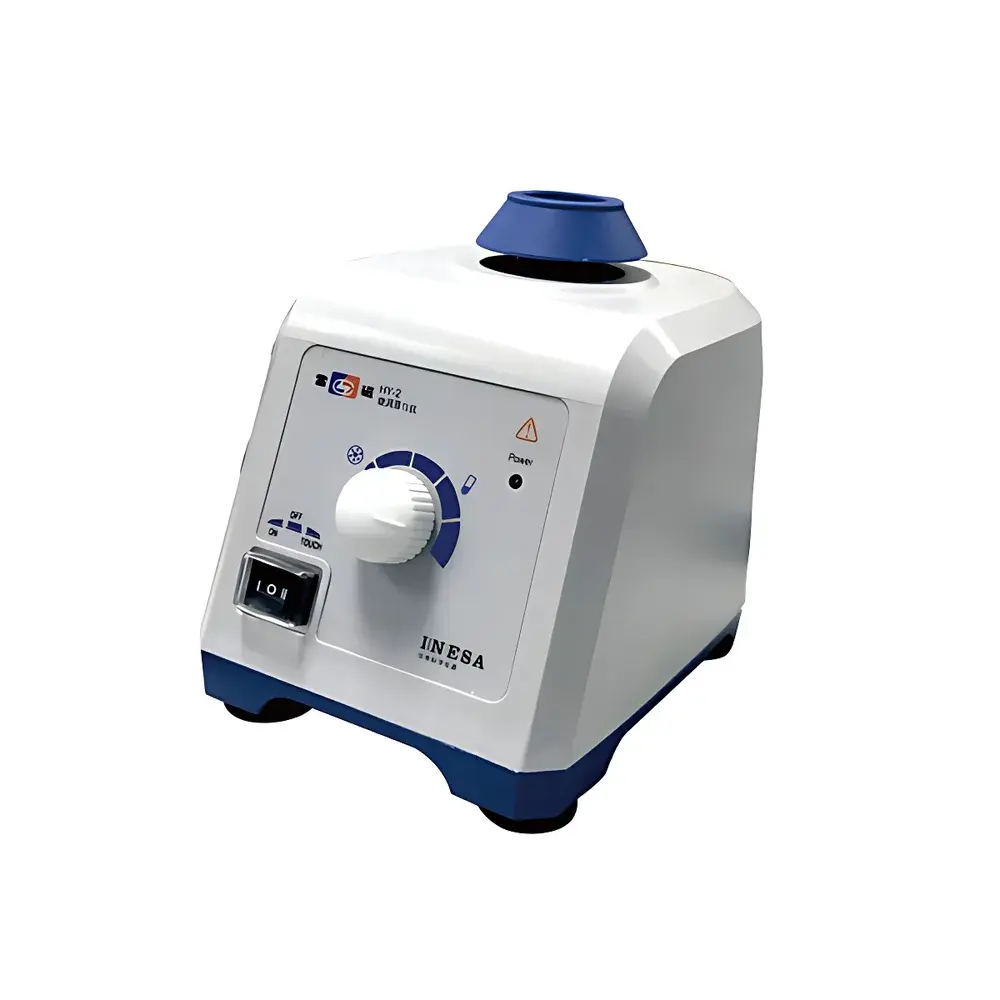
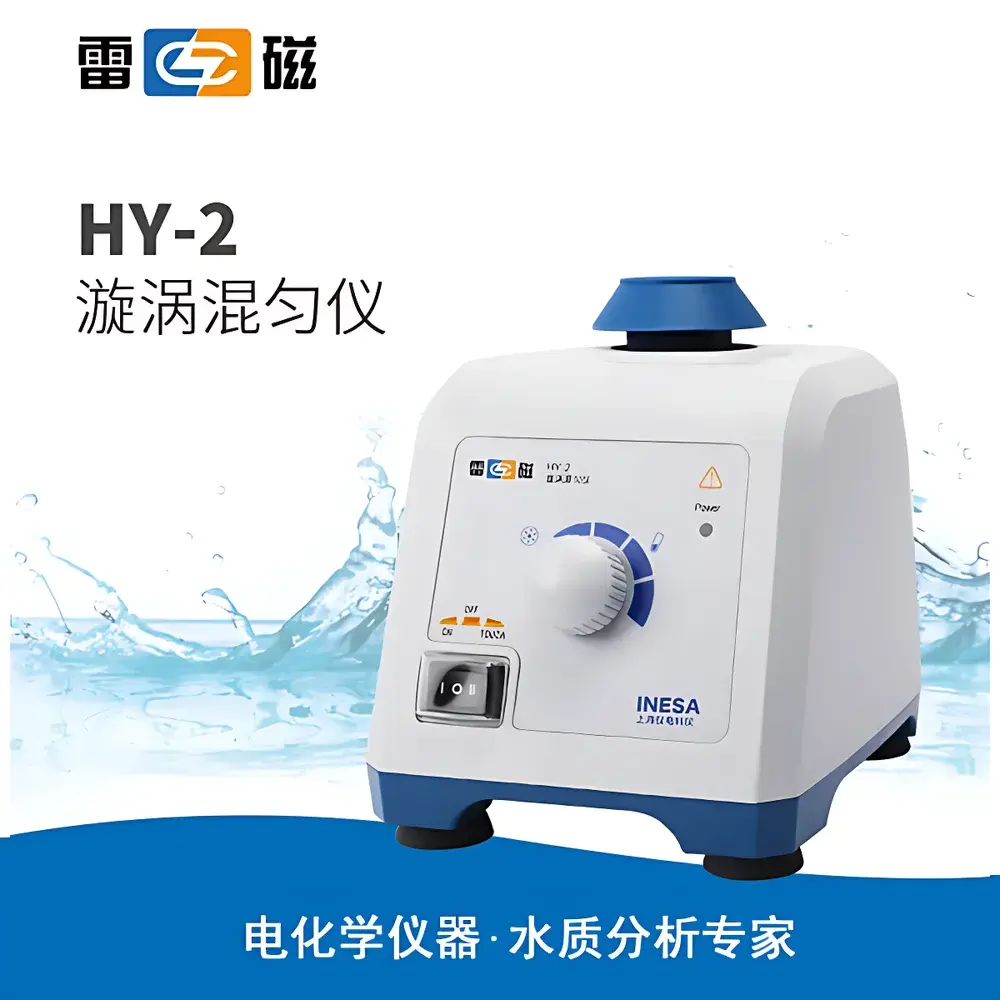
Leici HY-2 Vortex Mixer
| Brand | Leici |
|---|---|
| Origin | Shanghai, China |
| Manufacturer Type | Direct Manufacturer |
| Origin Category | Domestic (China) |
| Model | HY-2 |
| Price | ¥980 |
| Speed Control | Touch-Start & Continuous Operation |
| Operating Mode | Touch-Start & Continuous Operation |
| Oscillation Type | Circular Orbit (Planar) |
| Housing Material | Flame-Retardant ABS |
| Amplitude | 4.5 mm / 6 mm |
| Speed Indication | Analog Dial Scale |
| Speed Range | 0–2800 rpm |
| Voltage | 100–120 VAC / 200–240 VAC (Optional) |
| Power | 60 W |
| Frequency | 50/60 Hz |
| Motor Type | Shaded-Pole Motor |
| Orbit Diameter | 4 mm |
| Dimensions (L×W×H) | 170 × 120 × 140 mm |
Overview
The Leici HY-2 Vortex Mixer is a compact, benchtop orbital shaker engineered for rapid and reproducible homogenization of small-volume samples in research, quality control, and routine laboratory workflows. It operates on the principle of circular orbital motion—generating controlled centrifugal force through a rotating eccentric drive mechanism—to induce vigorous vortex formation in tubes and vials. This mechanical agitation ensures efficient mixing of liquids, liquid–solid suspensions, and fine dry powders without requiring magnetic stir bars or external coupling devices. Designed for reliability under continuous use, the HY-2 features a flame-retardant ABS housing, low-vibration mechanical architecture, and a shaded-pole induction motor optimized for stable torque delivery across its full 0–2800 rpm speed range. Its planar circular oscillation (4 mm orbit diameter) delivers consistent energy transfer with minimal sample splashing or tube ejection risk—critical for handling volatile reagents, biological lysates, or viscous buffers.
Key Features
- Two-mode operation: Instant touch-start activation for momentary mixing and selectable continuous-run mode for extended homogenization protocols.
- Stepless analog speed control via rotary dial (0–2800 rpm), enabling precise adjustment to match viscosity, container size, and suspension stability requirements.
- Compact footprint (170 × 120 × 140 mm) and ergonomic profile facilitate integration into crowded fume hoods, biosafety cabinets, or modular lab benches.
- Flame-retardant ABS construction meets standard electrical safety requirements for Class I laboratory environments; no metal housing corrosion concerns in humid or chemically exposed settings.
- Low-noise motor design (<55 dB at 2800 rpm) supports use in shared analytical spaces without acoustic interference to adjacent instrumentation (e.g., balances, spectrophotometers).
- Interchangeable cup adapters—including universal rubber cup, microcentrifuge tube holders (0.2–2.0 mL), and conical tube inserts—allow seamless transition between sample formats without tooling.
Sample Compatibility & Compliance
The HY-2 accommodates standard laboratory containers including Eppendorf-style microtubes (0.2–2.0 mL), 15 mL and 50 mL conical centrifuge tubes, culture flasks (up to 250 mL), and glass vials with flat-bottomed bases. Its 4.5 mm / 6 mm dual-amplitude setting enables optimization for either gentle resuspension (low amplitude) or aggressive dispersion of aggregated particles (high amplitude). While not certified to ISO/IEC 17025 or GLP-specific validation templates, the device complies with general electrical safety standards per GB 4793.1–2007 (equivalent to IEC 61010-1) for laboratory equipment. Its analog control interface and absence of digital firmware exempt it from FDA 21 CFR Part 11 requirements—making it suitable for non-GxP environments such as academic teaching labs, environmental field stations, and preliminary R&D screening.
Software & Data Management
The HY-2 is a standalone electromechanical instrument with no embedded microprocessor, network interface, or data logging capability. Speed is indicated via calibrated analog dial scale—providing immediate visual feedback without reliance on software calibration or firmware updates. This architecture eliminates cybersecurity vulnerabilities, reduces maintenance overhead, and ensures operational continuity during power fluctuations or IT infrastructure outages. For laboratories requiring audit-trail documentation, manual recording of operating parameters (speed, duration, mode) into bound lab notebooks or LIMS-integrated electronic records remains the recommended practice. No driver installation, cloud connectivity, or proprietary software is required for commissioning or daily use.
Applications
- Routine sample preparation prior to HPLC, GC, or spectrophotometric analysis—ensuring uniform analyte distribution in extraction solvents or dilution matrices.
- Cell lysis buffer equilibration and reagent reconstitution in molecular biology workflows (e.g., PCR master mix assembly, restriction enzyme digestion setup).
- Homogenization of soil/water extracts in environmental monitoring programs compliant with EPA Method 3510C (vortex-assisted liquid–liquid extraction).
- Dispersion of nanoparticle suspensions, catalyst powders, or pharmaceutical excipients during formulation development.
- Quality assurance checks in food testing labs—mixing of homogenized tissue digests or fortified standard solutions prior to heavy metal quantification by ICP-MS.
FAQ
Is the HY-2 compatible with international voltage standards?
Yes—dual-voltage configuration (100–120 VAC / 200–240 VAC) supports global deployment; verify correct input selection before powering on.
Does the mixer include tube adapters?
The base unit ships with a universal rubber cup adapter; optional accessories include microtube holders and conical tube platforms (sold separately).
Can the HY-2 be used for cell culture applications?
It is suitable for non-sterile pre-culture mixing steps (e.g., media reconstitution); however, it is not autoclavable or designed for use inside laminar flow hoods without additional containment.
What maintenance is required?
No scheduled lubrication or calibration is needed; periodic cleaning of the cup surface with 70% ethanol and inspection of motor mounting screws every 6 months is recommended.
Is speed accuracy traceable to national standards?
Speed indication is factory-calibrated against mechanical tachometer reference; formal metrological traceability requires third-party verification using an optical tachometer.



