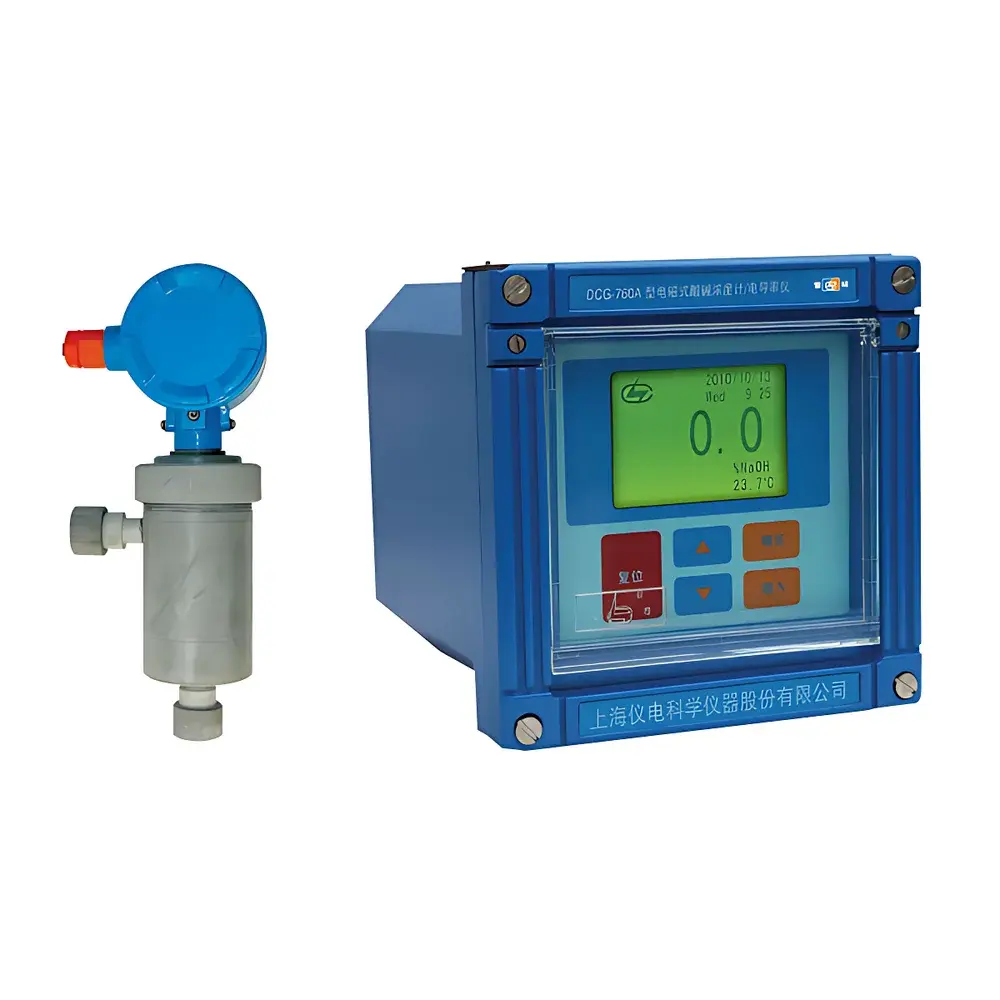
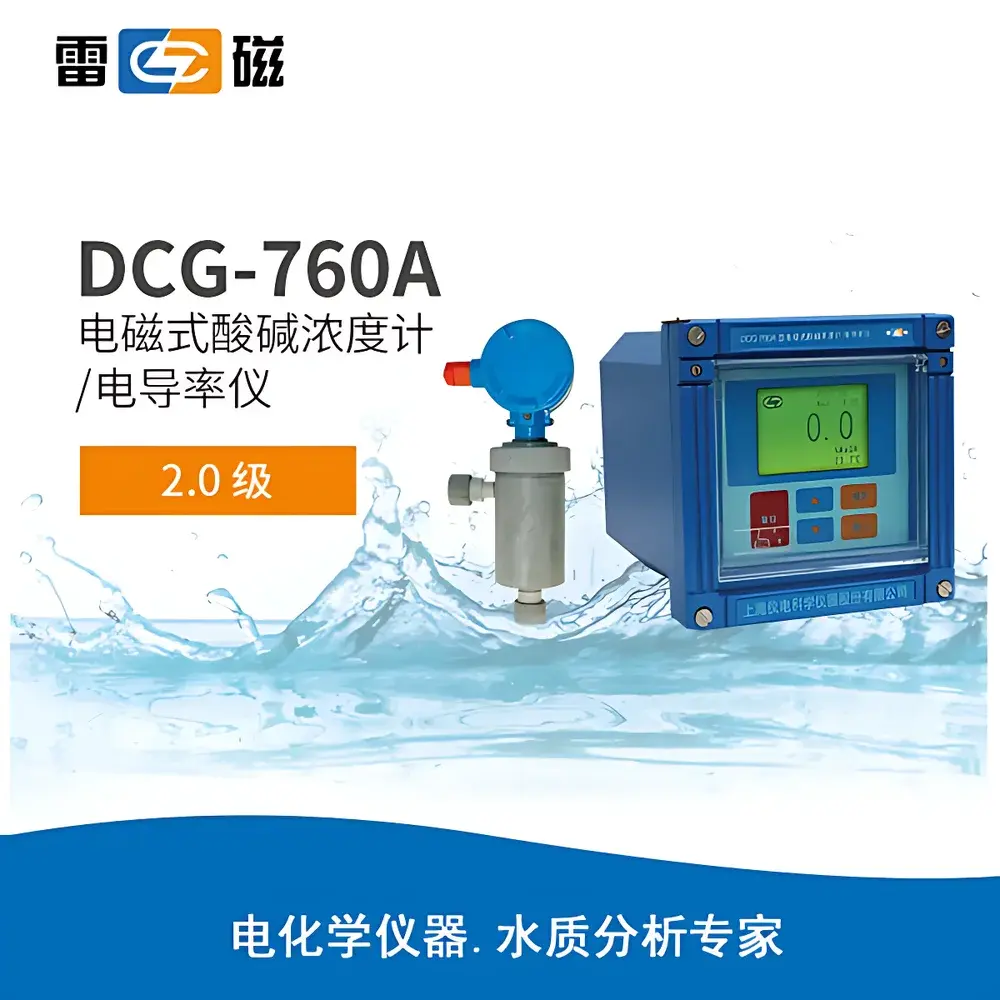
Leichi DCG-760A Electromagnetic Acid/Alkali Concentration Meter & Online Conductivity Analyzer
| Brand | Leichi |
|---|---|
| Origin | Shanghai, China |
| Manufacturer Type | Direct Manufacturer |
| Country of Origin | China |
| Model | DCG-760A |
| Price Range | USD 850–1,420 (FOB) |
| Conductivity Range | 0–1000 mS/cm |
| Temperature Range | −10.0 to 120.0 °C |
| Basic Instrument Error | ±2.0% FS (Conductivity), ±0.3% HCl/NaOH (Concentration), ±0.5 °C (Temp, 0–60 °C) |
| Dimensions | 144 × 144 × 160 mm |
| Weight | ~2 kg |
| IP Rating | IP65 |
| Output | Isolated 4–20 mA DC (configurable span) |
| Temp Compensation | Automatic, 5.0–45.0 °C (ref. 25.0 °C) |
| Resolution | 0.1% (conc.), 0.1/1 mS/cm (cond.), 0.1 °C (temp) |
| Repeatability | ±0.1% HCl/NaOH |
| Drift Stability | ±0.1%/24h (conc.), ±0.5% FS/24h (cond.) |
Overview
The Leichi DCG-760A is an industrial-grade electromagnetic acid/alkali concentration meter and online conductivity analyzer engineered for continuous, maintenance-free monitoring in demanding process environments. Unlike contact-type conductivity sensors—prone to electrode polarization, fouling, and calibration drift—the DCG-760A employs a non-invasive electromagnetic induction principle (based on Faraday’s law of electromagnetic induction) to measure the conductance of flowing electrolyte solutions. This architecture eliminates electrode degradation and enables stable, high-reproducibility measurement across highly conductive media—including concentrated hydrochloric acid (HCl) and sodium hydroxide (NaOH) solutions—without signal saturation or surface passivation. Designed specifically for integration into closed-loop control systems, the analyzer delivers real-time, temperature-compensated conductivity and derived concentration values with traceable metrological performance compliant with ISO/IEC 17025-aligned verification practices.
Key Features
- Non-contact electromagnetic sensing technology—no electrodes, zero polarization, no chemical corrosion or scaling-related drift
- Dual-mode operation: simultaneous or selectable measurement of conductivity (0–1000 mS/cm across four programmable ranges) and derived concentration (0–10.0% w/w HCl or NaOH)
- Integrated Pt1000 RTD temperature sensor with automatic compensation (5.0–45.0 °C, referenced to 25.0 °C) and extended measurement range (−10.0 to 120.0 °C)
- High-resolution graphical LCD display showing concurrent conductivity/concentration and temperature readings with intuitive menu navigation
- Microprocessor-based electronics with embedded linearization algorithms for HCl/NaOH-specific concentration curves per IEC 60788 and ASTM D1125 guidelines
- Isolated 4–20 mA analog output with fully configurable upper/lower limits and zero/span adjustment for PLC/DCS interfacing
- Programmable alarm thresholds with relay outputs for high/low limit violation and sensor fault detection
- Robust IP65-rated enclosure (144 × 144 × 160 mm, ~2 kg) suitable for wall or panel mounting in humid, dusty, or splash-prone industrial zones
- Power supply: 220 V AC ±10%, 50 Hz ±1%; includes built-in surge suppression and brownout protection
Sample Compatibility & Compliance
The DCG-760A is validated for use with aqueous solutions of strong electrolytes where conductivity correlates predictably with concentration—primarily HCl and NaOH in industrial cleaning, regeneration, neutralization, and dosing applications. It is compatible with standard sanitary or flanged piping configurations via the optional DCGF-100A electromagnetic flow-through transmitter (sold separately), which features PTFE-lined stainless steel body and 316L wetted parts. The analyzer meets CE marking requirements for electromagnetic compatibility (EN 61326-1) and low-voltage safety (EN 61010-1). Its measurement methodology supports audit-ready documentation per FDA 21 CFR Part 11 when integrated with compliant data logging systems. While not certified for SIL-rated safety loops, its reliability profile aligns with IEC 61508 functional safety principles for Category B equipment in non-critical process monitoring.
Software & Data Management
The DCG-760A operates as a standalone field instrument with no external software dependency. All configuration—including range selection, temperature compensation parameters, alarm setpoints, and 4–20 mA output mapping—is performed locally via membrane keypad and LCD interface. Configuration changes are retained through power cycles due to non-volatile EEPROM storage. For centralized data acquisition, the isolated 4–20 mA output interfaces directly with PLCs, SCADA systems, or third-party data historians (e.g., Ignition, Siemens Desigo, or Wonderware). Optional RS-485 Modbus RTU communication (available via firmware upgrade kit) enables remote parameter read/write and real-time diagnostics—including sensor health status, temperature deviation alerts, and calibration history flags—supporting preventive maintenance planning under ISO 55001 asset management frameworks.
Applications
- Power generation: Continuous monitoring of condensate polishing resin regeneration rinse conductivity and acid/alkali dosing control in feedwater treatment
- Petrochemical refining: In-line verification of caustic wash concentration in desalter units and amine system lean/rich solution conductivity tracking
- Pharmaceutical water systems: USP Water for Injection (WFI) and Purified Water (PW) conductivity surveillance at distribution loop points (per USP and EU Annex 1)
- Chemical manufacturing: Real-time titration endpoint detection in batch neutralization reactors and scrubber liquor concentration control
- Municipal wastewater: Monitoring of brine concentration in electrochlorination cells and membrane cleaning solution strength verification
- Food & beverage: Sanitizer (e.g., peracetic acid + H2O2) concentration validation during CIP cycles
FAQ
What concentration ranges does the DCG-760A support for HCl and NaOH?
The analyzer measures 0–10.0% w/w HCl and 0–10.0% w/w NaOH, with 0.1% resolution and ±0.3% FS basic error under calibrated conditions.
Can the DCG-760A be used with non-aqueous or mixed-solvent systems?
No. It is validated exclusively for aqueous HCl and NaOH solutions where conductivity–concentration linearity is well characterized. Non-aqueous solvents or organic blends invalidate the built-in calibration curves.
Does the instrument require periodic calibration with standard solutions?
Yes. While electromagnetic sensors do not polarize, factory calibration must be verified annually using NIST-traceable KCl standards (e.g., 1413 µS/cm and 12.88 mS/cm) and certified HCl/NaOH reference solutions per ASTM D1125 Annex A1.
Is temperature compensation mandatory for accurate concentration output?
Yes. Concentration calculation relies on temperature-compensated conductivity input. The unit applies automatic compensation within 5.0–45.0 °C; outside this band, manual correction or external PT100 input is required.
What is the maximum process pressure rating for the DCGF-100A transmitter?
The DCGF-100A is rated for 1.0 MPa (10 bar) at 20 °C; derating applies above 60 °C per ASME B16.5 Class 150 flange specifications.
Related Products