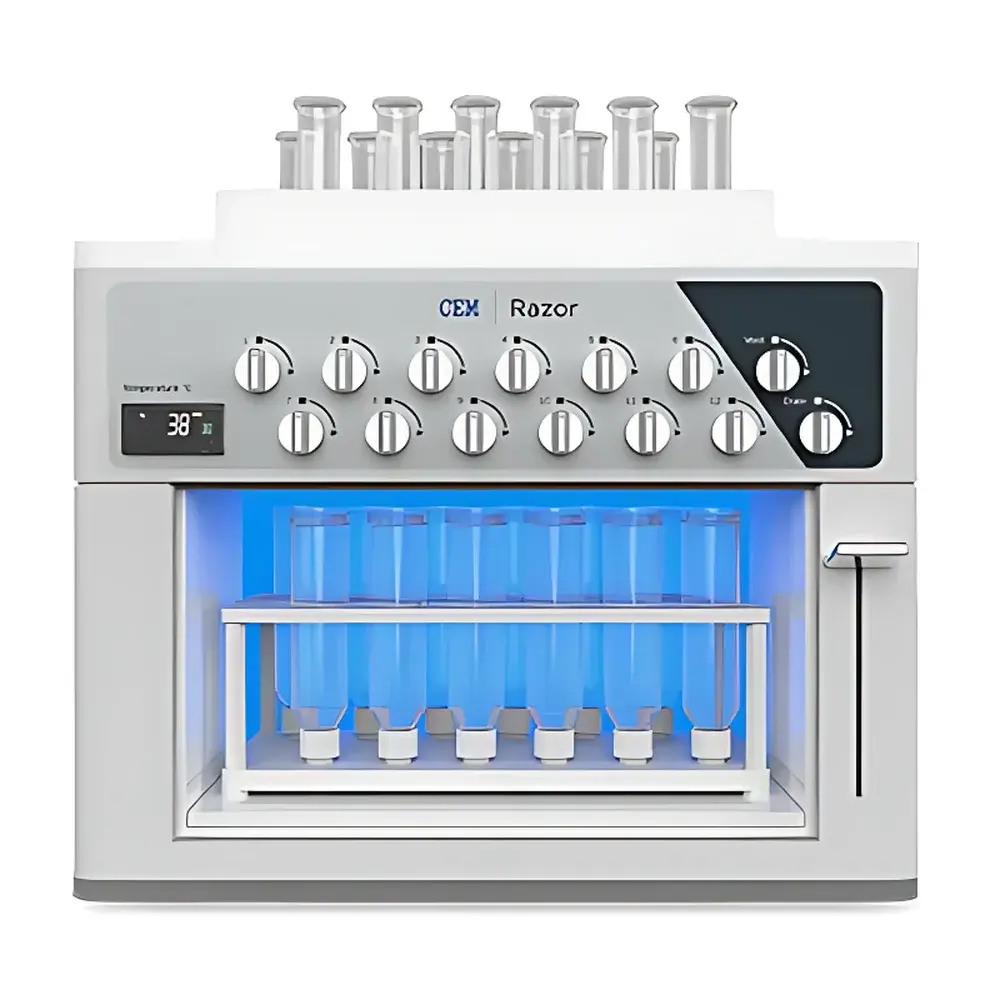
CEM RAZOR High-Throughput Peptide Cleavage System
| Brand | CEM |
|---|---|
| Origin | USA |
| Manufacturer Status | Authorized Distributor |
| Origin Category | Imported |
| Model | RAZOR |
| Amino Acid Addition | Automated |
| Reagent Addition | Automated |
| Operator Authentication | Password + Facial Recognition |
| Audit Trail | Yes |
Overview
The CEM RAZOR High-Throughput Peptide Cleavage System is an engineered thermal cleavage platform designed for post-synthesis deprotection of resin-bound peptides under controlled, reproducible acidic conditions. Unlike conventional room-temperature cleavage protocols relying on extended incubation (e.g., 2–4 hours in TFA-based cocktails), the RAZOR system applies precise, uniform conductive heating to accelerate acidolysis kinetics while maintaining strict thermal homogeneity across all reaction vessels. It operates on the principle of thermally enhanced nucleophilic displacement—where elevated temperature (up to 38 °C, adjustable in 0.1 °C increments) lowers the activation energy barrier for tert-butyloxycarbonyl (Boc) and 9-fluorenylmethyloxycarbonyl (Fmoc) side-chain protecting group removal, without inducing backbone degradation or tertiary structure scrambling. This enables complete, stoichiometric cleavage within 30 minutes for up to 12 parallel samples—significantly reducing exposure time to corrosive reagents such as trifluoroacetic acid (TFA), triisopropylsilane (TIS), water, and 1,2-ethanedithiol (EDT) or dithiothreitol (DTT). The system is purpose-built for integration into GMP-compliant peptide manufacturing workflows and academic high-throughput screening pipelines where speed, traceability, and batch-to-batch consistency are non-negotiable.
Key Features
- Parallel processing capacity: Simultaneous cleavage of up to 12 individual resin-bound peptides in standardized 2–10 mL reaction vials.
- Precision thermal control: PID-regulated heating block with ±0.3 °C accuracy and <1 °C inter-vial temperature deviation across the full array.
- Automated reagent handling: Integrated peristaltic pumps and solenoid valves deliver pre-programmed cleavage cocktails with volumetric accuracy ±2% CV.
- Operator authentication layer: Dual-factor identity verification via encrypted password entry and ISO/IEC 30107-1 compliant facial recognition—ensuring role-based access and ALCOA+ compliance.
- Corrosion-resistant architecture: All wetted parts constructed from PTFE-lined 316L stainless steel and chemically inert fluoropolymer seals; no brass, aluminum, or elastomer components exposed to TFA vapor.
- Minimal maintenance design: No high-pressure manifolds, pneumatic actuators, or disposable fluidic cartridges—routine upkeep limited to heater block calibration and optical sensor cleaning.
Sample Compatibility & Compliance
The RAZOR system accommodates standard solid-phase peptide synthesis (SPPS) resins—including Wang, Rink amide, 2-chlorotrityl chloride (2-CTC), and Sieber amide supports—in particle sizes ranging from 100–300 µm. It supports cleavage cocktails containing TFA (≥85%), scavengers (TIS, EDT, phenol, anisole), and water at defined ratios (e.g., 92.5:2.5:2.5:2.5 v/v). Instrument firmware conforms to FDA 21 CFR Part 11 requirements for electronic records and signatures, including immutable audit trail logging of all user actions, parameter changes, run start/stop timestamps, and hardware status events. Full GLP/GMP documentation packages—including IQ/OQ/PQ protocols, calibration certificates, and raw data export in .csv and .txt formats—are available upon request. The system meets ISO 13485:2016 design control provisions for in vitro diagnostic (IVD) ancillary equipment and aligns with ASTM E2500-13 guidance for science-based equipment qualification.
Software & Data Management
The embedded touchscreen interface runs CEM’s proprietary CleavageSuite™ v3.2 firmware, supporting method creation, scheduling, and real-time thermal profiling visualization. Each cleavage run generates a timestamped metadata file containing operator ID, vial mapping, setpoint profile, actual temperature log (sampled every 2 seconds), reagent delivery volumes/timing, and final completion status. Data exports are natively compatible with LIMS platforms via HL7 and ASTM E1384 interfaces. Audit trails are cryptographically hashed and stored in write-once/read-many (WORM) memory—preventing post-hoc modification. Electronic signatures comply with Annex 11 and USP analytical instrument qualification standards.
Applications
- Rapid validation of coupling efficiency prior to full-scale synthesis—via 2-minute mini-cleavage and direct MALDI-TOF MS analysis.
- High-throughput generation of crude peptide libraries for epitope mapping, SAR studies, or vaccine antigen screening.
- Process development for cGMP-grade therapeutic peptides, including glucagon analogs, antimicrobial peptides, and constrained macrocycles.
- Reduction of downstream purification burden: >95% average cleavage completeness (vs. ~70–85% for ambient protocols) translates to narrower HPLC peak distributions and higher preparative column loading capacity.
- Compatibility with automated SPPS platforms: Seamless integration via RS-232 or Ethernet for coordinated synthesis → cleavage → lyophilization workflows.
FAQ
What cleavage reagents are validated for use with the RAZOR system?
TFA-based cocktails containing TIS, EDT, DTT, phenol, or anisole are fully supported; HF and TFMSA are not permitted due to material compatibility constraints.
Can the RAZOR system be used for Boc-SPPS deprotection?
Yes—optimized methods exist for HCl/dioxane and TFA/DCM cleavage of Boc-protected resins, with thermal ramping profiles tailored to minimize diketopiperazine formation.
Is remote monitoring supported?
Yes—via optional CEM CloudLink module enabling secure HTTPS-based access to live thermal graphs, run status, and audit logs from any authorized workstation.
How is calibration verified?
NIST-traceable PT100 sensors are factory-calibrated; users perform quarterly verification using certified dry-block calibrators (±0.1 °C reference standard).
Does the system support custom vial formats?
Only CEM-certified 2–10 mL polypropylene or glass vials with standardized O-ring sealing geometry; third-party vessels void warranty and compromise thermal uniformity.
Related Products