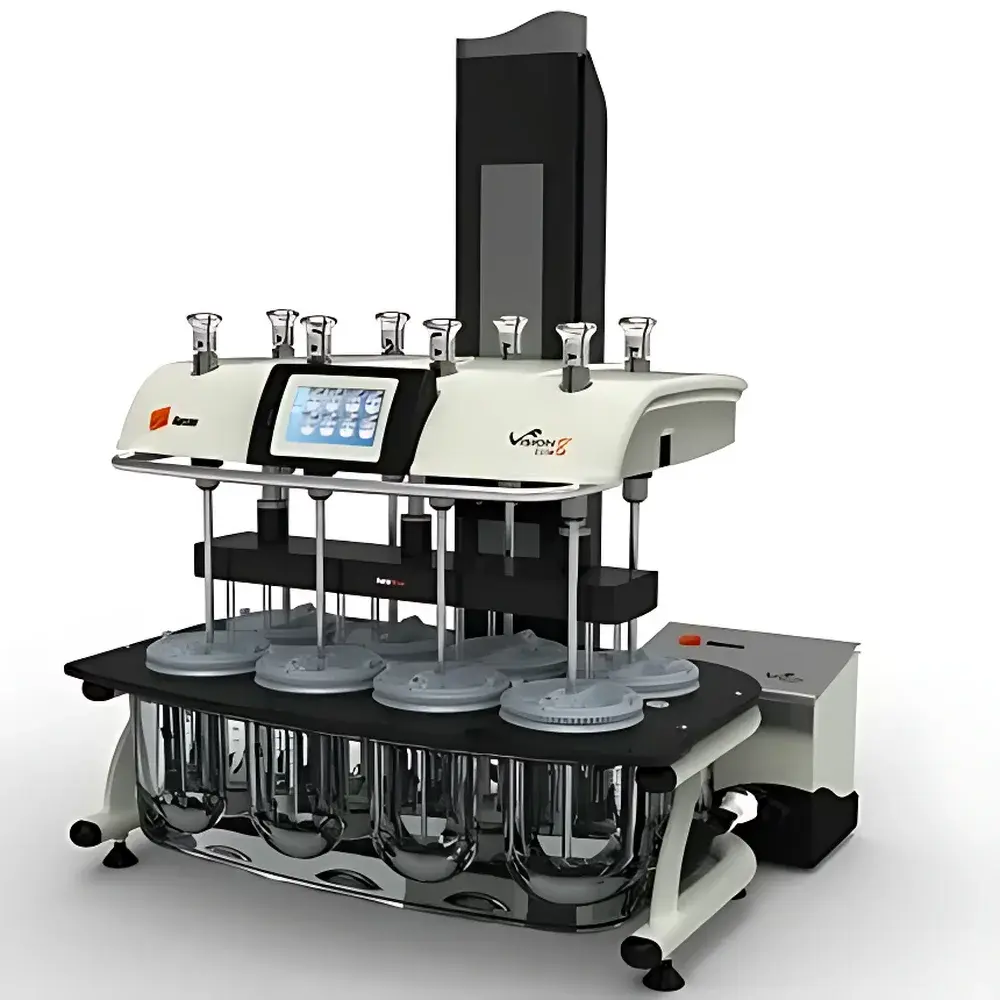
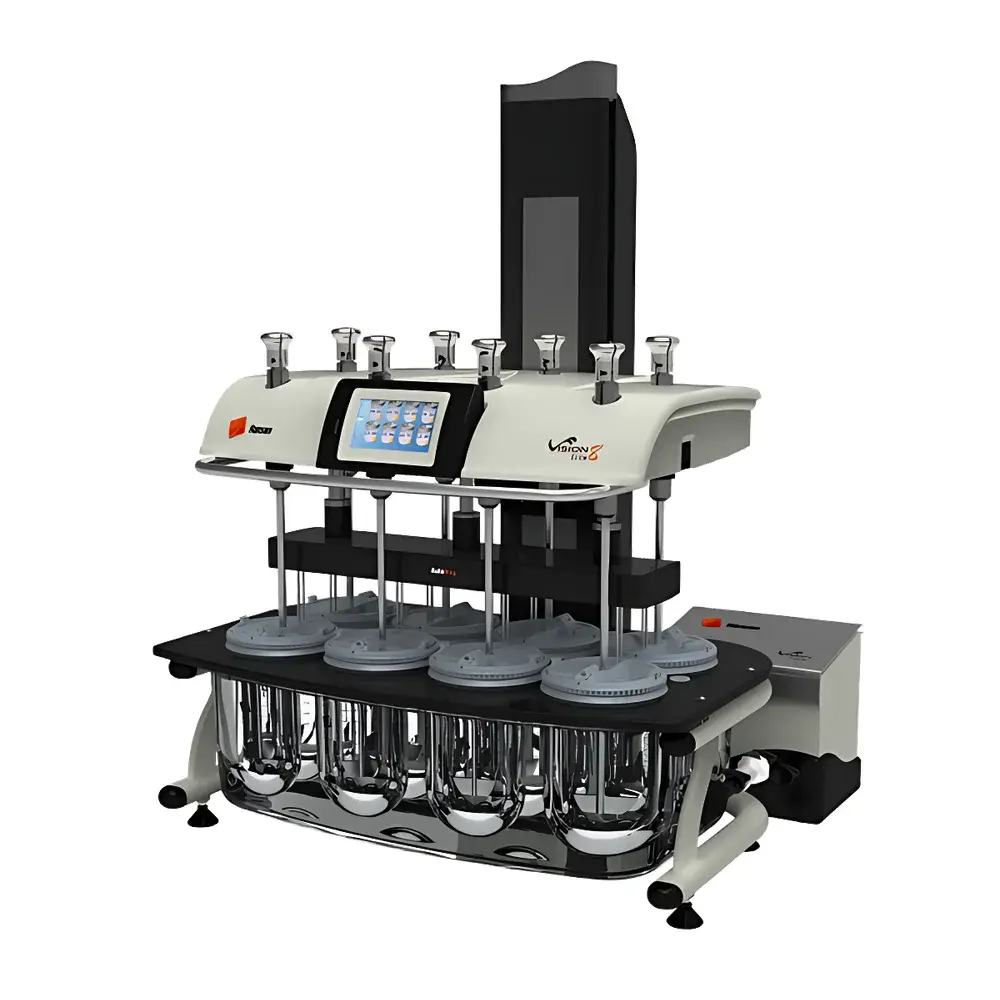
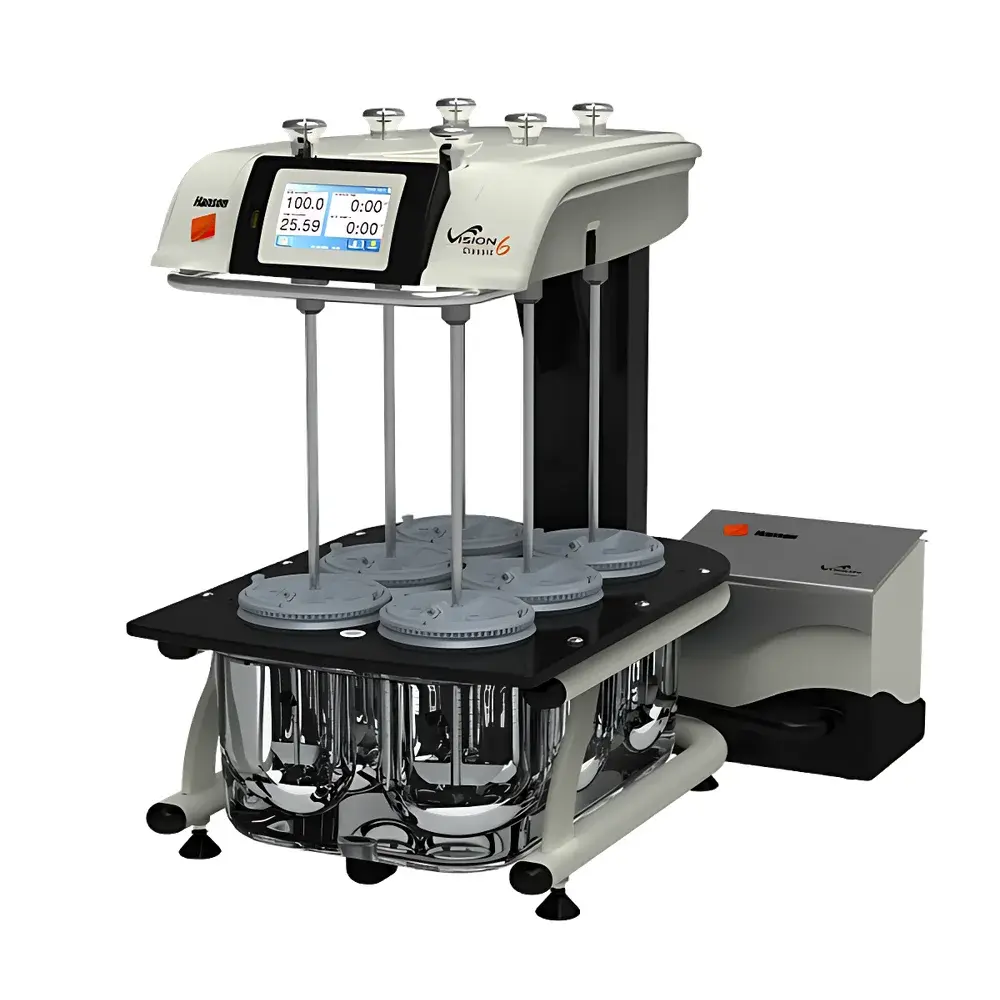
Hanson Vision G2 Elite 8 / Classic 6 Dissolution Tester
| Brand | Hanson |
|---|---|
| Origin | USA |
| Model | Vision G2 Elite 8 / Vision G2 Classic 6 |
| Instrument Type | Offline Dissolution Tester |
| Number of Vessels | 6 or 8 |
| Temperature Range | 25–55 °C |
| Temperature Accuracy | ±0.2 °C |
| Temperature Resolution | 0.01 °C |
| Rotational Speed Range | 25–250 rpm |
| Speed Accuracy | ±1 rpm |
| Basket/Paddle Wobble | 0 mm |
| Bath Volume | 11.4 L (Classic 6) / 18.9 L (Elite 8) |
| Compliance | Fully compliant with 21 CFR Part 11 |
| Data Interface | RS232, USB, LAN |
| Onboard Storage | Up to 100 programmable dissolution methods |
| Power Supply | 220 V AC, 50–60 Hz, 65 W |
Overview
The Hanson Vision G2 Elite 8 and Classic 6 Dissolution Testers are fully validated, offline pharmaceutical dissolution systems engineered for precision, regulatory compliance, and operational robustness in R&D, quality control (QC), and stability testing laboratories. Based on the Couette flow principle and calibrated hydrodynamic conditions defined in USP General Chapter <711>, these instruments replicate physiological dissolution environments for solid oral dosage forms—including tablets, capsules, and extended-release formulations—under strictly controlled temperature, agitation, and sampling parameters. Designed and manufactured by Teledyne Hanson (USA), the Vision G2 platform represents the second-generation evolution of the original Vision series, integrating 32-bit digital control architecture, real-time feedback loops, and deterministic mechanical design to ensure high reproducibility across all 6 or 8 vessels simultaneously. Each system operates as a standalone unit or integrates seamlessly into enterprise laboratory networks via Ethernet or USB, supporting full audit trails, electronic signatures, and secure method management per FDA 21 CFR Part 11 requirements.
Key Features
- High-fidelity temperature control: Dual-sensor PID regulation maintains bath temperature within ±0.2 °C across the full 25–55 °C range, with 0.01 °C resolution and independent digital temperature probes (DTPs) optional per vessel.
- Precision rotational drive: Brushless DC motor with closed-loop speed feedback delivers stable agitation from 25–250 rpm (±1 rpm accuracy); paddle and basket wobble is mechanically constrained to 0 mm—ensuring compliance with USP <711> centering tolerances.
- Intelligent sampling architecture: AutoMag and SuperMag modules enable programmable, motorized probe descent with digital height calibration—guaranteeing identical immersion depth and minimal hydrodynamic disturbance across all vessels. Probes retract fully post-sampling to eliminate carryover and flow perturbation.
- Full-color touchscreen interface: Intuitive icon-driven GUI supports rapid method setup, real-time status monitoring, and contextual help. Up to 100 dissolution protocols—including multi-stage pH-shift, sink condition override, and timed dose dumping—can be stored onboard.
- Regulatory-ready data handling: Built-in 21 CFR Part 11 compliance features include role-based user authentication, electronic signatures, immutable audit logs, and automatic timestamped report generation (PDF/CSV) via network printer or USB export.
- Modular expandability: Optional accessories include automated drug dosing (AutoDrop), UV flow cells, fraction collectors, and environmental chamber integration for photostability-coupled dissolution studies.
Sample Compatibility & Compliance
The Vision G2 platform accommodates standard USP Apparatus 1 (basket), Apparatus 2 (paddle), and Apparatus 4 (flow-through cell) configurations. All mechanical components—including shafts, vessels, and probe assemblies—are constructed from ASTM-certified 316 stainless steel and borosilicate glass to prevent leaching and ensure chemical inertness with aggressive media (e.g., 0.1 N HCl, pH 6.8 phosphate buffer, surfactant-containing solutions). The system meets ISO/IEC 17025 traceability requirements when paired with NIST-traceable calibration standards. It supports ICH Q5C stability protocols and is routinely deployed in GLP- and GMP-regulated environments for bioequivalence support, release testing, and formulation optimization.
Software & Data Management
Hanson’s proprietary Dissolution Pro™ software (v5.x or later) provides centralized method deployment, remote instrument monitoring, and advanced data visualization—including real-time dissolution profile overlays, similarity factor (f2) calculation, and Weibull modeling. All raw sensor data (temperature, rpm, time-stamped sample events) are logged at 100 ms intervals and archived with SHA-256 hash integrity verification. Electronic records comply with ALCOA+ principles (Attributable, Legible, Contemporaneous, Original, Accurate, Complete, Consistent, Enduring, Available) and support FDA inspection readiness through configurable retention policies and automated backup to network-attached storage (NAS) or LIMS.
Applications
- Quality control release testing per USP/Ph. Eur./JP monographs
- Comparative dissolution profiling for generic product development
- Formulation screening of modified-release dosage forms (e.g., matrix tablets, osmotic pumps)
- Dissolution–permeation correlation (DPC) studies using integrated Franz cells
- Forced degradation–dissolution coupling to assess chemical stability under dissolution stress
- Stability-indicating method validation per ICH Q2(R2)
FAQ
Does the Vision G2 support both Apparatus 1 and Apparatus 2 configurations?
Yes—interchangeable shaft assemblies and vessel holders allow rapid reconfiguration between basket and paddle modes without recalibration.
Can dissolution methods be transferred between different Vision G2 units?
Yes—methods are stored in portable .HAN format and can be imported/exported via USB flash drive or network share.
Is individual vessel temperature monitoring available?
Optional Digital Temperature Probes (DTPs) provide real-time, vessel-specific temperature logging with ±0.1 °C accuracy.
How does the system ensure sampling consistency across all vessels?
Motorized probe descent depth is digitally set and synchronized; all probes enter and exit the medium simultaneously, eliminating timing skew and mechanical drift.
What validation documentation is provided with the instrument?
Each unit ships with Factory Acceptance Test (FAT) report, IQ/OQ protocol templates, and a full set of USP <711>-aligned performance qualification (PQ) test procedures.