
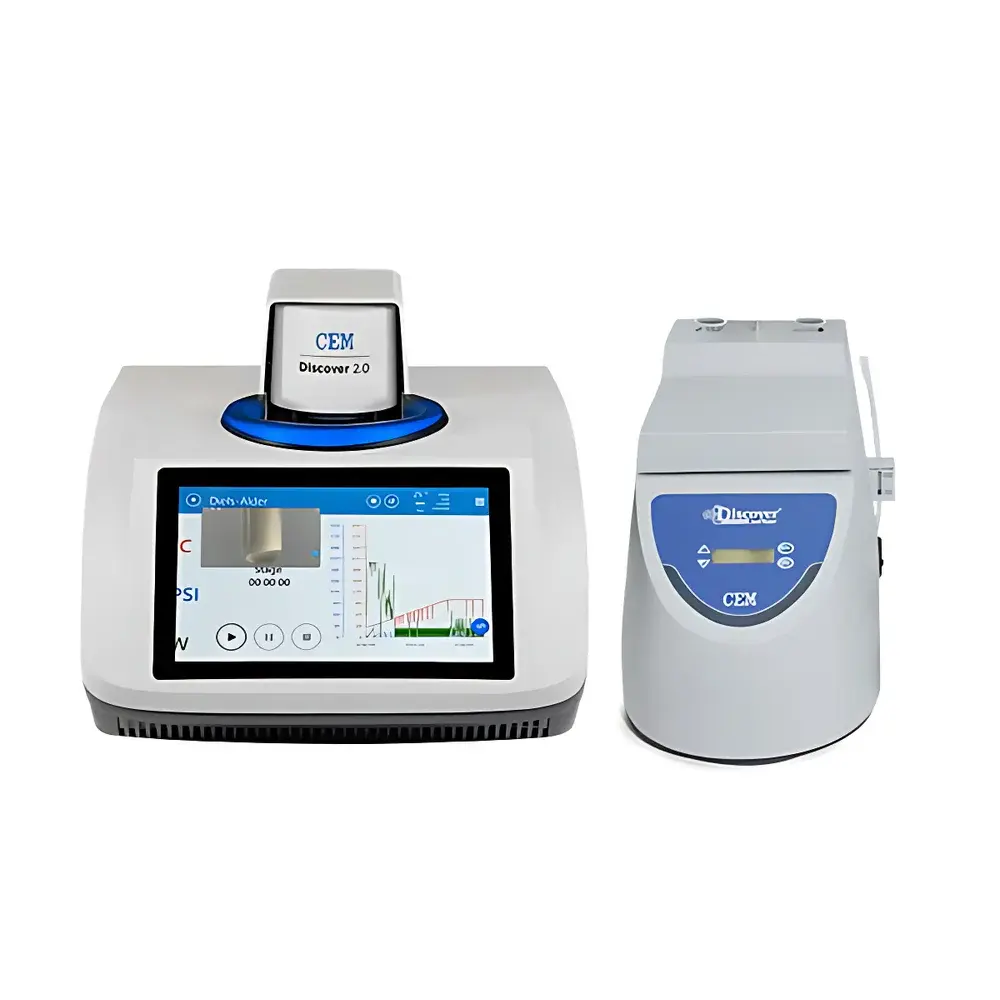
CEM CoolMate Advanced Low-Temperature Microwave Synthesis and Extraction System
| Brand | CEM |
|---|---|
| Origin | USA |
| Instrument Type | Single-Mode Microwave Reactor |
| Temperature Range | –80 °C to 300 °C |
| Pressure Range | 0–35 bar |
| Microwave Power Output | 0–600 W |
| Magnetron Frequency | 2450 MHz |
| Stirring Modes | Electromagnetic + Mechanical Stirring |
| Reaction Vessel Capacity | 300 mL |
Overview
The CEM CoolMate is a purpose-engineered single-mode microwave synthesis and extraction system designed to extend the operational envelope of microwave-assisted chemistry into cryogenic regimes. Unlike conventional multimode or high-temperature-focused microwave reactors, the CoolMate integrates patented ring-focused cavity architecture with active in situ cooling—enabling precise control over reaction thermodynamics while delivering high-intensity microwave energy directly to the sample. Its core principle relies on controlled dielectric heating within a resonant single-mode cavity, coupled with real-time thermal management via integrated cryogenic cooling (down to –80 °C). This allows kinetic acceleration of reactions without thermal degradation—a critical capability for substrates exhibiting low thermal stability, such as glycosyl donors, organolithium species, reactive intermediates, or labile biomolecules. The system operates under full pressure containment up to 35 bar, supporting both sealed-vessel synthesis and open-vessel extraction protocols compliant with modern green chemistry objectives.
Key Features
- Patented ring-focused single-mode cavity ensures uniform, reproducible microwave energy coupling—minimizing hot-spot formation and maximizing reaction efficiency.
- Integrated dual-mode cooling system enables stable operation from –80 °C to 300 °C; maintains sub-zero temperatures during microwave irradiation to suppress decomposition pathways.
- Real-time temperature monitoring via fiber-optic probe with ±0.5 °C accuracy and millisecond response time—essential for kinetic studies and exothermic reaction control.
- Dual stirring mechanism (electromagnetic + mechanical) ensures homogeneous mixing across wide viscosity and phase-separation ranges, including heterogeneous catalytic systems.
- Full-pressure-rated 300 mL reaction vessels constructed from reinforced quartz and PEEK-composite materials—compatible with aggressive reagents and high-boiling solvents.
- Intuitive touchscreen interface with preloaded method libraries for Diels–Alder cyclizations, lithiations, deprotections, and natural product extractions.
Sample Compatibility & Compliance
The CoolMate accommodates a broad spectrum of sample types—including air-sensitive organometallics, thermolabile carbohydrates, peptides, plant matrices, and polymeric precursors—without requiring specialized handling beyond standard glovebox or Schlenk techniques. All vessel assemblies meet ASTM E2875-22 (Standard Practice for Microwave-Assisted Chemical Synthesis) and ISO/IEC 17025:2017 requirements for analytical instrumentation validation. Pressure containment design conforms to PED 2014/68/EU directives, and temperature calibration traceability is maintained per NIST SRM standards. For regulated environments, the system supports audit-trail-enabled operation compliant with FDA 21 CFR Part 11 when paired with optional CEM Synergy Software v5.2.
Software & Data Management
CEM Synergy Software provides comprehensive method development, execution logging, and data export capabilities. Each run records time-stamped microwave power profiles, temperature/pressure trajectories, stirring speed, and cooling duty cycle—exportable in CSV, XML, or PDF formats for GLP/GMP documentation. The software includes built-in kinetic modeling tools (Arrhenius and Eyring analysis), comparative reaction heatmaps, and customizable pass/fail criteria for automated quality gatekeeping. Remote monitoring via secure HTTPS connection allows centralized fleet management across multi-lab installations. All raw sensor data is stored locally with SHA-256 hashing for integrity verification.
Applications
- Low-temperature lithiation and transmetalation reactions with enhanced selectivity and reduced side-product formation.
- Accelerated Diels–Alder cycloadditions achieving >3× yield improvement versus conventional heating at identical conversion levels.
- Glycosylation and nucleoside synthesis where anomeric stereocontrol depends critically on thermal history.
- Green extraction of heat-labile phytochemicals (e.g., flavonoids, terpenes, alkaloids) from botanical matrices at –40 °C to preserve structural integrity.
- Protein-conjugate synthesis and peptide coupling under non-denaturing conditions using microwave-enhanced amide bond formation.
- Kinetic investigation of slow-reacting intermediates via controlled ramp-and-hold protocols below 0 °C.
FAQ
What distinguishes CoolMate from conventional microwave synthesizers?
It is the only commercially available single-mode system capable of simultaneous high-power microwave irradiation (up to 600 W) and active sub-zero cooling (–80 °C), enabling unprecedented control over reaction enthalpy and entropy profiles.
Can CoolMate be used for scale-up studies?
Yes—the 300 mL vessel volume and pressure/temperature robustness support process-relevant screening; however, it is optimized for discovery-phase optimization rather than production-scale synthesis.
Is fiber-optic temperature measurement validated for cryogenic conditions?
Yes—CEM’s proprietary sapphire-tipped probes are calibrated across the full –80 °C to 300 °C range per IEC 60751 and include drift compensation algorithms for long-duration runs.
Does the system support inert atmosphere control?
All reaction vessels feature dual-port gas inlets with mass-flow-controlled purge capability, compatible with N₂, Ar, or custom gas mixtures for oxygen- or moisture-sensitive chemistries.
How is safety ensured during high-pressure low-temperature operation?
The reactor chamber incorporates redundant pressure relief valves, burst-disk isolation, and real-time pressure decay monitoring with automatic microwave cutoff if deviation exceeds ±2% of setpoint.



