
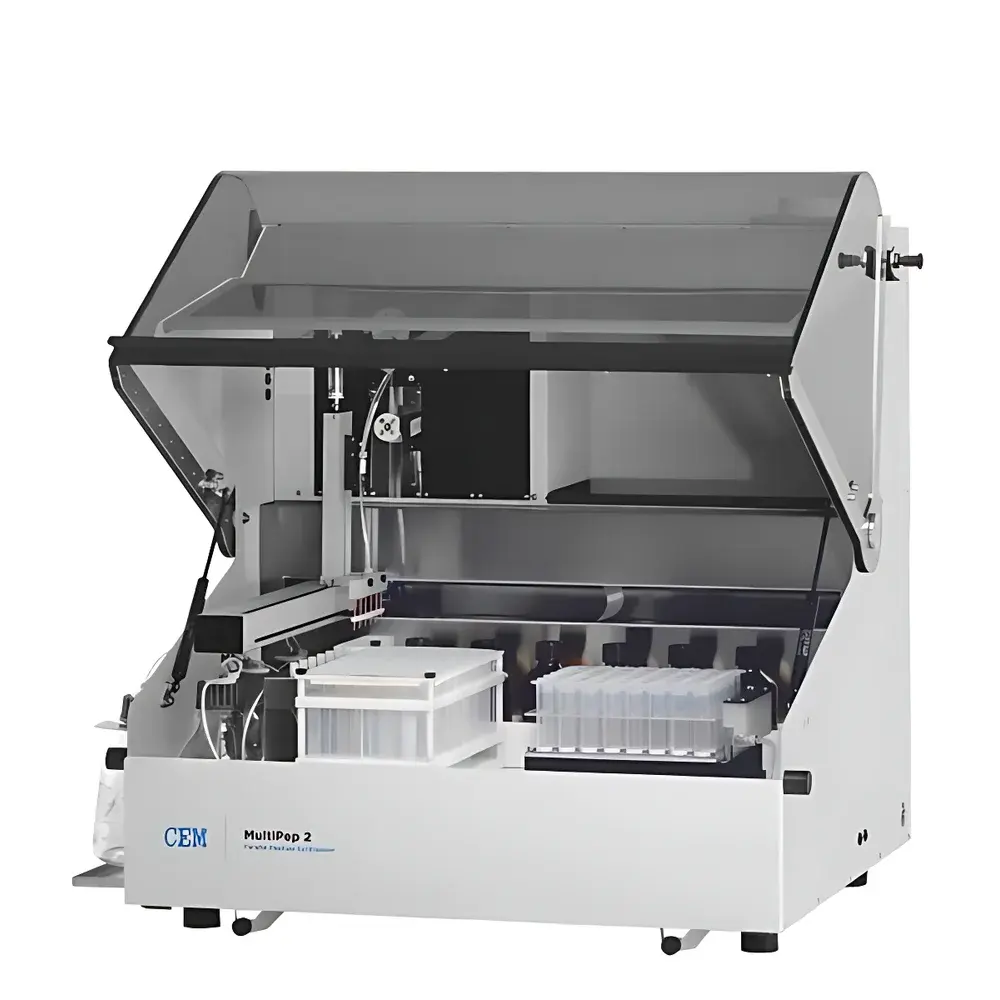
INTAVIS MultiPep 1 (SLi) / MultiPep 2 (RSi) Parallel Peptide Synthesizer with SPOT and CelluSpots™ Modules
| Brand | CEM |
|---|---|
| Origin | USA |
| Manufacturer Status | Authorized Distributor |
| Origin Category | Imported |
| Model | MultiPep 1 (SLi) / MultiPep 2 (RSi) |
| Amino Acid Delivery | Automated |
| Reagent Delivery | Automated |
| User Authentication | Password + Facial Recognition |
| Audit Trail | Yes |
| Synthesis Scale | 0.001–0.3 mmol |
Overview
The INTAVIS MultiPep 1 (SLi) and MultiPep 2 (RSi) are fully automated, high-throughput parallel peptide synthesizers engineered for research-grade solid-phase peptide synthesis (SPPS) on membranes, resin columns, and functionalized glass slides. These instruments implement Fmoc- and Boc-compatible chemistry with precise spatial and temporal control over coupling, deprotection, washing, and capping steps. Unlike conventional single-column synthesizers, the MultiPep platform supports true parallelism—enabling simultaneous synthesis of hundreds to thousands of distinct peptides across multiple formats including cellulose membranes (SPOT synthesis), chromatographic columns (2–10 mL), and microtiter plates (96-well). The system is purpose-built for epitope mapping, antibody characterization, enzyme substrate profiling, receptor–ligand interaction studies, and peptide library screening in drug discovery and immunology workflows.
Key Features
- Fully automated amino acid and reagent delivery via positive-pressure fluidics with real-time pressure monitoring and leak detection.
- Dual authentication layer: password-based login combined with facial recognition ensures secure, traceable operator access per GLP/GMP-compliant laboratory requirements.
- Comprehensive audit trail functionality compliant with FDA 21 CFR Part 11—recording all user actions, parameter changes, sequence edits, and hardware events with timestamped, immutable logs.
- Modular architecture supporting interchangeable synthesis kits: SPOT module for cellulose membrane-based synthesis; CelluSpots™ module for covalent peptide–cellulose conjugate synthesis on glass slides; and standard column/plate modules for traditional SPPS.
- On-the-fly amino acid pre-activation in dedicated activation tubes, minimizing racemization and maximizing coupling efficiency.
- Multi-channel vacuum-assisted cleavage and wash system with programmable vacuum ramping and solvent evacuation profiles.
- Integrated heating blocks (optional) for temperature-controlled synthesis—enhancing coupling kinetics and crude purity for difficult sequences.
- Software-embedded synthesis protocols optimized by peptide chemistry experts, covering standard Fmoc protocols, pseudoproline dipeptide strategies, and double-coupling routines.
Sample Compatibility & Compliance
The MultiPep platform accommodates diverse solid supports: functionalized cellulose membranes (Whatman 540/589), polypropylene synthesis columns (2, 5, and 10 mL), and standard 96-well plates with fritted or filter-bottom wells. All consumables are compatible with common SPPS solvents (DMF, DCM, NMP, piperidine, TFA) and reagents (HBTU/HATU/DIC, Oxyma Pure, etc.). The instrument meets ISO 13485 design control principles for research instrumentation and supports laboratories undergoing GLP audits or preparing for regulated preclinical peptide development. Full compliance with ASTM E2500-13 (good practice for verification and validation of automated laboratory equipment) is enabled through documented IQ/OQ protocols available upon request.
Software & Data Management
Control and method management are handled via the proprietary MultiPep Control Software—a Windows-based application with intuitive drag-and-drop sequence editor, multi-level user permission settings, and version-controlled method storage. Each synthesis run generates a structured XML log file containing full metadata: sequence list, reagent lot numbers, timestamps, vacuum cycles, wash volumes, and error flags. Raw data export supports CSV, PDF, and XML formats for integration into LIMS or ELN systems. Electronic signatures, role-based access control, and forced password rotation align with 21 CFR Part 11 Annex 11 expectations for electronic records integrity.
Applications
- High-density epitope mapping using SPOT-synthesized peptide arrays on cellulose membranes (up to 2400 spots per membrane).
- CelluSpots™ array generation for immobilized peptide–cellulose conjugates—ideal for SPR, ELISA, and fluorescence polarization assays.
- Parallel synthesis of structure–activity relationship (SAR) libraries targeting GPCRs, kinases, or proteases.
- Rapid optimization of cleavage conditions and side-chain protection schemes via combinatorial column-based synthesis.
- Custom microarray fabrication using the integrated chip spotter—compatible with hydrophobic/hydrophilic surfaces and organic-aqueous solvent mixtures.
- Reproducible synthesis of phosphopeptides, glycopeptides, and cyclic peptides requiring elevated temperature or extended coupling times.
FAQ
What synthesis chemistries does the MultiPep support?
Fmoc-based solid-phase synthesis is the primary mode; Boc chemistry is supported with appropriate reagent kits and deprotection protocols.
Can I synthesize peptides longer than 30 residues?
Yes—optimized coupling cycles, double couplings, and in-situ activation enable routine synthesis of peptides up to 50+ residues, depending on sequence complexity and purification strategy.
Is remote monitoring or control possible?
The system supports local network connectivity for remote status viewing via browser-based dashboard; however, active method execution requires local authenticated login for security and audit integrity.
How is cross-contamination prevented between synthesis positions?
Dedicated fluidic lines per position, non-return valves, and automated post-cycle needle and line purging minimize carryover; all wetted parts are chemically resistant (PTFE, PEEK, borosilicate glass).
Does INTAVIS provide method validation documentation?
Yes—IQ/OQ documentation packages, calibration certificates, and SOP templates are provided as part of installation qualification and can be adapted for internal validation under ISO/IEC 17025 or GxP frameworks.





