
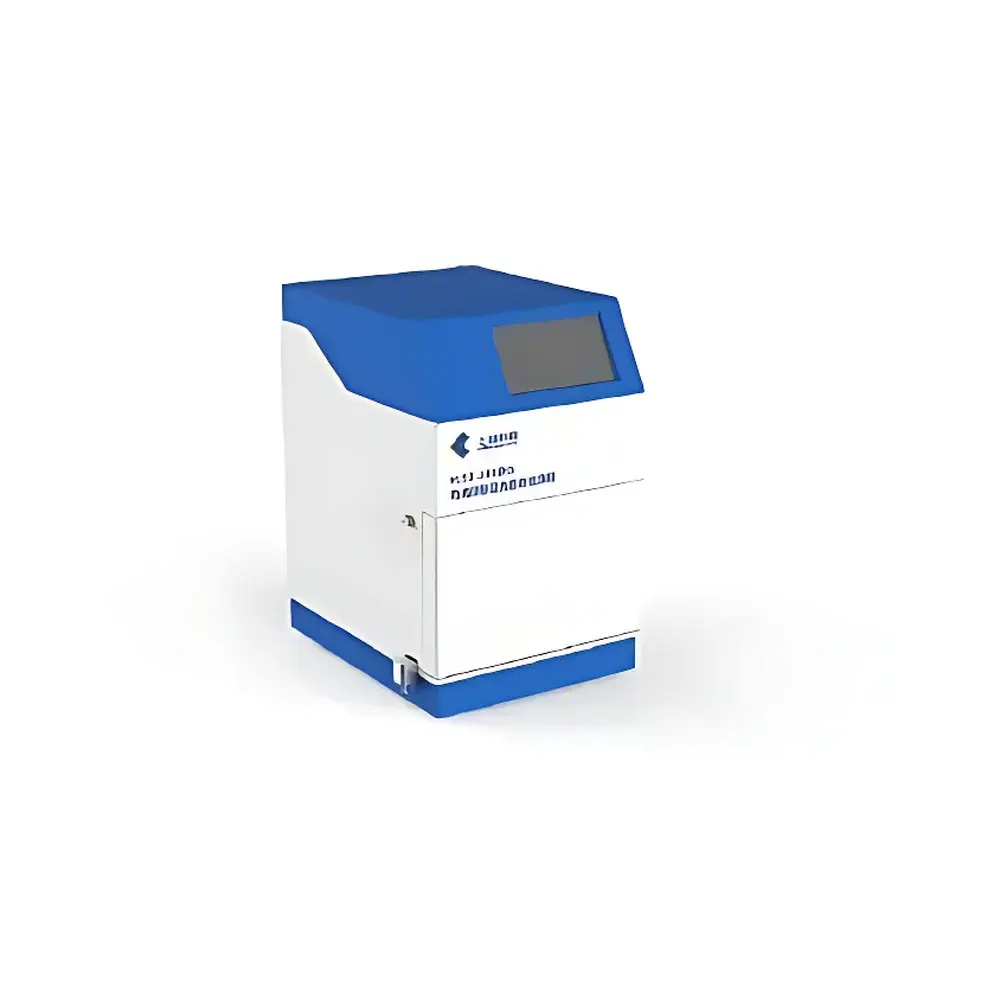
Kezhe ELSD-2000KS Evaporative Light Scattering Detector
| Brand | Kezhe / KEZHE SHANGHAI |
|---|---|
| Origin | Shanghai, China |
| Manufacturer Type | Original Equipment Manufacturer (OEM) |
| Product Category | Domestic |
| Model | ELSD-2000KS |
| Instrument Type | Evaporative Light Scattering Detector (ELSD) |
| Wavelength Range | 195–600 nm |
| Detection Method | Dual-beam |
| Light Source | Xenon lamp |
| Laser Wavelength (Standard) | 650 nm |
| Gas Flow Range | 0–5 L/min |
| Nebulization Pressure | 0–100 psi |
| Temperature Control Range | Ambient to 150 °C (±1 °C resolution) |
| Mobile Phase Flow Rate Compatibility | 0–5 mL/min |
| Detector | Imported large-area silicon photodiode |
| Power Supply | 220 V AC |
| Compatible Carrier Gases | Compressed air or nitrogen |
| Core Components | Stainless-steel evaporation tube, maintenance-free stainless-steel nozzle, laser source, photodetector, dedicated ELSD-2000KS chromatography workstation |
Overview
The Kezhe ELSD-2000KS is a robust, laboratory-grade evaporative light scattering detector engineered for universal integration with high-performance liquid chromatography (HPLC) systems. It operates on the fundamental principle of nebulization, solvent evaporation, and optical detection of non-volatile analyte particles via light scattering—making it particularly suitable for compounds lacking strong chromophores or UV absorbance, such as carbohydrates, lipids, saponins, glycosides, amino acids, surfactants, and natural product extracts. Unlike UV-Vis detectors, the ELSD-2000KS delivers mass-sensitive, near-uniform response across chemically diverse analytes, independent of molecular structure or extinction coefficient. Its dual-beam optical architecture—featuring a stabilized 650 nm laser source and imported large-area silicon photodiode—ensures low baseline noise, high signal-to-noise ratio, and long-term photometric stability. The detector’s stainless-steel evaporation pathway eliminates glass fragility and enhances chemical resistance, supporting routine analysis of aggressive mobile phases including acidic, basic, or high-salt buffers commonly used in herbal medicine and antibiotic separations.
Key Features
- Stainless-steel nebulizer and evaporation tube—corrosion-resistant, thermally stable, and compatible with organic/aqueous gradients and high-TFA or ammonium acetate eluents.
- Maintenance-free stainless-steel nozzle design—eliminates frequent clogging and reduces downtime; no Teflon or ceramic components requiring periodic replacement.
- Precise temperature control (ambient to 150 °C, ±1 °C resolution)—enables gentle, low-temperature evaporation for thermolabile compounds including glycosidic alkaloids and labile glycoconjugates.
- Dual-beam optical path with collimated 650 nm laser—minimizes drift and improves reproducibility by compensating for source intensity fluctuations and chamber particulate interference.
- Integrated electronic gas flow display and digital pressure regulation—provides real-time monitoring and repeatable nebulization conditions across method transfers.
- Tail-blown concentration mode—enhances detection sensitivity by reducing post-evaporation particle dispersion and maintaining clean detector cell optics.
- Low-thermal-mass design—achieves rapid temperature stabilization (<5 min to setpoint), improving daily throughput and method development efficiency.
Sample Compatibility & Compliance
The ELSD-2000KS is validated for quantitative analysis of pharmacopoeial herbal matrices and small-molecule therapeutics where reference standards are unavailable or unstable under UV detection. It supports full compliance with Chinese Pharmacopoeia (ChP) monographs requiring ELSD detection—including Lonicerae Japonicae Flos, Scutellariae Radix, Ginkgo biloba extract, and multiple compound formulae (e.g., Qingkailing, Guipi Wan, Yupingfeng). Its response linearity (R² ≥ 0.995 over 3 orders of magnitude) and precision (RSD ≤ 3.2% for replicate injections) meet ICH Q2(R2) guidelines for analytical method validation. While not inherently 21 CFR Part 11 compliant, the detector interfaces seamlessly with GLP/GMP-compliant chromatography data systems (CDS) that provide audit trails, electronic signatures, and secure data archiving—enabling full traceability in regulated environments.
Software & Data Management
The ELSD-2000KS includes a dedicated Windows-based chromatography workstation capable of real-time signal acquisition, peak integration, calibration curve generation (linear/log-log), and export to CSV, TXT, or AIA formats. It supports bidirectional communication with third-party HPLC controllers (Agilent, Waters, Shimadzu, Thermo) via RS-232 or USB virtual COM port. All instrument parameters—including gas flow, drift tube temperature, gain, and baseline offset—are remotely configurable and logged with timestamps. Raw detector output is stored with metadata (date/time, operator ID, method name), satisfying ALCOA+ data integrity principles when deployed within validated CDS environments. Firmware updates are delivered via encrypted USB key to ensure version control and cybersecurity compliance.
Applications
The ELSD-2000KS is routinely deployed in pharmaceutical QC laboratories for batch release testing of traditional Chinese medicine (TCM) preparations, antibiotic formulations (e.g., gentamicin, tobramycin, neomycin), and excipient quantification (cholesterol, PEGs, dextrins, fatty acids). Its compatibility with reversed-phase, HILIC, and normal-phase LC methods enables broad coverage of polar/non-polar natural products without derivatization. Academic and contract research labs utilize it for fingerprinting complex botanical extracts, monitoring enzymatic hydrolysis of glycosides, and characterizing surfactant micelle composition. The detector also serves as a reliable alternative to CAD (charged aerosol detection) in cost-constrained settings where comparable sensitivity and ruggedness are required without proprietary consumables.
FAQ
What mobile phase additives are compatible with the ELSD-2000KS?
Volatile additives—including ammonium acetate, ammonium formate, acetic acid, and formic acid—are fully supported. Non-volatile salts (e.g., sodium phosphate, KBr) must be avoided to prevent nozzle and drift tube fouling.
Can the ELSD-2000KS be used with gradient elution?
Yes—its temperature-stabilized evaporation chamber and adaptive gas flow control accommodate standard C18 gradients (e.g., water/acetonitrile + 0.1% formic acid) without baseline drift or signal suppression.
Is method transfer from Alltech or Sedex detectors straightforward?
Instrumental parameters (nebulizer temp, gas flow, gain) are directly translatable; retention times and relative response factors remain consistent across platforms when using identical column chemistry and mobile phase composition.
Does the detector support regulatory submissions?
Raw data and processing parameters are fully exportable and auditable. When integrated into a validated CDS with electronic signatures and audit trail functionality, it meets requirements for FDA, EMA, and NMPA submissions.
What maintenance is required beyond routine nozzle cleaning?
No scheduled optical alignment or lamp replacement is needed—the 650 nm laser has an operational lifetime exceeding 10,000 hours. Annual verification of temperature accuracy and gas flow calibration is recommended per ISO/IEC 17025 internal quality procedures.






