
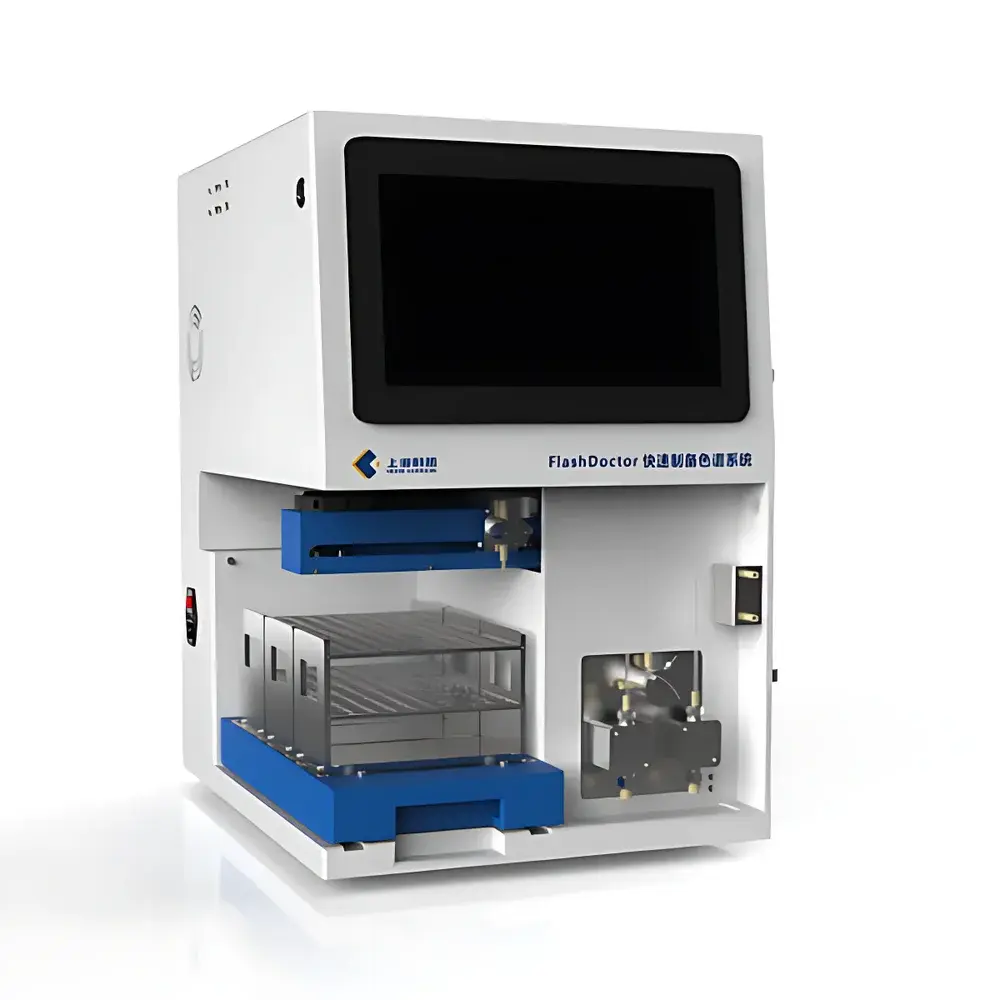
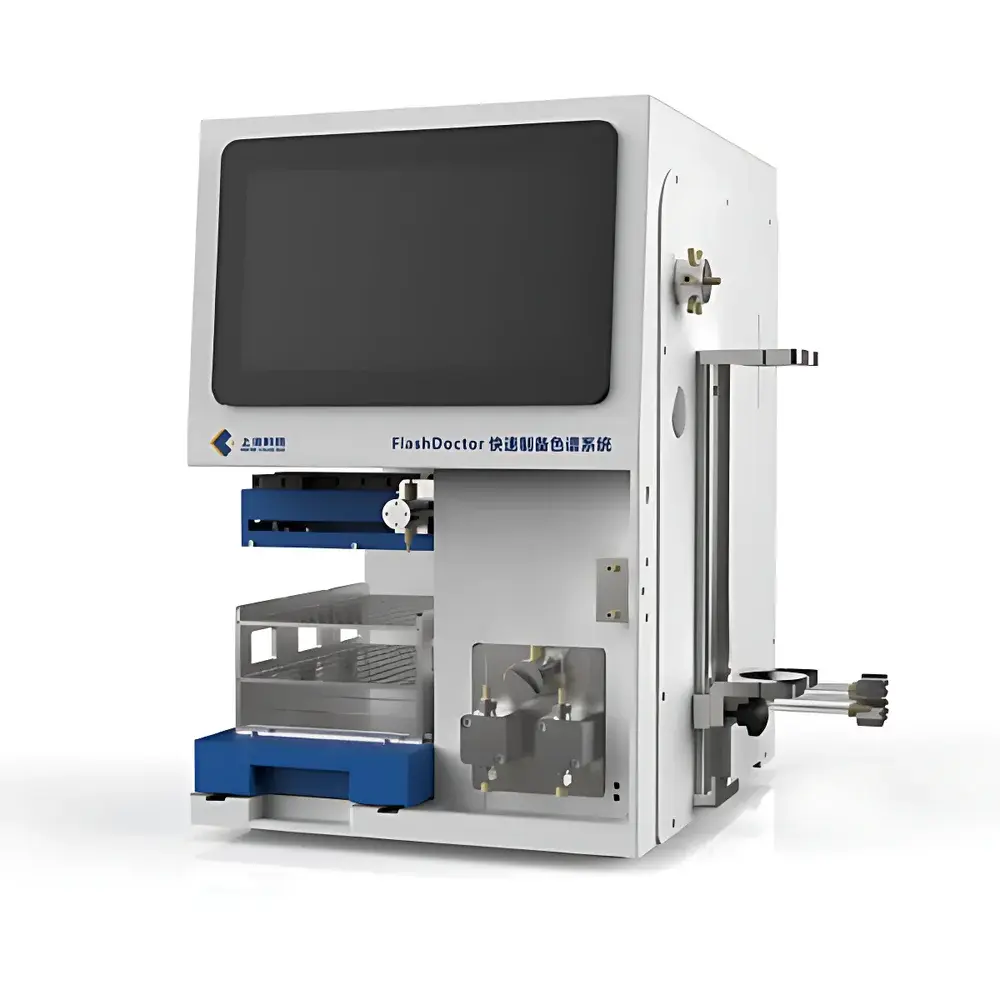
KEZHE SHANGHAI FlashDoctor-2500 Preparative Chromatography System
| Brand | KEZHE SHANGHAI |
|---|---|
| Origin | Shanghai, China |
| Manufacturer Type | Manufacturer |
| Product Category | Domestic |
| Model | FlashDoctor-2500 |
| Instrument Type | Fast Liquid Chromatography System |
| Application Scope | General-purpose |
| Flow Rate Range | 0–200 mL/min |
| Maximum Pressure | 5 MPa |
| Flow Accuracy | 0.1% RSD |
| Wavelength Range | 190–850 nm |
Overview
The KEZHE SHANGHAI FlashDoctor-2500 Preparative Chromatography System is a benchtop-scale, high-throughput flash purification platform engineered for rapid method development and scalable compound isolation in synthetic organic chemistry, natural product research, and pharmaceutical process development. Built upon classical low-pressure liquid chromatography (LPLC) principles with gradient-capable quaternary solvent delivery, the system operates within a pressure envelope of up to 5 MPa (725 psi), enabling compatibility with both silica-based normal-phase columns and reversed-phase C18 media—without hardware reconfiguration. Its core architecture integrates a precision quaternary pump module, a diode-array detector (DAD) with broad-spectrum UV-Vis acquisition (190–850 nm), and an X-Y robotic fraction collector capable of spatially resolved, peak-triggered collection. Designed for GLP-aligned laboratories, the FlashDoctor-2500 supports traceable operation through audit-trail-enabled software, user role management, and electronic signature compliance per FDA 21 CFR Part 11 requirements.
Key Features
- Quaternary solvent delivery system with four independent flow paths, enabling seamless gradient programming and solvent compatibility across polar/non-polar mobile phases.
- DAD detection with dual-lamp source (deuterium + tungsten-halogen), 8 nm spectral bandwidth, ±1 nm wavelength accuracy, and baseline noise ≤ ±0.2 mAU at 254 nm—optimized for quantitative tracking of diverse chromophores including conjugated aromatics, carbonyls, and heterocycles.
- X-Y matrix fraction collector with 135-position capacity (standard 15 × 150 mm test tube configuration); supports full-loop, peak-triggered, time-windowed, and manual collection modes.
- Real-time pressure monitoring with overpressure alarm and automatic shutdown logic to protect column integrity and ensure system longevity.
- Integrated solvent level sensing to prevent air ingress during extended runs—critical for maintaining pump priming and flow stability.
- Touchscreen HMI with workflow-driven interface; supports method templating, TLC-based method recommendation, and one-click fraction triggering based on real-time peak detection.
- Modular design facilitates field serviceability: quick-disconnect fittings, tool-free pump head access, and standardized column mounting brackets compatible with industry-standard flash cartridges (e.g., Biotage, ISCO, Grace).
- Optional ELSD integration for non-UV-absorbing analytes such as carbohydrates, lipids, glycosides, and peptides—extending applicability beyond conventional UV-detectable compounds.
Sample Compatibility & Compliance
The FlashDoctor-2500 accommodates a wide polarity spectrum—from highly polar glycosides to non-polar terpenoids—via interchangeable column chemistries and programmable solvent gradients. It meets analytical and preparative requirements outlined in multiple national standards, including GB 5009.202–2016 for polar compound analysis in edible oils. All operational parameters—including flow rate, gradient profile, collection logic, and detector settings—are digitally logged with timestamped metadata and immutable audit trails. Software enforces user authentication, permission-based access control, and electronic record retention aligned with ISO/IEC 17025, USP , and GMP Annex 11 expectations for regulated environments.
Software & Data Management
Control and data acquisition are managed via KEZHE’s proprietary ChromaLink™ software suite. The application provides full chromatographic data processing (peak integration, baseline correction, purity assessment), method optimization tools (TLC Rf-to-gradient mapping), and customizable reporting templates compliant with internal SOPs or external regulatory submissions. Data files are stored in vendor-neutral formats (e.g., .cdf, .csv) with embedded calibration history, lamp usage logs, and photometric validation records. Source code-level traceability ensures reproducibility across instrument platforms and laboratory sites.
Applications
- Purification of synthetic intermediates and final APIs during medicinal chemistry campaigns.
- Isolation of bioactive constituents from plant extracts, microbial broths, or fermentation supernatants.
- Method scouting and scale-up studies bridging analytical HPLC to kilogram-scale preparative workflows.
- Quality control of excipients and raw materials per pharmacopeial monographs requiring separation-based impurity profiling.
- Support of green chemistry initiatives through solvent consumption reduction (≤30% less than traditional flash systems) and automated recycling logic for eluent fractions.
FAQ
Does the FlashDoctor-2500 support both normal-phase and reversed-phase chromatography?
Yes—the quaternary pump and pressure-rated fluidic path allow unrestricted switching between silica- and C18-based columns without hardware modification.
Can the system be integrated into a LIMS or enterprise data infrastructure?
Yes—ChromaLink™ supports OPC UA and ASTM E1384-compliant data export protocols for secure, structured transfer to third-party laboratory information systems.
What is the minimum detectable absorbance for trace-level compounds?
At 254 nm, the DAD achieves a signal-to-noise ratio ≥ 30:1 for 10 ng on-column injection of standard aromatic probes under optimized flow conditions.
Is method validation documentation available for regulated use?
KEZHE provides IQ/OQ/PQ protocol templates, installation qualification checklists, and performance verification reports aligned with USP and ISO/IEC 17025 requirements.
How often does the DAD require photometric recalibration?
The system includes automated light-intensity self-calibration routines triggered at user-defined intervals or after lamp replacement; no external reference standards are required.
Related Products





