
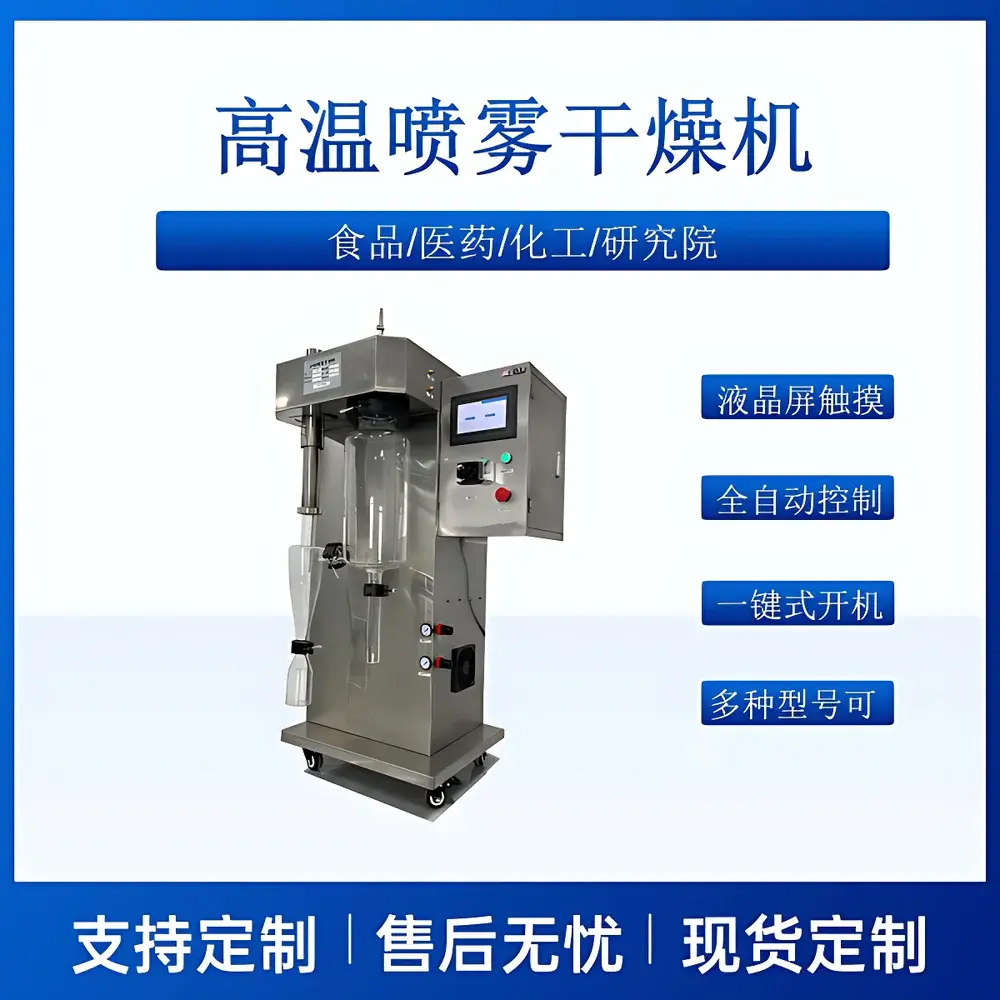
ANYAN CY-8000Y Benchtop Two-Fluid Spray Dryer for Metal Oxide Nanoparticle Synthesis
| Brand | ANYAN (Hangzhou Anyan Instrument Co., Ltd.) |
|---|---|
| Origin | Zhejiang, China |
| Manufacturer Type | Authorized Distributor |
| Country of Origin | China |
| Model | CY-8000Y |
| Sample Types | Emulsions, Suspensions |
| Max Feed Rate | 20–2000 mL/h (dependent on solids content) |
| Inlet Temp Range | 30–400 °C |
| Outlet Temp Range | 30–200 °C |
| Evaporation Capacity | 1500–2000 mL/h |
| Minimum Feed Volume | 50 mL |
| Nozzle Orifice Options | 0.5 / 0.7 / 0.75 / 1.0 / 1.5 / 2.0 mm |
| Temperature Control Accuracy | ±0.5 °C (PID-regulated) |
| Average Drying Time | 0.8–1.0 s |
| Power Supply | 3.8 kW / 220 V |
| Dimensions (H×L×W) | 1380 × 770 × 590 mm |
| Noise Level | <60 dB(A) |
| Construction | 316L stainless steel frame + borosilicate glass drying chamber, cyclone, and collection vessel |
Overview
The ANYAN CY-8000Y is a precision-engineered benchtop two-fluid spray dryer designed specifically for laboratory-scale synthesis and thermal processing of inorganic nanomaterials—particularly metal oxide precursors such as iron oxide (Fe3O4, α-Fe2O3), titanium dioxide (TiO2), zinc oxide (ZnO), cerium oxide (CeO2), and mixed-metal oxides derived from aqueous or alcoholic suspensions. Operating on the principle of flash evaporation via pneumatic atomization, the system converts liquid feedstocks into uniform, free-flowing micro- to submicron-sized dry powders within ~1 second of thermal exposure. This ultra-short residence time minimizes thermal degradation pathways, preserving stoichiometric integrity, crystallinity, and surface reactivity—critical for catalytic, magnetic, and electrochemical applications. Unlike conventional oven or freeze-drying methods, spray drying enables direct conversion of colloidal suspensions into engineered particulates with controlled morphology, narrow particle size distribution (PSD), and minimal agglomeration—making it indispensable for materials science labs developing battery cathode precursors, gas-sensing films, or photocatalytic coatings.
Key Features
- Integrated dual-mode control: Fully automated one-touch startup with real-time animated process visualization on a 7-inch color LCD touchscreen; seamless switch to manual mode for dynamic parameter adjustment during operation.
- High-purity fluid handling path: All wetted components—including atomization chamber, cyclone separator, and collection vessel—fabricated from optical-grade borosilicate glass (Schott Duran® equivalent) to eliminate metallic leaching and ensure sample traceability.
- Two-fluid (air-assisted) nozzle system with interchangeable orifices (0.5–2.0 mm) optimized for high-viscosity metal salt suspensions; includes auto-cleaning “needle purge” function with adjustable frequency to prevent nozzle clogging during extended runs.
- PID-controlled inlet/outlet temperature regulation with ±0.5 °C accuracy across full operating range (30–400 °C inlet); independent monitoring and logging of both temperatures for process validation and reproducibility assurance.
- Built-in oil-free diaphragm air compressor (ISO 8573 Class 0 certified) delivering clean, dry atomizing gas—eliminating risk of hydrocarbon contamination in oxide nanoparticle synthesis.
- Automated tower wall sweeping and internal cyclone cleaning functions increase powder recovery efficiency to >92%, reducing material loss and cross-contamination between sequential metal oxide batches.
- Full 316L stainless steel structural frame with integrated HEPA-grade inlet air filtration (EN 1822 H13) to maintain ISO Class 5 cleanroom-equivalent conditions inside the drying chamber.
Sample Compatibility & Compliance
The CY-8000Y accommodates a broad spectrum of metal oxide precursor systems—including nitrate-, chloride-, acetate-, and citrate-based aqueous suspensions; sol-gel-derived alkoxide solutions; and stabilized colloids containing polyvinylpyrrolidone (PVP), polyethylene glycol (PEG), or ammonium hydroxide dispersants. Its design conforms to core principles outlined in ASTM E2913 (Standard Guide for Nanomaterial Characterization), ISO 80000-7 (quantities and units for physical chemistry), and USP (validation of analytical procedures). While not GMP-certified out-of-the-box, the system supports audit-ready operation when paired with optional 21 CFR Part 11-compliant data logging software (available upon request), enabling electronic signatures, user access controls, and immutable audit trails for GLP-compliant materials development workflows.
Software & Data Management
All operational parameters—including inlet/outlet temperature, peristaltic pump speed (0–50 rpm), airflow rate (adjustable via digital damper), and needle purge interval—are displayed in real time on the embedded touchscreen interface. Raw sensor data can be exported via USB port in CSV format for post-run analysis in MATLAB, Python (Pandas), or statistical process control (SPC) platforms. Optional Ethernet-enabled firmware upgrade allows remote monitoring and historical trend analysis through browser-based dashboards—supporting multi-user lab environments where protocol standardization across research groups is required. Calibration certificates for temperature sensors (NIST-traceable Pt100 probes) and airflow transducers are provided with each unit.
Applications
- Synthesis of spherical, non-agglomerated metal oxide nanoparticles for lithium-ion battery cathode precursors (e.g., LiCoO2, NMC, LFP).
- Rapid prototyping of doped TiO2 or WO3 thin-film precursors for gas sensors and photoelectrochemical cells.
- Production of thermally stable Fe3O4 microspheres for magnetic hyperthermia agents and contrast enhancement in MRI.
- Drying of enzyme-metal oxide hybrid composites without denaturation, leveraging sub-second thermal exposure.
- Process optimization studies for scalable continuous manufacturing—data generated on the CY-8000Y directly informs pilot-scale spray dryer configuration (e.g., nozzle geometry, residence time distribution, heat flux profiles).
FAQ
Can the CY-8000Y handle highly viscous metal oxide suspensions (e.g., >500 cP)?
Yes—when equipped with the 1.5 mm or 2.0 mm nozzle option and operated at elevated inlet temperatures (≥250 °C), the system successfully atomizes stabilized zirconia or alumina slurries up to 800 cP. Pre-heating the feed line is recommended for optimal consistency.
Is the glassware resistant to hydrofluoric acid (HF)-containing precursors?
No—standard borosilicate glass is incompatible with HF. For fluorinated metal oxide synthesis (e.g., LiNi0.5Mn1.5O4), quartz-lined or PTFE-coated accessory kits must be specified at order stage.
What is the typical particle size distribution (PSD) achieved for iron oxide nanoparticles?
Under standardized conditions (inlet 220 °C, outlet 110 °C, 0.75 mm nozzle, 5 wt% FeCl3/FeSO4 suspension), D50 ranges from 1.2–2.8 µm with span <1.4 (Malvern Mastersizer 3000 verified).
Does the system support inert atmosphere operation (e.g., N2 or Ar)?
Yes—the drying chamber features dual gas inlet ports; optional nitrogen purge kits (including O2 sensor feedback loop) are available for oxygen-sensitive oxide synthesis such as NiO or Cu2O.
How often does the nozzle require maintenance or replacement?
With regular use and proper cleaning cycles, the stainless-steel nozzle maintains dimensional stability for ≥500 hours. Replacement nozzles are stocked and field-swappable in <5 minutes without tools.



