
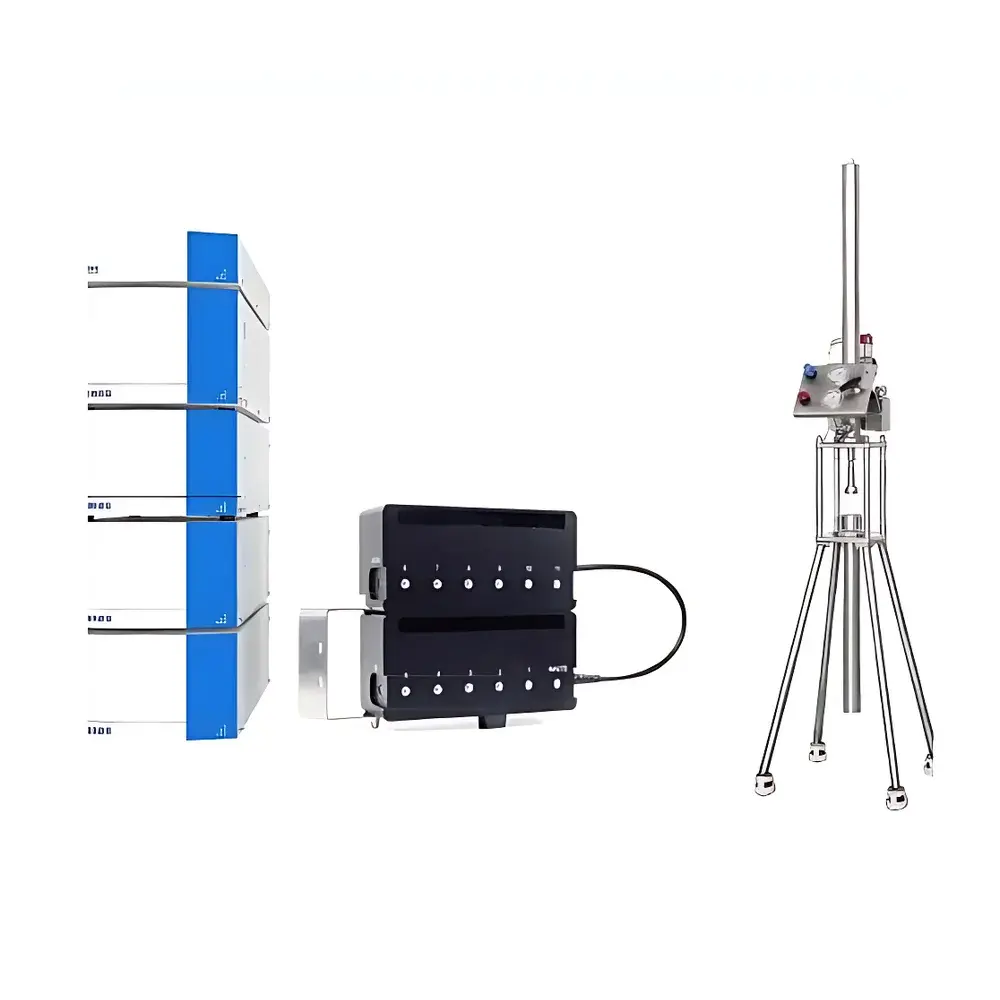
KEZHE ScalePuri-150 Medium-Scale Preparative High-Pressure Liquid Chromatography System
| Brand | KEZHE SHANGHAI |
|---|---|
| Origin | Shanghai, China |
| Manufacturer Type | Original Equipment Manufacturer (OEM) |
| Product Category | Domestic |
| Model | ScalePuri-150 |
| Application Level | Laboratory & Pilot-Scale |
| Instrument Type | High-Pressure Preparative Liquid Chromatograph |
| Flow Rate Range | 0.01–1000 mL/min |
| Flow Accuracy | ±2.0% |
| Flow Precision | ±1.5% (injector pump) |
| Maximum Pressure | 10 MPa (100 bar) |
| Wavelength Range | 190–850 nm |
| Wavelength Accuracy | ±1 nm |
| Baseline Noise | ±0.1 mAU @ 254 nm |
| Baseline Drift | 0.2 mAU/30 min @ 254 nm |
| Data Acquisition Rate | Not specified |
Overview
The KEZHE ScalePuri-150 is a medium-scale preparative high-pressure liquid chromatography (HPLC) system engineered for robust, reproducible isolation and purification of bioactive compounds at pilot-scale volumes—ranging from tens to hundreds of grams per run. Designed specifically for demanding applications in natural product chemistry, pharmaceutical process development, and synthetic compound purification, the system implements a dual-pump high-pressure binary gradient architecture coupled with axial compression column technology. Its operational pressure limit of 10 MPa (100 bar) enables efficient use of both conventional silica-based and modern high-efficiency stationary phases—including C18, phenyl-hexyl, amino, and cyano chemistries—while maintaining column integrity under extended loading conditions. Unlike analytical or small-scale prep systems, the ScalePuri-150 integrates flow dynamics, detection fidelity, and fraction collection logic into a single platform capable of bridging early-stage discovery workflows with pre-clinical material supply requirements.
Key Features
- High-capacity binary high-pressure pump delivering precise flow control across 0.01–1000 mL/min, with ±2.0% flow accuracy and real-time pressure monitoring up to 10 MPa
- UV-Vis detector featuring simultaneous four-wavelength monitoring (190–850 nm), dual-lamp source (deuterium + tungsten-halogen), wavelength accuracy of ±1 nm, and low-noise performance (±0.1 mAU baseline noise at 254 nm)
- DAC150 dynamic axial compression column (150 mm ID × 650 mm height), optimized for uniform flow distribution, minimal band broadening, and >95% recovery yield in multi-gram separations
- Integrated programmable injector pump (0.01–200 mL/min, ±1.5% accuracy) supporting both loop and direct injection modes for flexible sample introduction
- Intelligent fraction collector with multiple triggering modes: time-based, volume-based, threshold voltage (peak-triggered), and multi-threshold peak detection
- Modular software-controlled operation via KEZHE’s dedicated preparative LC workstation, enabling real-time parameter adjustment, method storage, and remote instrument supervision
- Comprehensive system safety suite including overpressure shutdown, pressure fluctuation damping, and audible/visual alarm protocols
- Source lamp life tracking, automatic intensity calibration, and optical path diagnostics to ensure long-term detector stability
Sample Compatibility & Compliance
The ScalePuri-150 accommodates a wide range of sample matrices—including crude herbal extracts, fermentation broths, reaction mixtures, and synthetic intermediates—with compatibility for both reversed-phase and normal-phase chromatographic modes. Its column interface supports standard 100–150 mm internal diameter columns and optional axial compression hardware for enhanced packing density and resolution retention. From a regulatory standpoint, the system conforms to Good Laboratory Practice (GLP) and Good Manufacturing Practice (GMP) frameworks. Audit trail functionality, electronic signature support (per FDA 21 CFR Part 11), user role-based access control, and full data integrity logging are embedded within the software architecture. The system is suitable for IQ/OQ/PQ qualification and meets essential design criteria referenced in ICH Q5, USP , and ISO/IEC 17025 for method validation and traceable separation processes.
Software & Data Management
KEZHE’s modular preparative LC workstation provides a unified interface for instrument control, method development, peak integration, and fraction mapping. It includes native chromatogram deconvolution tools, retention time alignment algorithms, and customizable report templates compliant with internal SOPs and external audit requirements. All raw data files are stored in vendor-neutral formats (e.g., .cdf or .csv) with metadata embedding—including operator ID, timestamp, method version, and hardware configuration snapshot. The software enforces strict change control: any modification to acquisition parameters, collection logic, or calibration settings is automatically timestamped and attributed to the logged-in user. Data backups can be scheduled to network drives or cloud repositories, and optional integration with LIMS platforms is supported via standardized API endpoints.
Applications
The ScalePuri-150 serves as a core tool in pharmaceutical R&D labs for isolating lead compounds from natural sources, purifying synthetic analogues for structure–activity relationship (SAR) studies, and generating reference standards for assay development. In academic and industrial phytochemistry, it enables scalable fractionation of complex plant extracts—such as those from Salvia miltiorrhiza, Paullinia cupana, or Camellia sinensis—with consistent retention of thermolabile constituents. Its high-flow capability and gradient flexibility also make it suitable for orthogonal purification strategies, including pH-mediated two-dimensional LC and sequential solvent polarity stepping. Additionally, the system supports process optimization experiments—e.g., evaluating loading capacity vs. resolution trade-offs, assessing column lifetime under repeated high-mass injections, and validating cleaning-in-place (CIP) protocols.
FAQ
What column dimensions are supported by the ScalePuri-150?
The system is optimized for columns with internal diameters between 100 mm and 150 mm, and accommodates standard lengths up to 650 mm; custom-length DAC columns can be integrated upon request.
Can the UV detector operate simultaneously at four wavelengths without scanning delay?
Yes—the detector acquires absorbance data at four user-defined wavelengths in parallel using synchronized photodiode array sampling, eliminating dwell-time artifacts during gradient elution.
Is the system compatible with non-UV-detectable compounds?
Optional detectors—including ELSD (evaporative light scattering) and MS-coupled interfaces—are available through KEZHE’s modular expansion kit, enabling universal detection for non-chromophoric analytes.
Does the software support automated method transfer from analytical to preparative scale?
The workstation includes a scale-up calculator module that translates retention times, k’ values, and gradient profiles from analytical methods (e.g., 4.6 mm ID columns) into equivalent preparative conditions, accounting for column volume, flow rate scaling, and mass overload effects.
How is system suitability verified prior to critical runs?
Built-in system suitability tests include backpressure profiling, gradient delay volume measurement, UV lamp intensity verification, and baseline stability assessment—all documented with pass/fail thresholds aligned with USP and EP 2.2.46 guidelines.





