
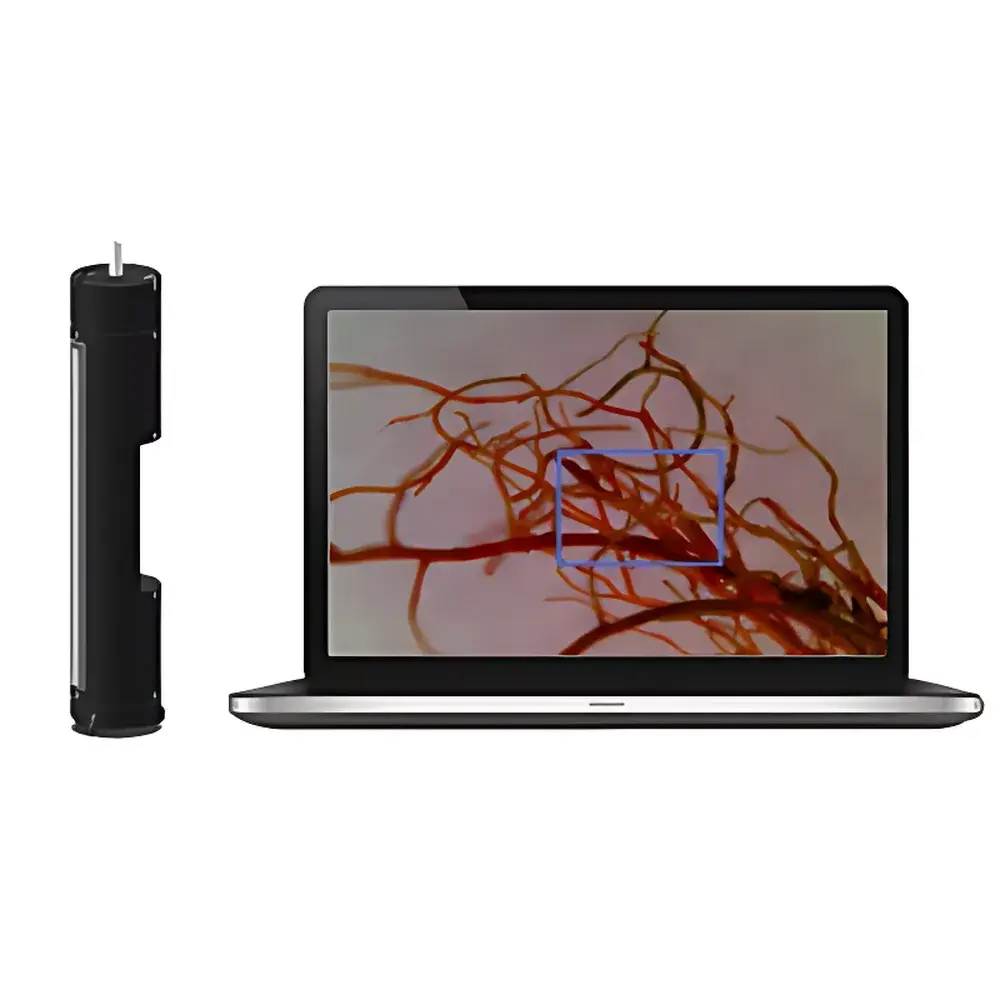
RootSS900 Plant Root System In Situ Scanning & Imaging Monitoring System
| Origin | Beijing, China |
|---|---|
| Manufacturer Type | Authorized Distributor |
| Origin Category | Domestic (PRC) |
| Model | RootSS900 |
| Price | USD 53,200 (FOB Beijing) |
| Imaging Resolution | 4800 DPI (photography), up to 1200 DPI (360° rotational scan) |
| Scan Area | 220 mm × 210 mm |
| Photo Field of View | 50 mm × 40 mm |
| Capture Speed | ≤1 s per image |
| Light Sources | Software-controlled independent white, UV (365 nm), red (630 nm), and green (525 nm) LEDs for both imaging and scanning |
| Depth Probe | Stainless-steel segmented extension rod (20 cm/segment), mm-scale刻度, infinitely adjustable locking via precision定位孔 |
| Environmental Sensors | Integrated temperature sensor + water immersion detection module with auto-alarm and power cutoff |
| Geomagnetic Orientation Module | Real-time Earth magnetic azimuth calibration (±0.5° accuracy) embedded in metadata |
| Power Interface | USB 3.0 bus-powered (no external controller or AC adapter required) |
| Software Features | Real-time lens distortion correction, dynamic color balancing, QR code recognition (auto-tagging of root tube IDs), GLP-compliant audit trail logging |
Overview
The RootSS900 Plant Root System In Situ Scanning & Imaging Monitoring System is an engineered solution for non-destructive, high-fidelity acquisition and quantitative analysis of root architecture under controlled or field-adjacent conditions. Designed around a dual-mode optical acquisition architecture—combining high-resolution static photography with programmable 360° rotational scanning—the system enables longitudinal monitoring of root morphology, spatial orientation, and phenotypic response across developmental stages. Its core measurement principle relies on multi-spectral reflectance imaging under precisely controlled illumination (white, UV, red, and green), coupled with geometrically registered rotational scanning to reconstruct circumferential root surface topology. Unlike destructive excavation or 2D planar imaging systems, the RootSS900 preserves root-soil interface integrity during data capture and embeds geospatial context via real-time geomagnetic azimuth tagging—critical for repeatable positioning in rhizotron, minirhizotron, or soil column studies.
Key Features
- USB 3.0 bus-powered architecture eliminates dependency on external controllers, AC power, or bulky enclosures—enabling rapid deployment in greenhouse, growth chamber, or field-based rhizotrons.
- Four independently addressable LED light sources (white, 365 nm UV, 630 nm red, 525 nm green) with software-defined intensity control and automatic parameter logging—supporting spectral contrast enhancement for root tissue differentiation, lignin visualization, or microbial fluorescence screening.
- Real-time optical correction engine compensates for lens distortion and chromatic aberration during acquisition, ensuring pixel-level geometric fidelity without post-hoc calibration overhead.
- Stainless-steel modular extension rod (20 cm segments, mm-graduated, infinite-depth locking) provides mechanical stability and precise depth registration—compatible with standard 5–10 cm diameter root tubes used in ASTM D5219-22 and ISO 21527-2 compliant installations.
- Integrated environmental safety module monitors root tube temperature and detects aqueous intrusion; triggers audible/visual alarm and initiates safe power-down to protect optics and electronics.
- Embedded geomagnetic compass (±0.5° resolution) stamps each image and scan with true north-referenced azimuth metadata—enabling spatiotemporal alignment across multi-session experiments and cross-instrument data fusion.
Sample Compatibility & Compliance
The RootSS900 is validated for use with transparent or semi-transparent root observation tubes (acrylic, quartz, or borosilicate glass) ranging from 50–120 mm in diameter and up to 2 m in length. It supports both monocot and dicot root systems—including maize, wheat, Arabidopsis, soybean, and poplar—with minimal shadowing artifacts due to its coaxial illumination geometry. All firmware and software modules comply with GLP documentation standards: full audit trail logging (user actions, parameter changes, timestamped metadata), electronic signature support, and immutable export of raw TIFF/RAW and calibrated analysis files. The system meets IEC 61000-6-3 (EMC emission) and IEC 61000-6-2 (immunity) requirements for laboratory instrumentation, and its optical design adheres to ISO 9022-3 (microscopy illumination uniformity) guidelines.
Software & Data Management
The proprietary RootVision Suite (v4.2+) provides unified control of scanning, imaging, lighting, and sensor modules through a Qt-based GUI. Image acquisition workflows are scriptable via Python API (included), enabling integration into automated phenotyping pipelines. All images and scans are stored with EXIF-like structured metadata—including light spectrum ID, intensity (%), exposure time, geomagnetic heading, depth coordinate, temperature, and water status. QR code recognition (ISO/IEC 18004 compliant) automates sample labeling by reading printed codes affixed to root tubes—eliminating manual entry errors and enforcing traceability per FDA 21 CFR Part 11 Annex 11 requirements. Export formats include TIFF (16-bit), CSV (morphometric parameters), and HDF5 (multi-layer volumetric stacks for machine learning training).
Applications
- Long-term root architectural phenotyping in response to drought, nutrient stress, or mycorrhizal inoculation—tracking changes in root diameter distribution, branching angle, and lateral root density over time.
- Non-invasive assessment of pesticide or herbicide phytotoxicity on root meristem activity and cortical cell integrity using UV-induced autofluorescence contrast.
- Validation of root growth models (e.g., CRootBox, OpenSimRoot) by providing ground-truth 360° surface reconstructions for parameter fitting.
- Soil-root interaction studies requiring co-registered spatial metadata—e.g., correlating root growth directionality with local soil moisture gradients measured via adjacent TDR probes.
- Education and training in plant functional ecology, where real-time visualization of root tropisms (hydrotropism, gravitropism) enhances conceptual understanding of belowground signaling.
FAQ
Is the RootSS900 compatible with existing minirhizotron tubes?
Yes—it supports standard cylindrical observation tubes with inner diameters from 50 mm to 120 mm and accommodates wall thicknesses up to 8 mm. Optical coupling gel is recommended for acrylic tubes to minimize refraction artifacts.
Does the system support batch processing of multiple root tubes?
Yes. The RootVision Suite includes a queue manager that accepts pre-configured tube lists with depth ranges and lighting protocols—enabling unattended overnight acquisition across 12+ tubes.
Can raw image data be exported for third-party analysis (e.g., WinRHIZO, EZ-Rhizo)?
Yes. TIFF exports preserve full bit-depth and embedded metadata; calibration profiles are provided for reproducible grayscale normalization in external tools.
What is the warranty and service coverage for field-deployed units?
The RootSS900 carries a 24-month parts-and-labor warranty, including on-site calibration validation upon installation. Extended service plans include annual optical alignment verification and firmware compliance updates aligned with ISO/IEC 17025 laboratory accreditation requirements.





