
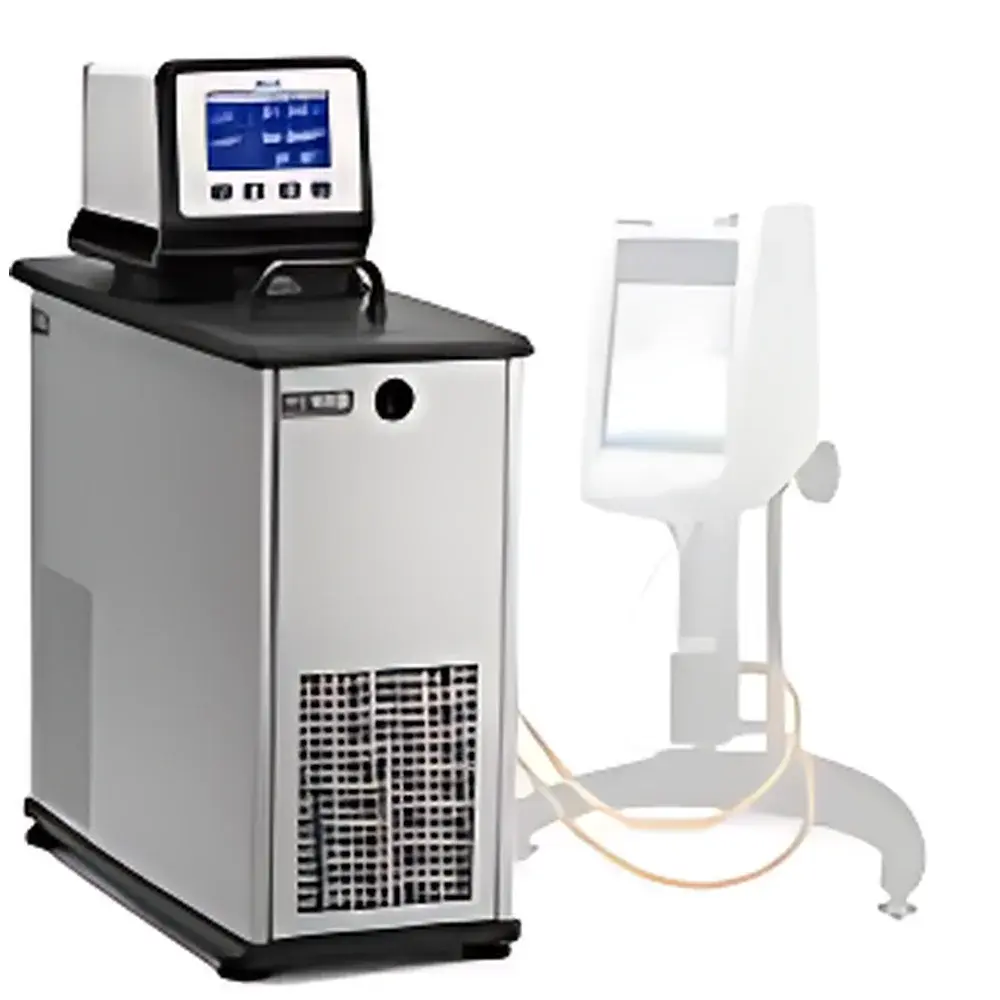
Brookfield TC-650 Circulating Bath Thermostat
| Brand | Brookfield |
|---|---|
| Origin | Germany |
| Model | TC-650 |
| Temperature Range (TC-650AP) | –20 °C to +200 °C |
| Temperature Range (TC-650SD) | –20 °C to +170 °C |
| Temperature Range (TC-650MX) | –20 °C to +135 °C |
| Temperature Stability | ±0.01 °C (AP), ±0.04 °C (SD), ±0.07 °C (MX) |
| Bath Capacity | 7.0 L |
| Pump Flow Rate | 16 L/min (AP), 11 L/min (SD), 12 L/min (MX) |
| Pump Type | Adjustable-speed (AP), 2-stage (SD), 1-stage (MX) |
| Internal Dimensions (W×D×H) | 157 × 142 × 127 mm |
| External Dimensions (W×D×H) | 540 × 220 × 617 mm (AP/SD), 540 × 220 × 645 mm (MX) |
| Weight | 45 kg (AP/SD), 42 kg (MX) |
| Power Supply | Voltage and frequency specified at order |
Overview
The Brookfield TC-650 Circulating Bath Thermostat is a precision-engineered temperature control system designed for integration with rotational rheometers, viscometers, and other laboratory instrumentation requiring stable thermal environments. Operating on the principle of forced-circulation liquid cooling and heating, the TC-650 maintains highly reproducible bath temperatures across its full operational range by continuously recirculating thermally conditioned fluid—typically water or water-glycol mixtures—through an external jacket or accessory heat exchanger. Its compact footprint (540 × 220 × 617 mm) enables seamless placement on standard lab benches without reliance on tap water cooling, making it suitable for controlled environments where utility infrastructure is limited or regulated. The unit supports three controller configurations—AP (Advanced Programmable), SD (Standard Digital), and MX (Multi-Function)—each optimized for distinct workflow requirements in QC, R&D, and regulatory-compliant testing laboratories.
Key Features
- Three controller variants (AP, SD, MX) offering scalable functionality—from basic setpoint control to PC-based programmability and real-time data logging
- High-precision temperature regulation with stability as tight as ±0.01 °C (AP model), achieved via PID-controlled heating/cooling and high-resolution platinum RTD sensing
- Adjustable-speed pump (AP) enabling dynamic flow optimization for varying thermal loads and viscosity-dependent heat transfer efficiency
- 7-liter reservoir capacity accommodating standard 600 mL beakers and compatible with Brookfield’s full suite of temperature-controlled accessories, including jacketed spindles and Peltier-cooled sample holders
- Rugged stainless-steel bath chamber and corrosion-resistant internal plumbing engineered for long-term use with aqueous and mildly aggressive heat-transfer fluids
- Compliance-ready design supporting audit trails and electronic record integrity when paired with RheoCalcT software under 21 CFR Part 11–configured systems
Sample Compatibility & Compliance
The TC-650 is validated for use with Brookfield DVNext, DV2T, and CAP2000+ rheometers, as well as third-party instruments equipped with external temperature-jacket interfaces. Its bath geometry accommodates samples in vessels up to 600 mL and supports immersion-based thermal equilibration of both Newtonian and non-Newtonian fluids. The system meets general safety requirements per IEC 61010-1 and carries CE marking for use within the European Economic Area. When operated with AP controller firmware and RheoCalcT v4.0+, the TC-650 supports GLP/GMP-aligned workflows—including user-access controls, parameter change logging, and timestamped calibration records—facilitating compliance with ISO/IEC 17025, ASTM D2196, and USP <911> viscosity testing guidelines.
Software & Data Management
The AP variant integrates natively with Brookfield’s RheoCalcT software via RS-232 or USB interface, enabling remote temperature ramping, multi-step protocols, and synchronized acquisition of viscosity, shear rate, and thermal data. All controller versions log operational parameters—including setpoint history, actual bath temperature, pump status, and error codes—to non-volatile memory. The MX controller adds touchscreen-driven local programming with up to 10 user-defined profiles; the SD version provides simplified numeric keypad input and dual-line LCD readout. Data export is supported in CSV format for post-processing in Excel, MATLAB, or LIMS platforms. No proprietary drivers are required—standard Windows COM port enumeration ensures plug-and-play compatibility.
Applications
- Temperature-dependent viscosity profiling of polymers, adhesives, and pharmaceutical suspensions per ASTM D1084 and ISO 3219
- Thermal stability assessment of lubricants and greases during shear under controlled ambient conditions
- Calibration verification of temperature-sensitive sensors using NIST-traceable reference fluids
- Pre-conditioning of samples prior to rheological characterization to eliminate thermal hysteresis effects
- Supporting accelerated aging studies where precise thermal cycling between –20 °C and +200 °C is required
- Integration into automated test cells for unattended, overnight rheometry sequences with thermal ramping
FAQ
What is the recommended heat-transfer fluid for operation above 100 °C?
For sustained operation above 100 °C, a 50:50 mixture of propylene glycol and deionized water is recommended to suppress boiling and minimize oxidation. Pure water may be used up to 95 °C with adequate ventilation.
Can the TC-650 be used with non-Brookfield rheometers?
Yes—the unit features standardized ¼” NPT inlet/outlet ports and delivers consistent flow rates and thermal stability compatible with most externally jacketed viscometers and rheometers from Anton Paar, Thermo Fisher, and TA Instruments.
Is external calibration required for temperature accuracy verification?
While factory-calibrated using traceable standards, periodic verification against a calibrated PT100 probe immersed at the bath center is advised per ISO/IEC 17025 Section 6.4. Calibration certificates are available upon request.
How does ambient temperature affect performance at extreme setpoints?
At ambient temperatures exceeding 30 °C or below 15 °C, maximum achievable bath temperature and minimum cooling capacity may deviate by ±2 °C from nominal specifications—particularly near the extremes of the –20 °C to +200 °C range.
What maintenance intervals are recommended for optimal longevity?
Pump impeller inspection and fluid replacement every 12 months (or 2,000 operating hours) is recommended. Annual cleaning of the condenser coil and verification of refrigerant charge (for models with integrated compressor) ensure sustained thermal performance.



