
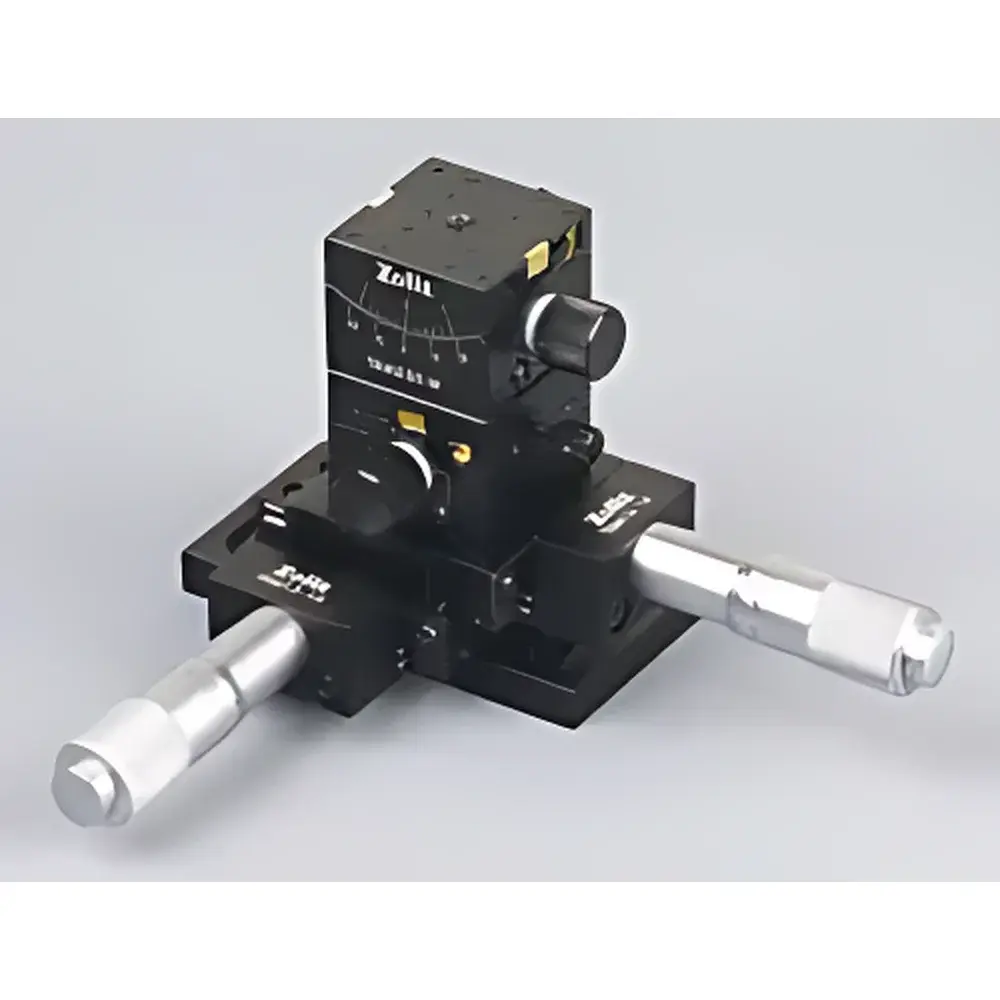
ASM13XY-G2 Four-Axis Combined Translation and Tip-Tilt Stage
| Brand | ZOLIX |
|---|---|
| Origin | Beijing, China |
| Manufacturer Type | Direct Manufacturer |
| Product Origin | Domestic (China) |
| Model | ASM13XY-G2 |
| Pricing | Available Upon Request |
| Degrees of Freedom | X, Y, θx, θy |
| Linear Travel (X/Y) | ±13 mm |
| Angular Range (θx/θy) | ±30° |
| Base Configuration | Two ASM13-1A Linear Translation Stages + One TSMG15-W Precision Tip-Tilt Stage + One TSMG30-W Precision Tip-Tilt Stage |
Overview
The ASM13XY-G2 Four-Axis Combined Translation and Tip-Tilt Stage is an integrated optomechanical positioning system engineered for high-stability, multi-degree-of-freedom alignment in precision optical laboratories. Designed around a modular architecture, it combines orthogonal linear translation (X and Y) with independent rotational degrees of freedom about the x- and y-axes (θx and θy), enabling full six-degree-of-freedom coarse alignment—excluding z-axis translation and yaw (θz)—within a compact, rigid platform. Its operational principle relies on mechanical coupling of calibrated micrometer-driven linear stages and kinematically constrained tip-tilt mechanisms, delivering deterministic, repeatable motion without hysteresis or backlash under typical laboratory loading conditions (≤2 kg). The stage is optimized for applications requiring iterative beam steering, collimation correction, fiber coupling alignment, and interferometric setup stabilization—particularly where spatial constraints preclude stacked or cascaded stage configurations.
Key Features
- Four independently controllable axes: bidirectional linear translation along X and Y (±13 mm each), plus angular adjustment about horizontal (θx) and vertical (θy) axes (±30° each)
- Modular construction using two ASM13-1A high-rigidity linear translation stages (13 mm travel, 0.5 µm resolution via differential micrometers) and two specialized tip-tilt units: one TSMG15-W (15 arcmin fine adjustment range, 1 arcsec repeatability) and one TSMG30-W (30 arcmin coarse/fine dual-range capability)
- Machined aluminum alloy baseplate with black anodized finish for dimensional stability, thermal homogeneity, and ESD-safe surface properties
- Integrated mounting interface compliant with standard 25 mm and 50 mm optical rail systems (e.g., Thorlabs TR series, Newport M-series), featuring tapped M4 and M6 holes on all side faces and top surface
- No internal electronics or motors—purely manual, mechanical operation ensures immunity to electromagnetic interference (EMI), zero power dependency, and compatibility with ultra-high vacuum (UHV) environments when optionally configured with vacuum-compatible lubricants and fasteners
Sample Compatibility & Compliance
The ASM13XY-G2 accommodates optical components ranging from Ø12.7 mm lens mounts to 100 mm × 100 mm optomechanical breadboards, with a maximum recommended payload of 1.8 kg distributed evenly across its central load zone. All structural components meet ISO 2768-mK general tolerances for machined parts, and surface flatness of the top mounting plate is specified at ≤15 µm over 100 mm. While not certified to specific international standards as a standalone subsystem, the stage’s mechanical design and material selection align with common requirements for GLP-compliant optical alignment workflows. It supports traceable calibration protocols per ISO/IEC 17025 when used in conjunction with external metrology tools (e.g., autocollimators, laser trackers, or coordinate measuring machines), and its passive construction avoids conflicts with FDA 21 CFR Part 11 data integrity expectations in regulated R&D settings where positional records are manually logged.
Software & Data Management
As a fully manual, non-motorized stage, the ASM13XY-G2 does not incorporate embedded firmware, onboard controllers, or digital communication interfaces. Positional data acquisition requires external instrumentation: angular orientation may be monitored using capacitive or optical encoder-based goniometers (e.g., Physik Instrumente S-330 series), while linear displacement can be tracked via linear variable differential transformers (LVDTs) or laser interferometers (e.g., Keysight 5530 series). Users commonly integrate such sensors into LabVIEW, MATLAB, or Python-based automation frameworks for closed-loop alignment sequences. Documentation includes English-language mechanical drawings (PDF/DXF), GD&T specifications, and assembly instructions compliant with ASME Y14.5–2018; no proprietary software drivers or cloud services are provided or required.
Applications
- Precision alignment of single-mode optical fibers to photonic integrated circuits (PICs) during active coupling procedures
- Iterative collimation and focus optimization of diode-pumped solid-state (DPSS) lasers and ultrafast amplifier systems
- Beam walk correction in Mach–Zehnder and Michelson interferometers subject to thermal drift
- Mounting and alignment of micro-optical elements—including MEMS mirrors, liquid crystal spatial light modulators (LC-SLMs), and quantum dot emitters—in cryogenic or vibration-isolated optical tables
- Calibration fixture integration for imaging systems requiring field-of-view centering and tilt compensation prior to MTF or PSF characterization
FAQ
Is the ASM13XY-G2 compatible with motorized actuation?
Yes—external stepper or piezo actuators (e.g., Newport ESP300-compatible stages or Physik Instrumente P-561 series) can be retrofitted to replace manual micrometers, though this requires custom adapter plates and mechanical recalibration.
What is the typical angular repeatability after thermal equilibration?
Under controlled lab conditions (23 ±0.5 °C, humidity 40–60% RH), angular repeatability is ≤3 arcseconds for θx/θy over 10 consecutive cycles when using the TSMG30-W’s fine-adjustment mode.
Can this stage be used in cleanroom Class 100 environments?
Yes—the anodized aluminum structure generates negligible particulates; however, users must verify lubricant compatibility (e.g.,选用 dry-film MoS₂ coatings) and perform particle shedding tests per ISO 14644-1 prior to deployment.
Does ZOLIX provide calibration certificates?
Standard delivery includes factory verification reports for travel range and orthogonality; NIST-traceable calibration certificates are available as a value-added service upon request.
Are replacement micrometer heads available separately?
Yes—standard 0.5 mm pitch, 10 µm vernier-readout micrometer barrels (M4 × 0.7 thread) are stocked and supplied with full interchangeability documentation.



