
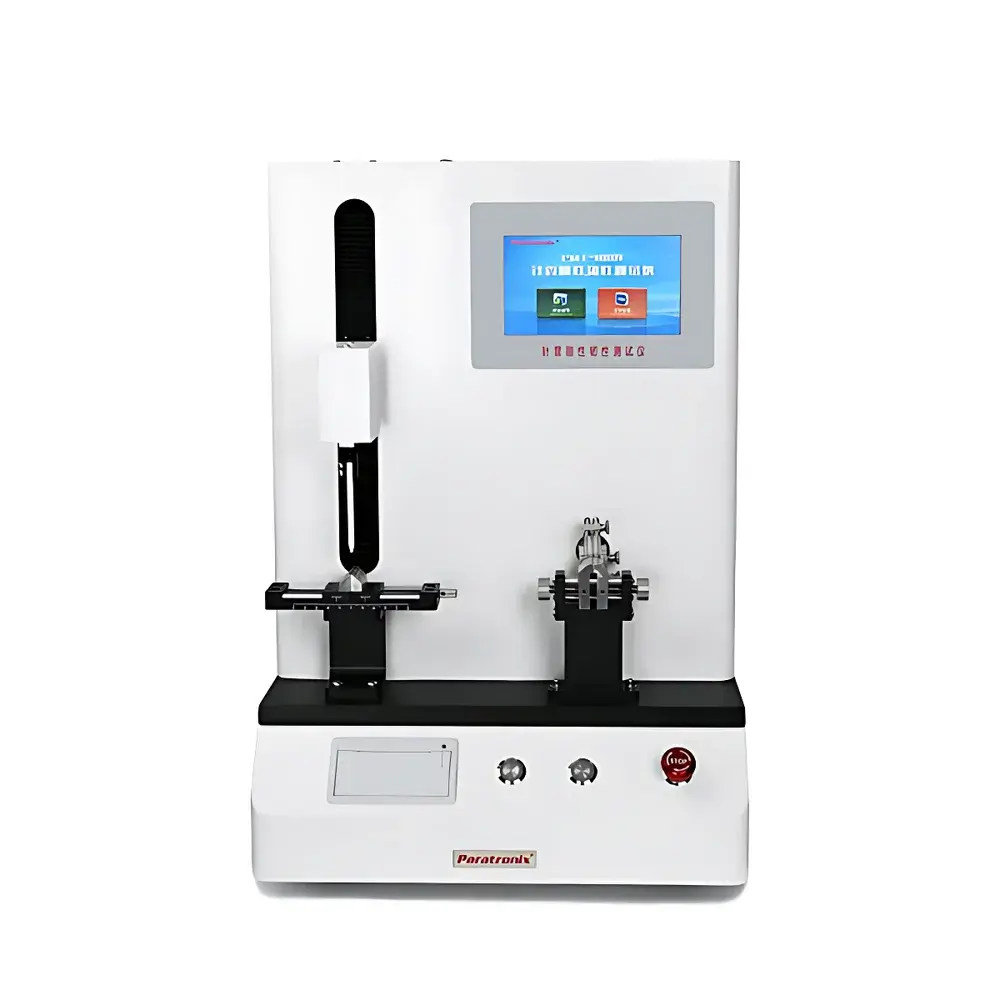
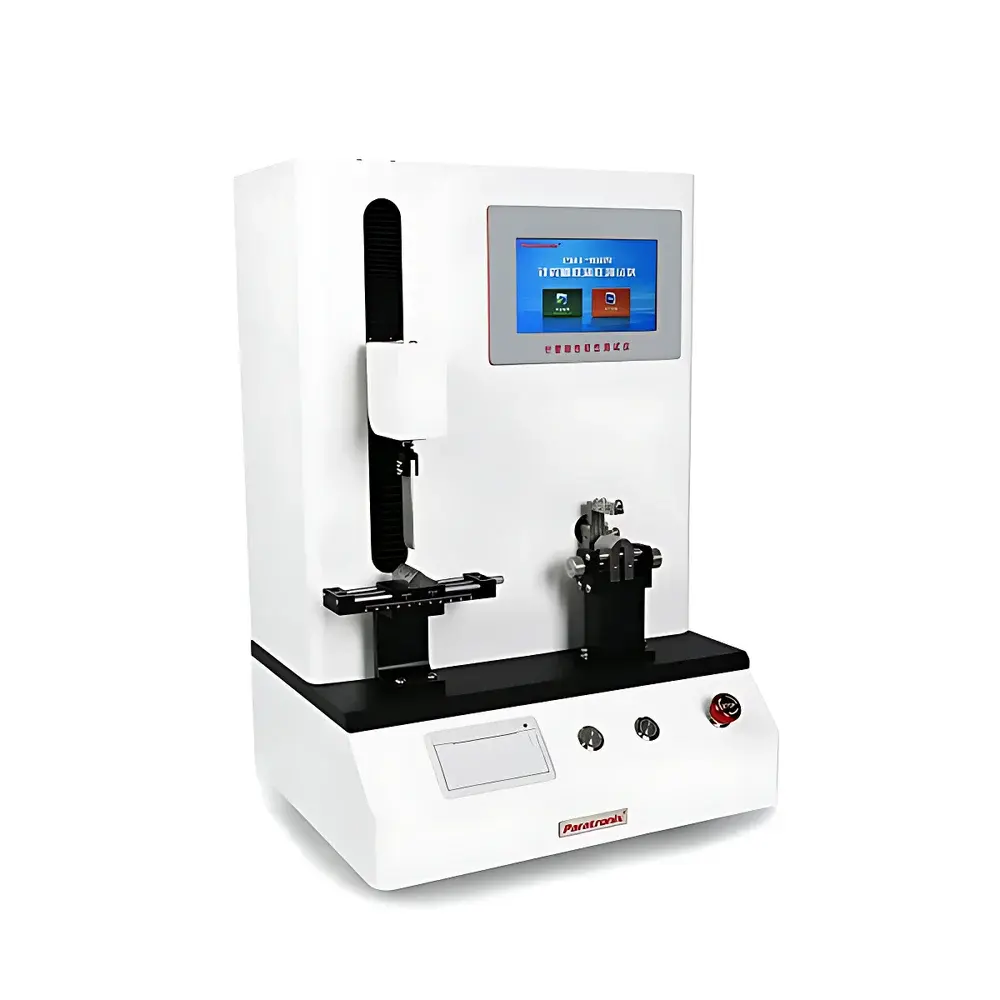
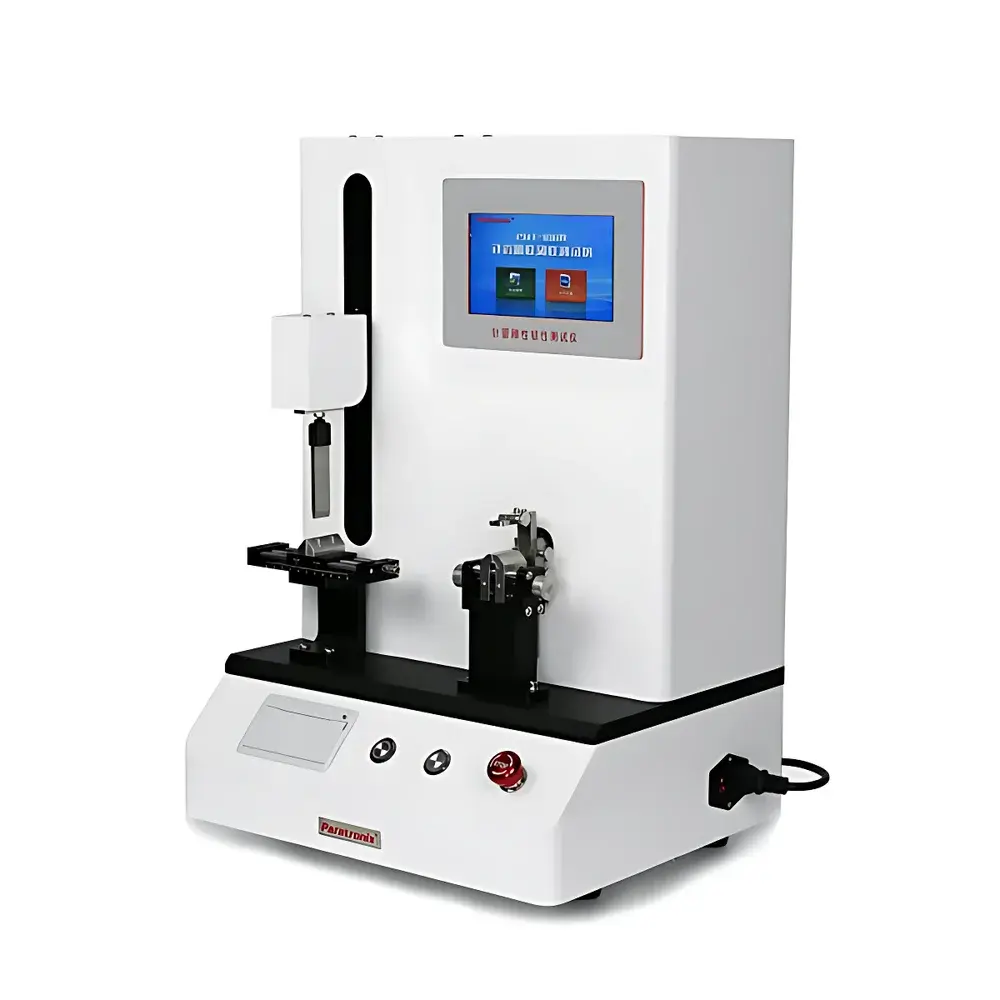
Paratronix PMT-100N Medical Needle Tubing Flexural Toughness Tester
| Brand | Paratronix |
|---|---|
| Origin | Shandong, China |
| Manufacturer Type | Direct Manufacturer |
| Model | PMT-100N |
| Max Test Force | 50 N |
| Loading Speed Range | 0.1–200 mm/min (infinitely variable) |
| Force Resolution | 0.01 N |
| Bending Angle Range | 1–30° |
| Bending Frequency | 0.1–1.0 Hz |
| Span Adjustment Range | 5–100 mm |
| Span Accuracy | ±0.1 mm |
| Wall Thickness Modes | Standard / Thin / Ultra-Thin Wall Selection |
| Power Supply | 220 V, 50 Hz |
| Dimensions (L×W×H) | 420 × 350 × 620 mm |
| Weight | ~30 kg |
Overview
The Paratronix PMT-100N Medical Needle Tubing Flexural Toughness Tester is a precision-engineered mechanical testing instrument designed specifically for evaluating the flexural durability and structural integrity of rigid stainless steel medical needle tubing under controlled cyclic bending conditions. It operates on the principle of standardized angular displacement-driven fatigue testing—applying repetitive, programmable bending motion at defined angles, frequencies, and span lengths to simulate clinical handling stresses encountered during insertion, manipulation, and packaging of hypodermic needles and related devices. The system complies with core regulatory test protocols outlined in GB 18457 (Stainless Steels for Medical Devices), GB 15811 (Hypodermic Needles), and YBB00092004–2015 (Pharmaceutical Packaging Materials), ensuring traceable, repeatable data generation suitable for quality control, design validation, and regulatory submissions.
Key Features
- 7-inch full-color capacitive touchscreen interface with intuitive icon-based navigation and real-time graphical feedback of bending angle, cycle count, and force response;
- Three-tier user permission architecture (Operator / Supervisor / Administrator) supporting audit trail generation and role-based access control—fully aligned with GMP Annex 11 and FDA 21 CFR Part 11 requirements for electronic records;
- Modular bending fixture platform accommodating standard, thin-wall, and ultra-thin-wall needle tubing geometries without hardware modification;
- High-stability load cell with 0.01 N resolution and ≤0.5% full-scale linearity error, calibrated per ISO 7500-1 Class 0.5;
- Infinitely variable crosshead speed control (0.1–200 mm/min) enabling precise replication of low-velocity flexural loading profiles specified in pharmacopoeial methods;
- Integrated non-volatile memory storing ≥10,000 test records with timestamp, operator ID, sample ID, and pass/fail status—exportable via USB to CSV or PDF;
- Full alphanumeric keypad for direct sample identification entry, eliminating reliance on external labeling systems;
- Robust aluminum alloy frame with vibration-damped base and precision-ground linear guides ensuring long-term mechanical repeatability across >50,000 bending cycles.
Sample Compatibility & Compliance
The PMT-100N supports testing of all rigid stainless steel needle tubing used in Class II and III medical devices, including but not limited to: single-use hypodermic needles (22G–32G), blood collection needles, IV catheter stylets, radiofrequency ablation needles, microwave applicator probes, and pre-filled syringe (PFS) stainless steel cannulae. Its adjustable span (5–100 mm) and bending angle range (1–30°) allow compliance with both minimum-bend-radius verification and high-cycle fatigue assessment per GB 15811 Clause 6.5 and ISO 7864 Annex A. All test parameters—including frequency (0.1–1.0 Hz), dwell time, and reversal symmetry—are programmable and logged with cryptographic hash integrity. Device firmware maintains internal calibration certificates traceable to CNAS-accredited reference standards, satisfying GLP documentation requirements for third-party inspection agencies and notified bodies.
Software & Data Management
Built-in embedded firmware provides deterministic real-time control of motorized actuation, sensor sampling (≥1 kHz), and event-triggered image capture (optional external camera integration). Test sequences are saved as encrypted .PMT files containing metadata (date/time, environmental temperature/humidity tags), raw sensor traces, and final judgment logic (e.g., “no fracture observed after 150 cycles at 15°”). Export functions support CSV (for statistical analysis in Minitab or JMP), XML (for LIMS ingestion), and PDF (for QA sign-off). Audit logs record every parameter change, login/logout event, and calibration action with immutable timestamps—enabling full forensic reconstruction during FDA pre-approval inspections or MDR conformity assessments.
Applications
- Validation of needle tubing ductility during stainless steel grade selection (e.g., 304 vs. 316L vs. precipitation-hardened alloys);
- Batch release testing of finished needles per ISO 13485 manufacturing controls;
- Comparative evaluation of surface-treated (e.g., electropolished, PTFE-coated) versus untreated tubing under identical bending stress;
- Design verification of novel micro-needle architectures intended for wearable drug delivery platforms;
- Root cause analysis of field failures linked to brittle fracture or plastic deformation during autoinjector actuation;
- Supporting technical dossiers for CE marking (MDD/MDR Annexes II & III) and NMPA registration submissions.
FAQ
Does the PMT-100N comply with ISO 11137 or ISO 13485 requirements for sterilization validation?
No—the instrument itself is not used for sterilization validation; however, its test outputs (e.g., post-sterilization bend resistance) are routinely incorporated into ISO 13485-compliant design verification protocols.
Can bending span be adjusted while the instrument is powered on?
Yes—motorized span positioning is fully automated and software-controlled, with position feedback from integrated linear encoders ensuring ±0.1 mm repeatability.
Is third-party calibration certification included with shipment?
Each unit ships with a factory calibration report traceable to national metrology institutes (SIMT, China), valid for 12 months; optional annual recalibration services are available through Paratronix authorized service centers.
What maintenance intervals are recommended for sustained GMP compliance?
Daily visual inspection of guide rails and load cell mounting; quarterly lubrication of lead screws; biannual verification of angle encoder linearity using certified optical goniometer standards.
Can test methods be password-locked to prevent unauthorized modification?
Yes—method templates can be assigned read-only attributes by the Administrator tier, enforcing method consistency across shifts and sites.



