
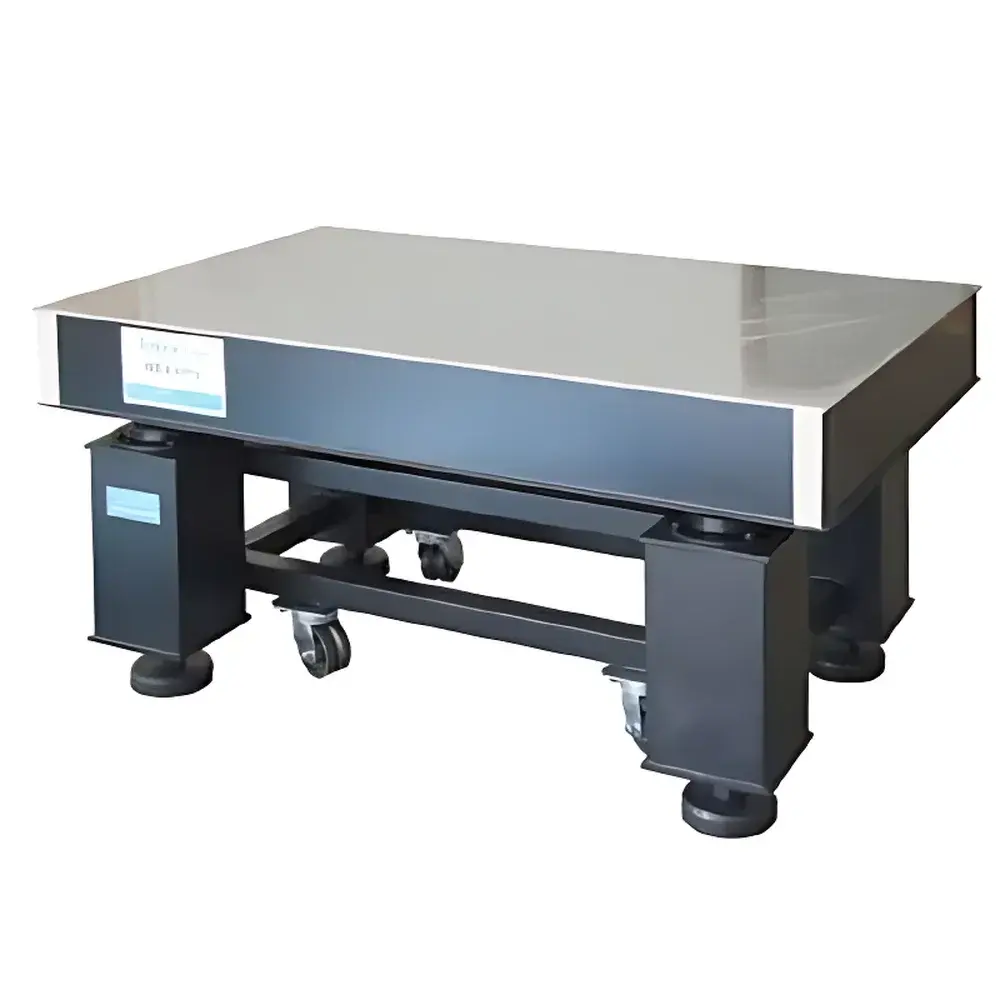
ZOLIX OTR Series Precision Damped Optical Table
| Brand | ZOLIX |
|---|---|
| Model | OTR Series |
| Origin | Beijing, China |
| Manufacturer | ZOLIX (Producer) |
| Table Thickness Options | 100 mm / 200 mm / 300 mm |
| Surface Flatness | 0.02–0.05 mm per 600 mm × 600 mm |
| Mounting Hole Pattern | M6 threaded holes on 25 mm × 25 mm grid |
| Inherent Frequency Range | <5–8 Hz |
| Table Structure | Three-layer sandwich (top: 4–6 mm ferromagnetic stainless steel |
| core | steel honeycomb grid |
| bottom | 4–6 mm carbon steel with black powder coating) |
| Side Panels | Inner carbon steel + outer black aluminum-plastic laminate |
| Base Frame | Fully welded, 4- or 6-point support with height-adjustable mechanism (±20 mm range) and casters |
| Total Height | 800 mm (adjustable) |
| Mass Loading Capacity | ~120 kg/m² (100 mm), ~140 kg/m² (200 mm), ~167 kg/m² (300 mm) |
| Damping System | High-performance precision damped isolators (upper) + standard damped pads (lower) |
Overview
The ZOLIX OTR Series Precision Damped Optical Table is engineered for demanding optical and photonics applications requiring exceptional mechanical stability and low-frequency vibration isolation. Unlike conventional passive optical tables relying solely on elastomeric pads, the OTR platform integrates a dual-stage damping architecture: high-damping precision isolators mounted at the interface between the rigid table top and the structural base frame, supplemented by secondary standard damped pads beneath the legs. This configuration reduces the system’s first mode of vibration to an inherent frequency below 5 Hz—significantly lower than typical damped tables (often >8–10 Hz)—and suppresses resonant amplification in the critical 1–20 Hz band where floor-borne disturbances (e.g., HVAC, footfall, building sway) are most prevalent. The table’s three-layer sandwich construction—comprising a ground ferromagnetic stainless-steel top plate, a high-stiffness steel honeycomb core, and a powder-coated carbon-steel base—delivers superior rigidity-to-mass ratio and minimal dynamic deflection under static and transient loads. With surface flatness controlled to ≤0.05 mm over any 600 mm × 600 mm area and a precisely machined M6 tapped grid at 25 mm pitch, the OTR platform meets the dimensional and metrological requirements of interferometry, ultrafast laser alignment, quantum optics setups, and nanoscale positioning systems.
Key Features
- Three-layer monolithic table structure: 4–6 mm ferromagnetic stainless-steel top plate bonded to a high-density steel honeycomb core and 4–6 mm carbon-steel base plate with black powder coating for corrosion resistance and EMI shielding.
- Dual-stage vibration control: Precision-tuned damped isolators (upper mounting interface) combined with standard damped pads (foot-level) to achieve sub-5 Hz first-mode resonance and broadband attenuation up to 30 dB in the 2–15 Hz range.
- High-precision surface finish: Top plate ground to ≤0.02–0.05 mm flatness over 600 mm × 600 mm, certified via coordinate measuring machine (CMM) traceable to national standards.
- Modular base frame: Fully welded, statically determinate 4- or 6-point support structure with integrated height adjustment (±20 mm range) and industrial-grade locking casters for repositioning without disassembly.
- Standardized mounting interface: Uniform 25 mm × 25 mm grid of M6 threaded holes—compatible with ISO-standard optical mounts, translation stages, kinematic mounts, and OEM integration kits.
- Robust mechanical integrity: Stainless-steel corner guards, black aluminum-plastic side panels, and reinforced leg cross-bracing ensure long-term dimensional stability under repeated loading cycles and environmental fluctuations.
Sample Compatibility & Compliance
The OTR Series accommodates optical components ranging from compact diode lasers and fiber couplers to large-format beam expanders, spatial light modulators, and multi-axis nanopositioning systems. Its load-bearing capacity—120–167 kg/m² depending on thickness—supports heavy instrumentation such as vacuum chambers, cryostats, and high-NA microscope objectives without measurable sag or creep. All structural steels comply with ASTM A36 and EN 10025 standards; surface treatments meet ISO 14644-1 Class 8 cleanroom compatibility for low-particulate environments. While not certified to ISO 10360 or ISO 14644-1 out-of-the-box, the platform’s dimensional repeatability and thermal drift characteristics (<0.5 µm/°C lateral expansion coefficient) align with GLP-compliant optical metrology workflows. Optional accessories—including calibrated spirit levels, torque-limiting hex keys, and anti-vibration anchoring kits—support audit-ready laboratory deployment per ISO/IEC 17025 requirements.
Software & Data Management
The OTR Series is a purely passive mechanical system with no embedded electronics, firmware, or software dependencies. Its performance validation relies on standardized mechanical testing protocols—not proprietary code. Users may integrate third-party vibration analysis tools (e.g., Brüel & Kjær PULSE, PCB Piezotronics EnDAQ, or MATLAB-based FFT post-processing) to quantify transmissibility, modal response, and RMS displacement across frequency bands. ZOLIX provides full dimensional drawings (STEP/IGES), CMM validation reports, and material certification documents (mill test reports for all steel grades) upon request—enabling traceable calibration and documentation for FDA 21 CFR Part 11–aligned quality systems when used in regulated R&D environments.
Applications
- Laser interferometry and gravitational wave detector prototype staging
- Ultrafast pump-probe spectroscopy requiring sub-10 fs timing stability
- Atomic force microscopy (AFM) and scanning tunneling microscopy (STM) base platforms
- Quantum computing testbeds involving trapped ions or superconducting qubits
- Optical coherence tomography (OCT) system integration with motion-sensitive detection arms
- High-resolution photolithography alignment stations and mask aligner bases
- Defense-grade electro-optical countermeasure (EOCM) hardware-in-the-loop simulation rigs
FAQ
What is the lowest achievable inherent frequency for the OTR platform?
The OTR Series achieves a first-mode inherent frequency as low as 4.8 Hz under nominal loading conditions (≤75% of rated mass capacity), verified via experimental modal analysis per ISO 10816-1.
Can the table be anchored to the floor for enhanced low-frequency isolation?
Yes—optional floor-anchoring kits with adjustable leveling feet and seismic-grade fasteners are available to further reduce translational coupling below 2 Hz.
Is the M6 thread pattern compatible with Thorlabs, Newport, and Standa mounting hardware?
Yes—the 25 mm × 25 mm M6 grid conforms to ISO 8015 and matches the mechanical interface specifications of all major optical component manufacturers.
Does ZOLIX provide installation support or site survey services?
ZOLIX offers remote technical consultation and on-site commissioning support (subject to regional service agreements) including laser-leveling verification, modal response mapping, and integration guidance for multi-table arrays.
How does thermal drift affect long-duration experiments on the OTR platform?
The symmetric steel sandwich design minimizes warping; measured thermal expansion coefficient is 11.7 µm/m·°C (average across layers), resulting in <1.2 µm lateral shift over 600 mm for a 10 °C ambient fluctuation—well within tolerance for sub-micron optical alignment.





