
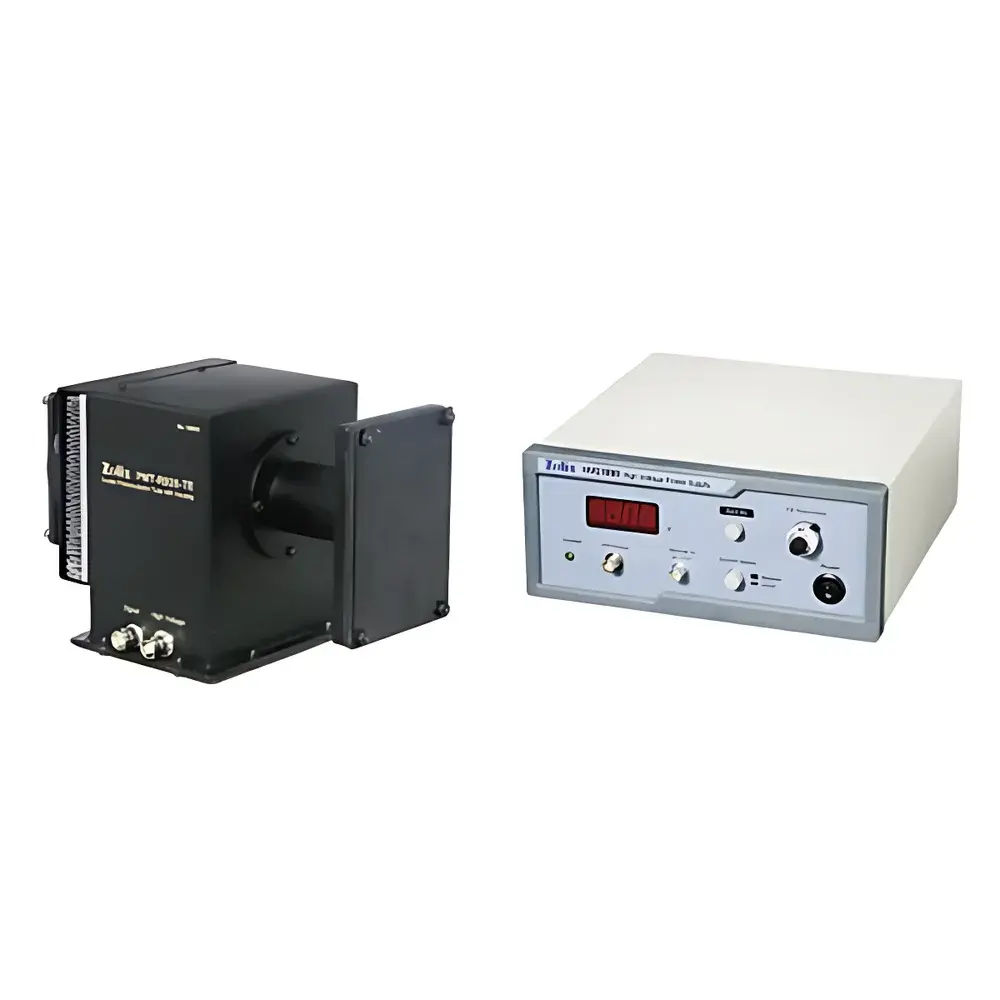
ZOLIX PMTH Series TE-Cooled Photomultiplier Tube
| Brand | ZOLIX |
|---|---|
| Model | PMTH Series |
| Cooling Type | Thermoelectric (TE) |
| Detector Type | Side-Window Photomultiplier Tube (PMT) |
| Compatible PMT Models | CR131, R928 |
| Spectral Range | 185–900 nm |
| Peak Wavelength | 400 ± 30 nm |
| Cathode Sensitivity (peak) | 74 mA/W |
| Peak Quantum Efficiency | 25.4% @ 260 nm |
| Gain | 1.0 × 10⁷ |
| Cathode Active Area | 8 × 24 mm |
| Cathode Luminous Sensitivity | 140–250 µA/lm |
| Anode Luminous Sensitivity | 1000–2500 A/lm |
| Typical Anode Dark Current | 3 nA |
| Max Anode Dark Current | 50 nA |
| Photocathode Material | Multi-alkali (S-20) |
| Dynode Structure | Box-and-Grid (9-stage) |
| Window Material | UV-Transmitting Glass |
| Anode Rise Time | 2.2 ns |
| Electron Transit Time | 22 ns |
| Cathode-to-Anode Voltage | 1250 V |
| Cathode-to-Last-Dynode Voltage | 250 V |
| Operating Ambient Temperature | −80 to +50 °C |
| Achievable Cooling Temperature | −10 °C (at 20–25 °C ambient) |
| Dark Count Rate (1 s integration, −10 °C) | 150–250 cps |
| HV Power Supply | Integrated, Low-Ripple, Adjustable Output |
Overview
The ZOLIX PMTH Series TE-Cooled Photomultiplier Tube is a high-performance, thermoelectrically stabilized detection module engineered for ultra-low-noise photon counting and analog current measurement in demanding spectroscopic applications. Built around industry-standard side-window PMT envelopes—such as the CR131 and R928—the system integrates a precision thermoelectric cooler (TEC), low-noise high-voltage power supply, and electromagnetic shielding within a compact, rigid mechanical housing. Its operation relies on the photoelectric effect at the multi-alkali (S-20) photocathode, followed by electron multiplication through a nine-stage box-and-grid dynode chain. The resulting gain of 1.0 × 10⁷ enables single-photon-level sensitivity across a broad spectral range (185–900 nm), with peak quantum efficiency of 25.4% at 260 nm and maximum cathode sensitivity of 74 mA/W at ~400 nm. Unlike cryogenic liquid-nitrogen-cooled alternatives, the TE-based thermal management achieves stable −10 °C cathode temperature under ambient conditions (20–25 °C), significantly reducing dark current without requiring infrastructure-intensive cooling systems.
Key Features
- Integrated thermoelectric cooling system maintaining cathode temperature at −10 °C (typ.), suppressing dark current to ≤3 nA (typ.) and ≤50 nA (max.)
- Low-noise, digitally stabilized high-voltage power supply with fine voltage resolution and ripple < 0.01% RMS
- Full electromagnetic interference (EMI) shielding compliant with IEC 61326-1 for laboratory-grade EMC performance
- Optimized dynode geometry delivering fast temporal response: anode rise time ≤2.2 ns, electron transit time ≤22 ns
- UV-transmitting glass window enabling high quantum efficiency down to 185 nm
- Robust mechanical design with standardized mounting interface (M4 threaded holes) for seamless integration into spectrometers, fluorimeters, and custom optical benches
Sample Compatibility & Compliance
The PMTH Series supports both analog current output and photon-counting modes, making it suitable for quantitative measurements of weak optical signals from diverse sample types—including aqueous solutions, thin films, powdered solids, and gas-phase emissions. Its spectral response aligns with ASTM E275 (Standard Practice for Describing and Measuring Performance of UV–Vis Spectrophotometers) and ISO 17025-accredited calibration protocols. The detector meets essential safety and electromagnetic compatibility requirements per IEC 61010-1 (Electrical Equipment for Measurement) and CE/UKCA marking directives. For regulated environments—such as pharmaceutical QC labs or environmental monitoring stations—the integrated HV supply supports programmable voltage ramping and real-time monitoring logs compatible with GLP/GMP audit trails when interfaced via RS-232 or USB.
Software & Data Management
ZOLIX provides native SDKs (C/C++, Python, LabVIEW) and a Windows-based control utility that enables full remote configuration of operating voltage, TEC setpoint, and integration timing. All acquired data—including dark count baselines, gain stability curves, and spectral intensity maps—are timestamped and stored in HDF5 format, ensuring traceability and interoperability with third-party analysis platforms (e.g., MATLAB, Origin, Igor Pro). The software implements automatic dark-current compensation routines based on real-time thermal feedback and supports batch-mode acquisition synchronized with external triggers (TTL-compatible input). Audit logging complies with FDA 21 CFR Part 11 requirements when used with validated user authentication and electronic signature modules.
Applications
- Time-resolved fluorescence spectroscopy (TRFS) and lifetime decay analysis in life sciences
- Low-light Raman spectroscopy where signal-to-noise ratio is limited by detector noise floor
- UV-Vis absorption and reflectance measurements of nanomaterials and semiconductors
- Environmental monitoring of trace pollutants using laser-induced fluorescence (LIF)
- Radiation detection and scintillation counting in nuclear instrumentation
- Custom OEM integration into portable spectrometers, flow cytometers, and plasma diagnostics systems
FAQ
What is the recommended operating voltage range for optimal linearity and dynamic range?
The PMTH Series is calibrated for nominal cathode-to-anode voltage of 1250 V. Linearity is maintained within ±0.5% up to 10 µA anode current; for photon counting, voltages between 800–1100 V are typically used to balance gain and pulse amplitude distribution.
Can the cooling temperature be adjusted below −10 °C?
No—the TEC architecture is optimized for −10 °C stabilization under standard lab ambient conditions. Lower temperatures would require vacuum-sealed Dewar assemblies and are outside the design envelope of this series.
Is the detector compatible with NIST-traceable calibration services?
Yes. ZOLIX offers optional factory calibration against NIST SRM 2031 (photometric scale) and SRM 2065 (spectral irradiance), with full uncertainty budgets reported per ISO/IEC 17025 guidelines.
How is electromagnetic shielding implemented in the housing?
The enclosure uses mu-metal inner lining combined with conductive gasketing at all access seams and feedthroughs, achieving >60 dB attenuation from 10 kHz to 1 GHz per MIL-STD-461G RS103.
What maintenance is required during long-term deployment?
No routine maintenance is required. The sealed PMT envelope and solid-state TEC ensure >50,000 hours MTBF. Periodic verification of dark current baseline and gain stability is recommended every 6 months in GxP environments.





