
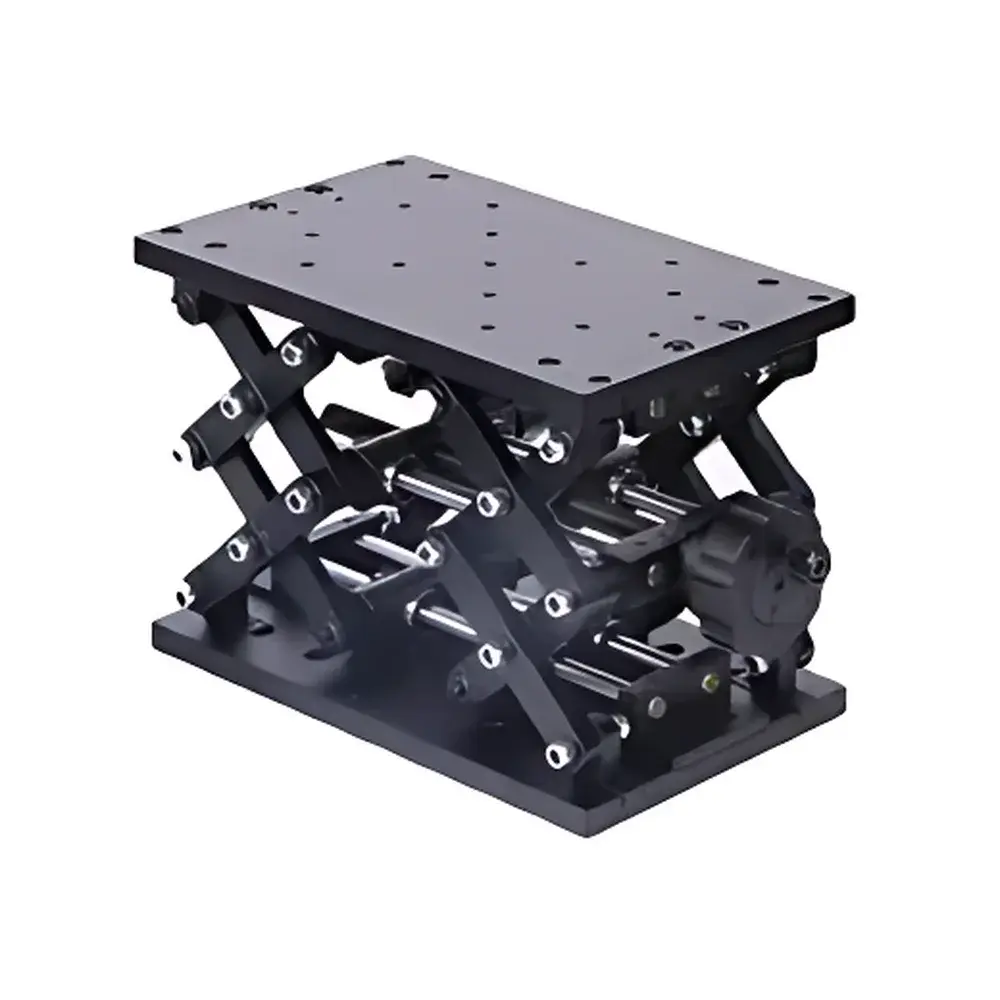
ZOLIX MJ Series Scissor-Lift Manual Translation Stage
| Brand | ZOLIX |
|---|---|
| Origin | Beijing, China |
| Manufacturer Type | Direct Manufacturer |
| Product Type | Manual Scissor-Lift Translation Stage |
| Model | MJ Series |
| Travel Options | 60 mm, 120 mm, 240 mm |
| Drive Mechanism | Precision Ground Dual-Direction Lead Screw with Ergonomic Knob |
| Top Plate Dimensions | 80×120 mm / 250×150 mm / 400×150 mm |
| Parallelism Tolerance | ≤0.1 mm (MJ60 & MJ120), ≤0.2 mm (MJ240) |
| Load Capacity | 20 kg / 30 kg / 40 kg |
| Weight | 1.15 kg / 5.5 kg / 8.5 kg |
| Locking Mechanism | Integrated Mechanical Lock |
| Compliance | Designed for ISO/IEC 17025-aligned optical alignment workflows |
Overview
The ZOLIX MJ Series Scissor-Lift Manual Translation Stage is a precision-engineered optical positioning solution designed for stable, repeatable vertical height adjustment in demanding laboratory and industrial optical setups. Unlike motorized or piezo-driven alternatives, the MJ Series employs a robust mechanical scissor-lift architecture based on kinematic over-constraint principles—specifically, a dual-rail, five-axis over-constrained guidance system coupled with a ground-lead screw transmission. This configuration eliminates parasitic tilt and lateral drift during elevation, delivering consistent axial motion with minimal hysteresis and high positional repeatability. The stage is optimized for applications requiring static load stability over extended periods—such as laser beam path alignment, interferometer cavity leveling, optical component mounting, and multi-axis optomechanical integration—where long-term mechanical integrity and zero power dependency are critical operational requirements.
Key Features
- Three standardized travel options (60 mm, 120 mm, 240 mm) enable scalable integration across compact benchtop systems and large-scale optical tables.
- Precision-ground bidirectional lead screw with ergonomic knurled knob ensures smooth, backlash-minimized actuation and tactile feedback for fine incremental control.
- Dual linear guide rails combined with five-point over-constrained linkage geometry suppress rotational error and maintain platform parallelism within ≤0.1 mm (MJ60/MJ120) or ≤0.2 mm (MJ240) across full stroke.
- Integrated mechanical locking mechanism—engaged via side-mounted lever—prevents unintended settling under sustained static load, preserving alignment integrity during instrument calibration or environmental fluctuation.
- Top plate dimensions (80×120 mm, 250×150 mm, 400×150 mm) accommodate standard optical mounts (e.g., SM1, Ø1″, kinematic bases) and support modular stacking with orthogonal translation stages or rotation platforms.
- Structural aluminum alloy construction balances rigidity, thermal stability, and weight efficiency—critical for minimizing vibration coupling in sensitive interferometric or spectroscopic configurations.
Sample Compatibility & Compliance
The MJ Series is compatible with standard optical components including lenses, mirrors, filters, detectors, and fiber collimators mounted via industry-standard kinematic or clamping interfaces. Its load capacity (20–40 kg) supports heavy-duty optical assemblies such as monochromators, spectrometer housings, or custom vacuum-compatible subassemblies. While not certified to specific regulatory standards, the design adheres to foundational mechanical engineering practices referenced in ISO 10110 (optical element tolerancing), ISO 9283 (manipulator performance testing), and ANSI/OPI B5.57 (precision positioning equipment). Its passive, non-electronic architecture inherently satisfies electromagnetic compatibility (EMC) and intrinsic safety requirements for use in RF-shielded labs, cleanrooms, or environments governed by GLP/GMP documentation protocols where electronic interference must be eliminated.
Software & Data Management
As a fully manual, non-motorized stage, the MJ Series does not require firmware, drivers, or software integration. It operates independently of computer control systems, eliminating dependencies on USB interfaces, motion controllers, or proprietary SDKs. This simplifies validation workflows—particularly in regulated environments where software qualification (per FDA 21 CFR Part 11 or EU Annex 11) would otherwise introduce audit complexity. Users maintain complete traceability through mechanical position indexing (e.g., engraved scale marks, vernier-assisted readouts) and documented handwheel rotation counts, supporting ALCOA+ data integrity principles without digital intermediaries.
Applications
- Laser cavity alignment and beam height optimization in Ti:sapphire, DPSS, and ultrafast amplifier systems.
- Vertical positioning of objective lenses or sample stages in confocal and Raman microspectroscopy platforms.
- Height calibration reference for optical profilometers and white-light interferometers.
- Stable elevation platform for vacuum feedthrough-mounted optics in UHV spectroscopy chambers.
- Modular height adjustment layer in multi-axis optomechanical breadboards used for quantum optics experiments and atomic physics setups.
- Service and maintenance positioning aid for large-format optical instruments requiring safe, tool-free vertical access.
FAQ
Is the MJ Series compatible with motorized motion control systems?
No—it is strictly manual. Integration with stepper/servo motors requires third-party retrofitting and voids factory specifications.
What is the recommended torque for locking the stage?
Apply firm hand pressure only; overtightening may deform the locking cam interface and compromise long-term repeatability.
Can the MJ240 support 40 kg continuously at maximum extension?
Yes—rated load capacity applies across full travel range, verified per static load testing per ISO 230-2 Annex C.
Are replacement lead screws or guide rails available as spare parts?
Yes—ZOLIX provides OEM-grade wear components under part numbers MJ-Screw-60/120/240 and MJ-Guide-Rail-Kit, with documented interchangeability across series generations.
Does the stage exhibit thermal drift under ambient temperature variation?
Measured coefficient of thermal expansion (CTE) of the aluminum structure is 23.1 µm/m·K; for sub-micron stability requirements, users should implement thermal soak protocols or active temperature stabilization of the optical table environment.



