
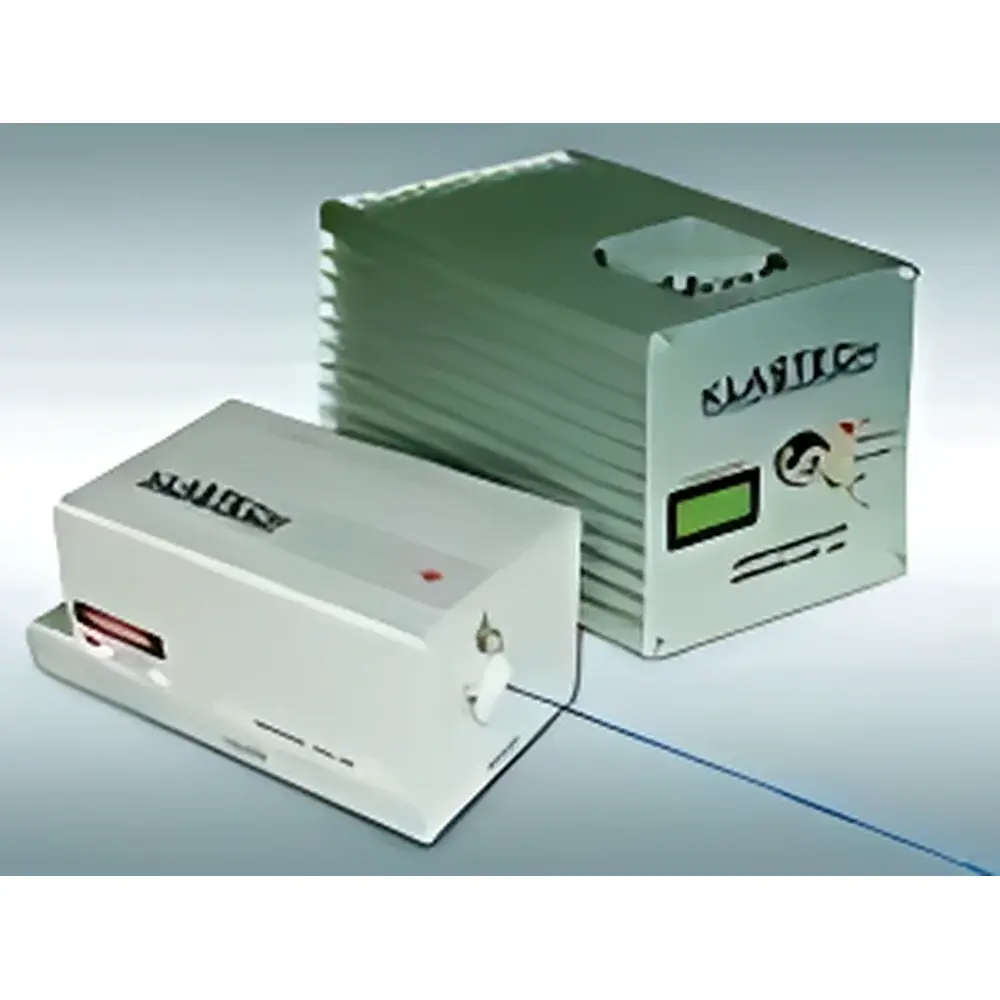
Kimmon DENICAFC-266-100 and KLASTECH Semiconductor Laser Systems
| Origin | Japan |
|---|---|
| Manufacturer Type | Authorized Distributor |
| Origin Category | Imported |
| Model | DENICAFC-266-100 |
| Price | Upon Request |
| Wavelength | 266 nm |
| Output Power | 100 mW |
| Transverse Mode | TEM₀₀ |
| Beam Diameter | 1 mm |
| Power Stability (4 h) | ±2% |
| Laser Head Dimensions | 216 × 80 × 66 mm |
Overview
The Kimmon DENICAFC-266-100 and complementary KLASTECH semiconductor laser systems represent a high-reliability platform for continuous-wave (CW) ultraviolet, visible, and near-infrared laser emission in precision optical instrumentation. Engineered for laboratory-grade stability and long-term operational integrity, these lasers employ diode-pumped solid-state (DPSS) architecture for the DENICAFC series—where a frequency-quadrupled Nd:YAG or Nd:YVO₄ crystal generates stable 266 nm UV output—and edge-emitting semiconductor diode technology for the KAL, KBL, KCL, KDPL, and SFIR product lines. All models operate in fundamental transverse electromagnetic mode (TEM₀₀), ensuring diffraction-limited beam quality essential for interferometry, confocal microscopy, Raman excitation, fluorescence lifetime measurement, and photolithography alignment. With rated lifetimes exceeding 10,000 hours and thermal management optimized for ambient operation (15–30 °C), these instruments are designed for integration into OEM analytical platforms or as standalone sources in ISO/IEC 17025-accredited testing laboratories.
Key Features
- Wavelength versatility across deep UV (266 nm) to NIR (1064 nm), supporting multi-modal spectroscopic and imaging workflows
- TEM₀₀ spatial profile with M² < 1.1, enabling efficient coupling into single-mode fibers and high-numerical-aperture optics
- Power stability of ≤ ±2% over 4-hour continuous operation—verified per IEC 61228 Annex B protocols
- Compact, conduction-cooled laser heads with standardized mechanical interfaces (e.g., M4 or M6 mounting holes) for modular system integration
- Low-noise analog modulation input (0–5 V, bandwidth up to 10 kHz) and TTL-compatible enable/disable functionality
- Compliance with IEC 60825-1:2014 Class 3B/4 laser safety requirements; CE-marked with integrated key switch and interlock circuitry
Sample Compatibility & Compliance
These lasers are compatible with standard optical breadboards, kinematic mounts, and fiber launch assemblies using SMF-28 (for 488–1064 nm) or solarization-resistant UV fiber (e.g., FUSION UV-200 for 266 nm). Beam divergence (≤1.2 mrad for diode-based units; <7 mrad for high-power 1064 nm modules) ensures minimal spot growth over working distances up to 2 m. All units conform to RoHS 2011/65/EU and REACH (EC) No. 1907/2006 material restrictions. For regulated environments—including pharmaceutical QC labs operating under FDA 21 CFR Part 11 or GLP/GMP frameworks—the systems support optional audit-trail-enabled power logging via RS-232 or USB-C serial interface, with timestamped output records traceable to NIST-traceable power meters.
Software & Data Management
No proprietary GUI is required for basic operation; however, comprehensive control is enabled via ASCII command protocol over RS-232 or USB virtual COM port. A cross-platform Python SDK (compatible with Windows, Linux, and macOS) provides API-level access to real-time power readback, temperature monitoring, error flag polling, and firmware version interrogation. Data streams can be logged in CSV format with microsecond-resolution timestamps, facilitating synchronization with external DAQ systems (e.g., National Instruments PXIe-6363) or time-correlated single-photon counting (TCSPC) hardware. Optional LabVIEW VI libraries and MATLAB Instrument Control Toolbox drivers are available upon request for automated calibration routines compliant with ISO/IEC 17025 clause 5.10.
Applications
- UV resonance Raman spectroscopy (266 nm excitation of aromatic amino acids and nucleic acid bases)
- Confocal fluorescence imaging with multi-wavelength excitation (375–532 nm)
- Laser-induced fluorescence (LIF) detection in capillary electrophoresis and microfluidic cytometry
- Interferometric displacement metrology using stabilized 532 nm or 1064 nm sources
- Photoacoustic spectroscopy source arrays requiring narrow linewidth (<0.1 nm) and low relative intensity noise (RIN < −120 dB/Hz)
- OEM integration into wafer inspection tools, where compact footprint and vibration-insensitive design minimize optical path drift
FAQ
What is the typical warm-up time to achieve specified power stability?
The DENICAFC series requires ≤15 minutes; KLASTECH diode lasers stabilize within ≤5 minutes after cold start.
Are these lasers suitable for use in cleanroom environments (ISO Class 5)?
Yes—laser heads are sealed against particulate ingress (IP54 equivalent), and outgassing rates meet ASTM E595 TML < 1.0% and CVCM < 0.10% thresholds.
Can the 266 nm DENICAFC-266-100 be operated in pulsed mode?
No—this is a CW-only source; for Q-switched 266 nm output, consult the Kimmon Q-series DPSS lasers with 1–10 kHz repetition rate options.
Is remote interlock monitoring supported?
Yes—each unit includes a 24 V DC-rated safety interlock loop (pin 1 = input, pin 2 = return) compliant with EN 61511 SIL 2 requirements.
Do you provide calibration certificates traceable to NIST?
Yes—optional factory calibration includes power output verification at 22 °C ±1 °C using a calibrated thermopile sensor (Ophir 3A-FS-SH-V1), with certificate issued per ISO/IEC 17025:2017.



