
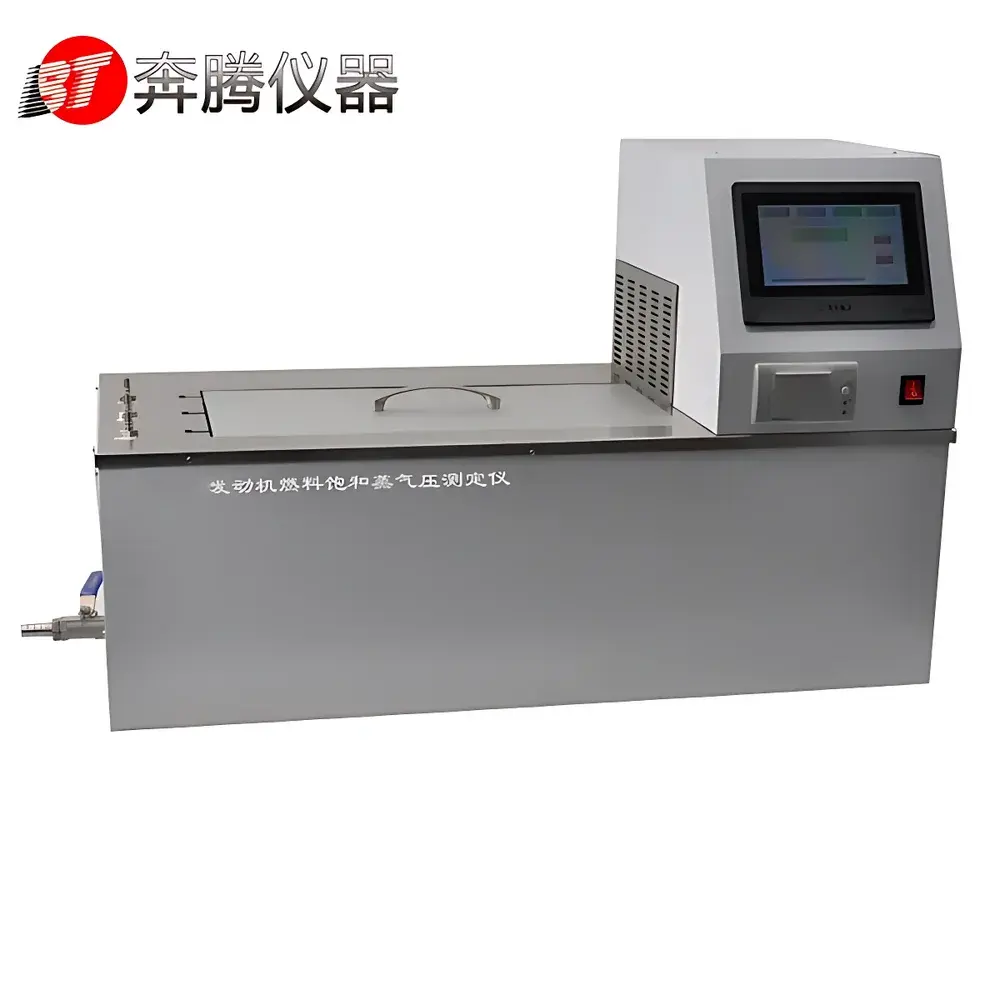
Benteng BT-2060 Reid Vapor Pressure (RVP) Analyzer for Petroleum Products
| Brand | Benteng |
|---|---|
| Origin | Jilin, China |
| Manufacturer Type | Direct Manufacturer |
| Model | BT-2060 |
| Analysis Method | Reid Method (ASTM D323 / GB/T 8017) |
| Power Supply | AC 220 V ±10%, 50 Hz |
| Power Consumption | ≤1700 W |
| Bath Temperature | 37.8 °C |
| Temperature Control Accuracy | ±0.1 °C |
| Heating Power | 1600 W |
| Sample Cells | 3 simultaneous test chambers |
| Pressure Range | 0–200 kPa (0–29 psi) |
| Chamber Motion | Rocking-type reciprocating motion |
| Ambient Operating Conditions | –10 to 35 °C, RH ≤85% |
| Dimensions | 600 × 500 × 456 mm |
| Display | LCD with full Chinese UI |
Overview
The Benteng BT-2060 Reid Vapor Pressure (RVP) Analyzer is a fully automated, microprocessor-controlled instrument engineered for precise and reproducible determination of vapor pressure in volatile petroleum products—including gasoline, reformulated fuels, naphthas, and light crude oils—according to the standardized Reid method. It implements the fundamental thermodynamic principle defined in ASTM D323 and GB/T 8017: a sealed, liquid-vapor equilibrium system is heated to 37.8 °C (100 °F) in a water bath, and the absolute pressure exerted by the vapor phase above the sample is measured after thermal stabilization and mechanical agitation. This measurement directly correlates to fuel volatility, a critical parameter influencing engine starting performance, vapor lock susceptibility, evaporative emissions, and regulatory compliance under EPA Tier 3, EU Fuel Quality Directive 2009/30/EC, and national refinery specifications.
Key Features
- Triple-chamber design enables concurrent analysis of up to three samples per cycle, improving laboratory throughput without compromising inter-test consistency.
- Integrated rocking-motion mechanism simulates standardized agitation per ASTM D323 Section 7.2, ensuring uniform vapor-phase equilibration across all test chambers.
- High-stability water bath with PID-controlled heating delivers ±0.1 °C temperature regulation at 37.8 °C—meeting the strict thermal tolerance requirements of both ASTM D323 and GB/T 8017.
- Electrically isolated immersion heater eliminates direct contact between heating elements and bath water, enhancing operator safety and reducing mineral buildup and maintenance frequency.
- Compact bath geometry (reduced vertical profile) provides unobstructed visual access to chamber immersion depth and water level, facilitating routine inspection and cleaning.
- LCD interface with native Chinese firmware supports intuitive menu navigation, real-time status monitoring, automatic result locking upon completion, and audible end-of-test notification.
- Built-in thermal printer provides immediate hard-copy documentation of RVP values, test timestamps, chamber identifiers, and operator inputs—supporting traceability in GLP-compliant environments.
Sample Compatibility & Compliance
The BT-2060 is validated for use with Class I and II petroleum distillates exhibiting initial boiling points below 200 °C and Reid vapor pressures ranging from 30 to 110 kPa (4.4 to 16.0 psi), consistent with typical gasoline and blending stock specifications. It complies with the mechanical, thermal, and procedural requirements of ASTM D323–23 (Standard Test Method for Vapor Pressure of Petroleum Products (Reid Method)) and its Chinese national equivalent GB/T 8017–2012. The instrument’s pressure transducer calibration traceability, chamber volume tolerances, and agitation timing are aligned with the metrological provisions outlined in ISO/IEC 17025:2017 for testing laboratories. While not certified to FDA 21 CFR Part 11, its audit-ready print output and immutable result locking support basic data integrity practices required under internal QA/QC protocols.
Software & Data Management
The BT-2060 operates via embedded firmware with no external PC dependency. All operational parameters—including bath setpoint, agitation duration, pressure zeroing sequence, and chamber selection—are configurable through the on-device interface. Test records include date/time stamp, chamber ID, raw pressure reading (kPa or psi), and pass/fail status relative to user-defined specification limits. Data retention is limited to the most recent 99 test cycles stored in non-volatile memory; for long-term archival, printed reports serve as primary evidence. No proprietary software, USB export, or network connectivity is provided—ensuring electromagnetic compatibility in refinery lab environments and minimizing cybersecurity exposure vectors common in connected instrumentation.
Applications
- Refinery quality control labs performing in-line RVP verification on gasoline blendstocks and finished fuels prior to pipeline transfer or terminal dispatch.
- Independent testing laboratories accredited to ISO/IEC 17025 conducting third-party conformity assessments for contract fuel supply agreements.
- Research and development facilities evaluating volatility impact of oxygenate additives (e.g., ethanol, MTBE) or hydrocarbon composition changes during formulation optimization.
- Regulatory inspection agencies performing field verification of posted RVP values on retail fuel dispensers in accordance with national fuel standards.
- Educational institutions teaching petroleum product characterization fundamentals, including vapor–liquid equilibrium behavior and ASTM standardization methodology.
FAQ
What standards does the BT-2060 comply with?
It is designed and verified to meet the apparatus and procedural requirements of ASTM D323 and GB/T 8017 for Reid vapor pressure determination.
Can the instrument measure samples other than gasoline?
Yes—it is suitable for any volatile petroleum liquid with an initial boiling point below 200 °C and vapor pressure within 0–200 kPa, including naphtha, light crude cuts, and aviation gasoline (AVGAS), provided sample handling follows ASTM D323 Section 6 precautions.
Is external calibration required?
The pressure sensor is factory-calibrated; users should perform periodic zero-pressure verification using atmospheric reference and confirm bath temperature accuracy with a NIST-traceable thermometer before critical testing.
Does the BT-2060 support data export to LIMS?
No—data output is exclusively via integrated thermal printer. For LIMS integration, manual transcription or external barcode-scanning of printed reports is required.
What maintenance is recommended?
Monthly descaling of the water bath, quarterly verification of chamber seal integrity, and annual inspection of pressure transducer linearity using calibrated dead-weight tester are advised per manufacturer guidelines.




