
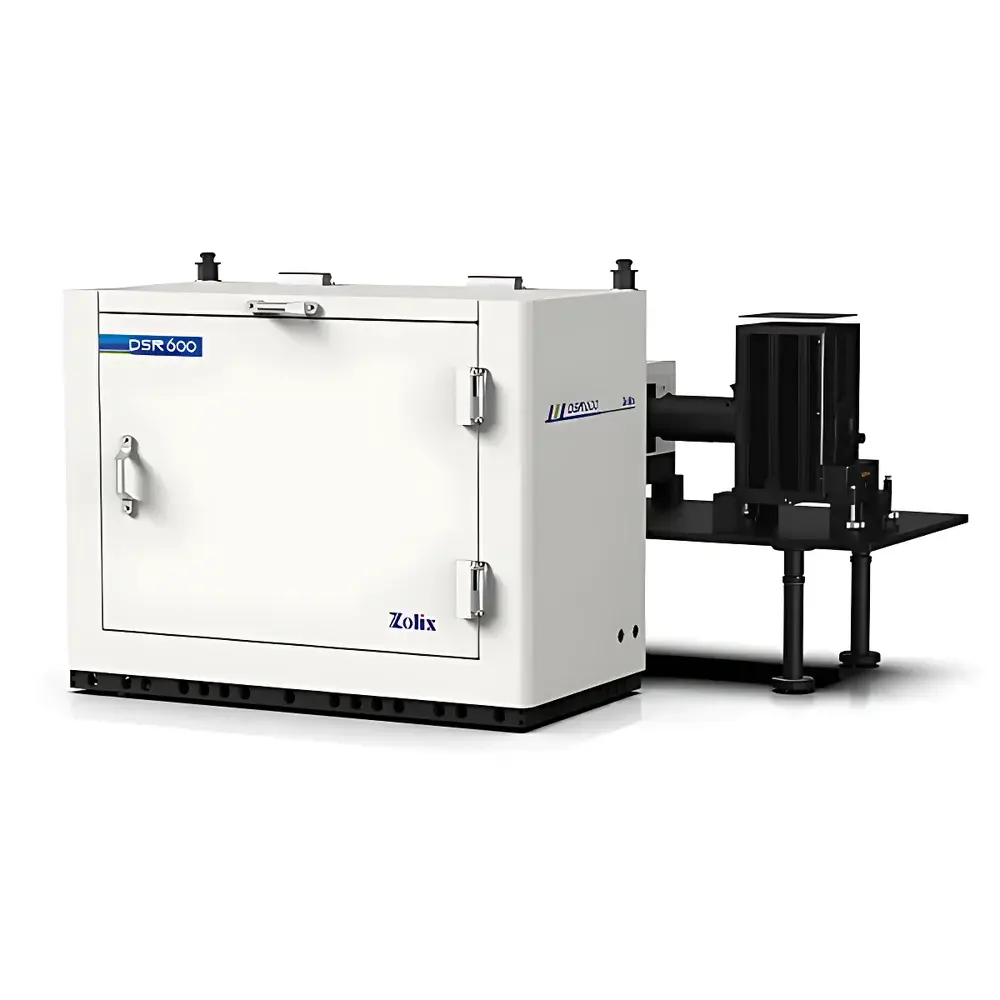
ZOLIX DSR600-PDE Photon Detection Efficiency Calibration System for Single-Photon Detectors
| Brand | ZOLIX |
|---|---|
| Model | DSR600-PDE |
| Origin | Beijing, China |
| Manufacturer Type | Manufacturer |
| Product Category | Domestic |
| Quotation | Upon Request |
| Spectral Range (Source + Monochromator) | 300–1100 nm (extendable to 2500 nm) |
| Standard Detector Options | Si (300–1100 nm), InGaAs (900–1700 nm or 2500 nm), NIST-traceable calibration certificates provided |
| Data Acquisition | 2/4-channel, time resolution selectable down to 400 ps, sampling rate up to 2.5 GS/s, record length 10 M points, input impedance 1 MΩ / 50 Ω |
| Precision Source Measure Unit (SMU) | current range 10 nA–1 A, resolution 100 fA, voltage source 0–200 V |
| Programmable Dual-Channel Power Supply | 0–32 V, 1 mV resolution |
Overview
The ZOLIX DSR600-PDE Photon Detection Efficiency Calibration System is a traceable, laboratory-grade instrumentation platform engineered for the absolute and wavelength-resolved characterization of single-photon detectors. It implements a primary-standard-compliant method based on calibrated optical power substitution and geometric area normalization, enabling direct determination of Photon Detection Efficiency (PDE) across the ultraviolet–visible–near-infrared (UV–Vis–NIR) spectrum. The system operates on the principle of monochromatic photon flux generation via a broadband source coupled with a high-stability scanning monochromator, followed by spatial homogenization in an integrating sphere. Two precisely aligned output ports deliver identical, uniform irradiance to both a reference photodetector—certified to NIST-traceable responsivity—and the device under test (DUT). By measuring the incident optical power at the reference detector and converting it to photon flux (photons per second), then scaling this value according to the active-area ratio between reference and DUT, the incident photon flux onto the DUT is determined. Concurrent pulse counting of the DUT’s output signals yields its detected photon count rate. PDE is thus calculated as the ratio of detected-to-incident photons per unit time, without reliance on secondary standards or empirical models. This methodology satisfies the metrological requirements for quantitative quantum efficiency validation in R&D labs, national metrology institutes, and semiconductor fabrication QA environments.
Key Features
- Full-spectrum PDE measurement from 300 nm to 1100 nm (extendable to 2500 nm with optional InGaAs monochromator and detector modules)
- Simultaneous acquisition of spectral responsivity (SR) and external quantum efficiency (EQE) using the same optical configuration and calibration framework
- Modular light source architecture supporting interchangeable broadband sources (e.g., deuterium-halogen, tungsten-halogen, or supercontinuum lasers) to optimize signal-to-noise ratio across spectral regions
- High-temporal-resolution data acquisition module with selectable time resolution (4 ns, 2 ns, 1.14 ns, 800 ps, or 400 ps) and 2.5 GS/s sampling rate, enabling precise coincidence-gated or time-tagged photon counting
- Integrated precision source measure unit (SMU) for biasing and characterizing detector dark current, breakdown voltage, and overvoltage-dependent PDE response
- Programmable dual-channel DC power supply with 1 mV resolution for stable, low-noise biasing of SPADs, SiPMs, and MPPCs during spectral scans
- Automated wavelength stepping, data logging, and real-time PDE curve rendering via dedicated control software
Sample Compatibility & Compliance
The DSR600-PDE system supports calibration of all major solid-state and vacuum-based single-photon detection technologies, including Geiger-mode avalanche photodiodes (G-APDs), single-photon avalanche diodes (SPADs), photon-counting photomultiplier tubes (PMTs), silicon photomultipliers (SiPMs), multi-pixel photon counters (MPPCs), and superconducting nanowire single-photon detectors (SNSPDs). Each standard detector is supplied with a NIST-traceable calibration certificate specifying spectral responsivity uncertainty (k = 2) across its operational range. The system architecture adheres to ISO/IEC 17025:2017 principles for calibration laboratories, and measurement procedures align with ASTM E1087 (Standard Test Method for Spectral Responsivity of Photovoltaic Devices) and IEC 60793-1-42 (Optical fibres — Part 1-42: Measurement methods and test procedures — Spectral responsivity). For regulated environments, raw data files include embedded metadata (timestamp, wavelength, integration time, bias voltage, ambient temperature) to support GLP/GMP audit trails and FDA 21 CFR Part 11 compliance when deployed with validated software configurations.
Software & Data Management
The system is controlled via ZOLIX’s proprietary DSR-CAL Suite, a Windows-based application built on .NET Framework with native support for LabVIEW and Python API bindings (PyDSR). The software provides full instrument orchestration—including monochromator positioning, SMU parameter sweeps, trigger synchronization, and counter gating—through a deterministic state-machine engine. All acquired data are stored in HDF5 format with hierarchical metadata embedding, ensuring long-term readability and interoperability with MATLAB, Python (h5py), and OriginLab. Built-in analysis modules compute PDE(λ), SR(λ), EQE(λ), and derive key parameters including peak wavelength, full-width-at-half-maximum (FWHM), cutoff wavelengths, and overvoltage-dependent PDE gain coefficients. Export options include CSV, ASCII, and industry-standard CIE chromaticity-compatible XML schemas. Audit logs record every user action, parameter change, and calibration event with digital signature and UTC timestamp.
Applications
- Quantitative PDE mapping of SiPM arrays for time-of-flight positron emission tomography (TOF-PET) detector development
- Validation of SPAD pixel uniformity and spectral crosstalk in CMOS-integrated single-photon imagers
- Characterization of SNSPD cutoff wavelength and polarization dependence under cryogenic conditions
- Traceable EQE verification of quantum dot-based single-photon emitters coupled to integrated photonic circuits
- Inter-laboratory comparison studies for quantum communication receiver certification (e.g., QKD system evaluation per ETSI EN 303 645)
- Material-level optimization of anti-reflection coatings and passivation layers on GaN-based UV SPADs
FAQ
What uncertainty level can be achieved in PDE measurement with the DSR600-PDE system?
Typical combined standard uncertainty (k = 1) for PDE at peak wavelength is ≤3.5%, dominated by reference detector calibration uncertainty (≤2.0%), integrating sphere non-uniformity (<1.2%), and photon counting statistics.
Can the system calibrate detectors operating below 300 nm or above 2500 nm?
Yes—vacuum UV extension (115–300 nm) is supported with deuterium lamp + MgF₂ optics and calibrated solar-blind PMT reference; mid-IR extension (2.5–5 µm) requires optional HgCdTe reference detector and grating monochromator.
Is the system compatible with cryogenic probe stations?
The optical head and integrating sphere are designed for vacuum-compatible mounting; fiber-coupled configurations enable seamless integration with closed-cycle cryostats (4 K–300 K) while maintaining alignment stability.
Does the software support automated compliance reporting for ISO/IEC 17025 accreditation?
Yes—the DSR-CAL Suite includes configurable report templates aligned with ILAC-P10:2022 requirements, including uncertainty budget tables, equipment traceability matrices, and environmental condition logs.
How is detector active area measured for accurate PDE calculation?
Users input DUT active area via software interface; for critical applications, optional beam-profiler integration (with 1 µm spatial resolution) enables direct imaging and metrological area determination per ISO 13694.
Related Products





