
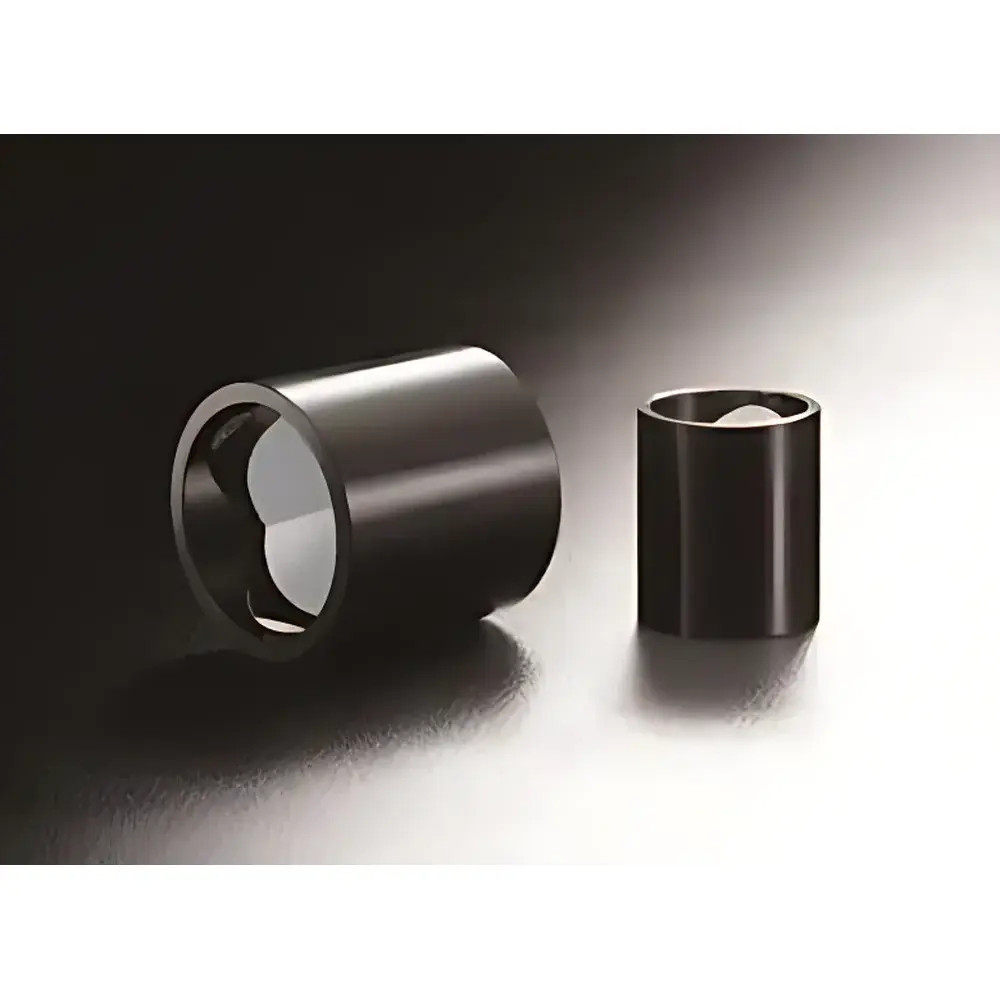
Hollow Retroreflector RCCB Series by ZOLIX
| Key | Brand: ZOLIX |
|---|---|
| Origin | Beijing, China |
| Manufacturer Type | Direct Manufacturer |
| Product Category | Optical Component |
| Model | RCCB Series |
| Wavelength Range | UV to NIR (190–1100 nm) |
| Reflective Coating | Unprotected Aluminum |
| Single-Surface Reflectivity | 85% ± 5% |
| Triple-Pass Return Efficiency | ~61% ± 3% |
| Angular Tolerance | < 2 arcsec (typical alignment precision) |
| Construction | Monolithic air-spaced trihedral assembly |
| Surface Finish | λ/10 rms (per mirror face) |
| Clear Aperture | ≥ 90% of nominal diameter |
| Mounting | Kinematic or kinematic-compatible base optional |
Overview
The Hollow Retroreflector RCCB Series by ZOLIX is a precision-engineered optical component designed for high-fidelity beam return in interferometric, metrological, and alignment-critical applications. Unlike solid glass corner-cube retroreflectors, the RCCB employs three independently aligned, air-spaced aluminum-coated mirrors arranged in a true trihedral geometry with mutual orthogonality maintained to < 2 arcseconds. This hollow architecture eliminates refractive index dispersion, bulk absorption, and thermal lensing effects inherent to solid prisms—making it uniquely suitable for broadband operation from deep ultraviolet (190 nm) through visible to near-infrared (1100 nm). Its operational principle relies on sequential specular reflection at three mutually perpendicular surfaces, ensuring that any incident ray—regardless of angle within the clear aperture—is returned parallel to its original path with minimal lateral offset (retracing error < λ/20 over ±5° full acceptance angle). The absence of substrate material removes wavelength-dependent phase shifts and chromatic beam displacement, a critical advantage in multi-wavelength interferometry, femtosecond pulse compression setups, and absolute distance measurement systems compliant with ISO 21097 and VDI/VDE 2634 standards.
Key Features
- Air-spaced trihedral design eliminates chromatic dispersion and substrate-induced wavefront distortion
- Unprotected aluminum coating optimized for UV–NIR spectral coverage (190–1100 nm), with single-surface reflectivity of 85% ± 5%
- Triple-bounce return efficiency of ~61% ± 3%, enabling quantitative power budgeting in closed-loop optical systems
- λ/10 rms surface flatness per mirror face, verified via phase-shifting interferometry (PSI) per ISO 10110-5
- No central obscuration; functional clear aperture exceeds 90% of nominal housing diameter
- Kinematic mounting interface options available for sub-microradian repositioning repeatability
- Low polarization-dependent phase shift (< 0.5° retardance across 45°–65° AOI), validated for use in polarized Michelson and Mach–Zehnder interferometers
Sample Compatibility & Compliance
The RCCB Series is compatible with collimated beams of diameter up to 90% of its specified clear aperture and divergence ≤ 1.5 mrad. It supports pulsed laser sources (including Ti:sapphire and excimer systems) with peak intensities up to 1 GW/cm² (for ns pulses) without coating damage—provided proper beam homogenization and avoidance of the six non-reflective edge seams visible at the trihedral apex. These seams arise from mechanical junctions between mirror substrates and must be excluded from illumination paths during alignment. The device complies with RoHS 2011/65/EU for hazardous substance restrictions and meets mechanical stability requirements outlined in MIL-STD-810G for vibration and thermal shock (−10°C to +60°C, 24 h cycling). While not certified to ISO 17025 as a calibrated artifact, its geometric fidelity supports traceable calibration of laser trackers (e.g., Leica AT960) and photogrammetric systems under ISO 10360-8.
Software & Data Management
As a passive optical component, the RCCB Series requires no embedded firmware, drivers, or software integration. However, its performance parameters—including angular misalignment sensitivity, return-beam centroid shift vs. incident offset, and polarization extinction ratio—are fully characterizable using standard optical metrology suites such as Zygo MetroPro, QED PhaseMap, or Thorlabs’ ThorCam-based alignment workflows. Measurement data generated during system integration may be logged in accordance with FDA 21 CFR Part 11-compliant electronic lab notebooks (e.g., LabArchives or Benchling) when deployed in regulated GMP/GLP environments for optical sensor validation or laser safety interlock verification.
Applications
- High-precision laser interferometry (e.g., gravitational wave detector auxiliary alignment, nanometrology stages)
- Broadband optical delay lines requiring achromatic retroreflection
- UV lithography tool calibration and beam path stabilization
- Polarization-sensitive interferometers where birefringent substrates would induce systematic phase errors
- Aerospace LIDAR reference targets and satellite-based Earth observation calibration arrays
- Ultrafast optics setups involving dispersion-compensated pulse recompression
FAQ
Why does the RCCB exhibit lower return efficiency than solid corner cubes?
Due to triple reflection at unprotected aluminum surfaces (85% per bounce), theoretical maximum return intensity is 0.85³ ≈ 61%. Solid fused silica cubes suffer Fresnel losses but benefit from protective dielectric coatings—however, those introduce dispersion and limit UV transmission.
Can the RCCB be used with femtosecond lasers?
Yes—provided pulse energy density remains below damage threshold and beam profile avoids the six non-reflective seam regions. No nonlinear absorption occurs in air gaps.
Is cleaning possible without damaging the aluminum coating?
Only dry methods are permitted: filtered compressed air or nitrogen. Solvents, tissues, or swabs will abrade the unprotected film. Contamination control should follow ISO 14644-1 Class 5 cleanroom protocols.
Does temperature affect angular alignment stability?
The monolithic aluminum housing exhibits CTE-matched mirror mounts; angular drift is < 0.3 arcsec/°C over −5°C to +50°C, verified per IEC 60068-2-14.






