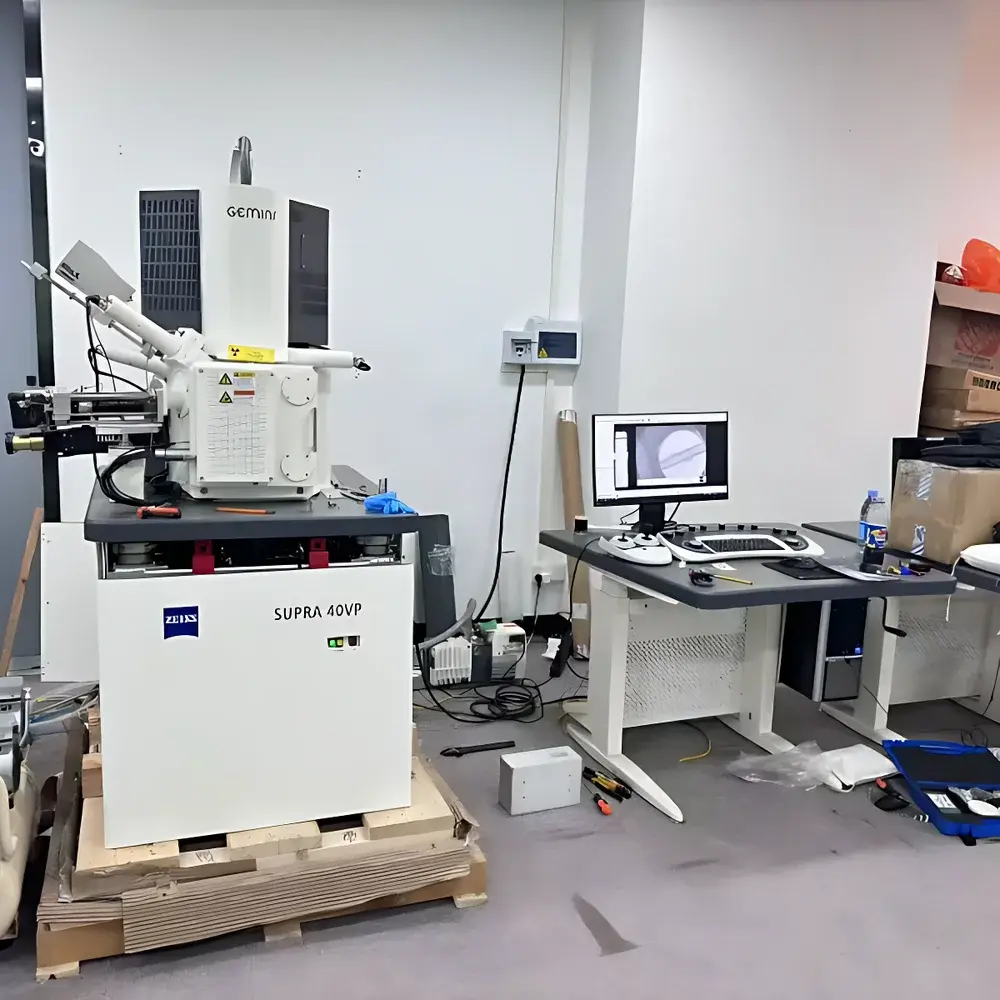
ZEISS SUPRA 40 VP Field Emission Scanning Electron Microscope (FE-SEM) with Integrated EDS
| Brand | ZEISS |
|---|---|
| Origin | Germany |
| Model | GEMINI SUPRA 40 VP |
| Resolution | 1.3 nm @ 15 kV, 2.1 nm @ 1 kV, 5.0 nm @ 0.1 kV (Standard Mode) |
| Magnification Range | 12× – 900,000× |
| Accelerating Voltage | 0.02 – 30 kV |
| Beam Current | 4 pA – 10 nA (optional up to 20 nA) |
| Electron Source | Thermal Field Emission Gun (TFEG) |
| Detector Configuration | In-lens SE, ETSE, VPSE, STEM-in-SEM, and integrated Energy Dispersive X-ray Spectrometer (EDS) |
Overview
The ZEISS SUPRA 40 VP is a high-performance field emission scanning electron microscope (FE-SEM) engineered for nanoscale imaging, microstructural analysis, and elemental characterization in academic research laboratories, industrial quality control environments, and materials science facilities. Built upon ZEISS’s proprietary GEMINI electron optical column architecture, the system integrates a thermal field emission gun (TFEG) to deliver exceptional brightness, long-term beam stability, and sub-nanometer resolution across a wide range of operating voltages — from ultra-low landing energies (0.02 kV) for surface-sensitive imaging of beam-sensitive or uncoated specimens, to high-voltage conditions (up to 30 kV) for enhanced penetration and backscattered electron (BSE) contrast. The variable pressure (VP) mode enables direct observation of non-conductive, hydrated, or outgassing samples without sputter coating, leveraging differential pumping and gaseous secondary electron detection. This dual-mode capability — high vacuum (HV) and variable pressure (VP) — ensures broad applicability while maintaining analytical fidelity.
Key Features
- GEMINI II electron optical column with optimized magnetic–electrostatic lens design for minimal spherical aberration and high signal-to-noise ratio at low kV
- Thermal field emission electron source providing stable probe current over extended acquisition periods, critical for quantitative EDS mapping and time-resolved imaging
- Multi-detector configuration: In-lens secondary electron (SE) detector for high-resolution topographic imaging; Everhart-Thornley (ETSE) detector for conventional SE contrast; VPSE detector for low-vacuum operation; and dedicated STEM-in-SEM detector for transmitted electron imaging of thin sections
- Integrated energy dispersive X-ray spectrometer (EDS) with silicon drift detector (SDD), typically ≥10 eV Mn-Kα resolution and ≥20 mm² active area, enabling rapid qualitative and semi-quantitative elemental analysis
- Motorized stage with ±60° tilt, 360° rotation, and precise X/Y/Z positioning (sub-micron repeatability), compatible with standard SEM stubs and custom holders
- Intuitive SmartSEM software interface supporting automated alignment, beam calibration, stage navigation, and EDS spectrum acquisition with library-based phase identification (e.g., AZtecEngine)
Sample Compatibility & Compliance
The SUPRA 40 VP accommodates a wide variety of sample types — including ceramics, polymers, biological tissues (fixed or cryo-prepared), geological specimens, battery electrodes, semiconductor wafers, and metal alloys — without mandatory conductive coating in VP mode. Sample chamber dimensions (Ø 180 mm × H 120 mm) support standard 100 mm diameter SEM stubs and larger custom mounts. All operational parameters are logged with timestamped metadata, supporting GLP-compliant documentation workflows. While the instrument itself is not certified as FDA 21 CFR Part 11 compliant, its data acquisition software supports audit-trail-enabled user accounts, electronic signatures (when deployed with validated IT infrastructure), and export of raw image/EDS files in open formats (TIFF, .raw, .eds) for third-party analysis and regulatory submission.
Software & Data Management
SmartSEM v6.x (or later) provides full instrument control, real-time image acquisition, and synchronized EDS spectral collection. The software includes batch acquisition protocols, region-of-interest (ROI) mapping, line-scan quantification, and matrix correction algorithms (ZAF or φ(ρz)) for compositional analysis. Export options include standardized formats (e.g., TIFF with embedded scale bars, CSV for spectral data, HDF5 for large hyperspectral datasets), ensuring compatibility with MATLAB, Python (via PyXRF, HyperSpy), and commercial platforms such as Thermo Scientific Pathfinder or Oxford Instruments AZtec. Raw data files retain full acquisition metadata — kV, working distance, dwell time, detector type, and EDS live time — essential for traceable scientific reporting and inter-laboratory comparison.
Applications
- Nanomaterial morphology and dispersion analysis in composites and catalysts
- Fractography and failure analysis of metallic and polymer components
- Particle size distribution and shape analysis per ISO 13322-1 and ASTM E1245
- Coating thickness measurement and interfacial characterization using cross-sectional BSE imaging
- In situ elemental mapping of corrosion products, inclusion phases, or dopant distributions in semiconductors
- Life sciences applications including immunogold labeling, freeze-fracture replicas, and correlative light-electron microscopy (CLEM) workflows
FAQ
Is this unit fully refurbished and performance-verified?
Yes — all used SUPRA 40 VP systems undergo comprehensive ZEISS-certified refurbishment, including column cleaning, electron gun reconditioning, detector recalibration, vacuum system leak testing, and resolution verification per ISO 16700 Annex A.
What warranty and service support is included?
A 12-month limited hardware warranty is provided, covering defects in materials and workmanship. Extended service agreements with on-site engineer response (within 48 business hours) and preventive maintenance visits are available upon request.
Can the system be upgraded with additional detectors or automation modules?
Yes — the platform supports retrofits including STEM detectors, cathodoluminescence (CL) systems, electron backscatter diffraction (EBSD), and automated particle analysis (APA) software modules, subject to mechanical and software compatibility assessment.
Are original ZEISS documentation and software licenses transferable?
Full technical documentation, safety manuals, and software license keys are transferred with the instrument; however, certain cloud-connected features (e.g., remote diagnostics) require registration under the new end-user’s ZEISS account.