
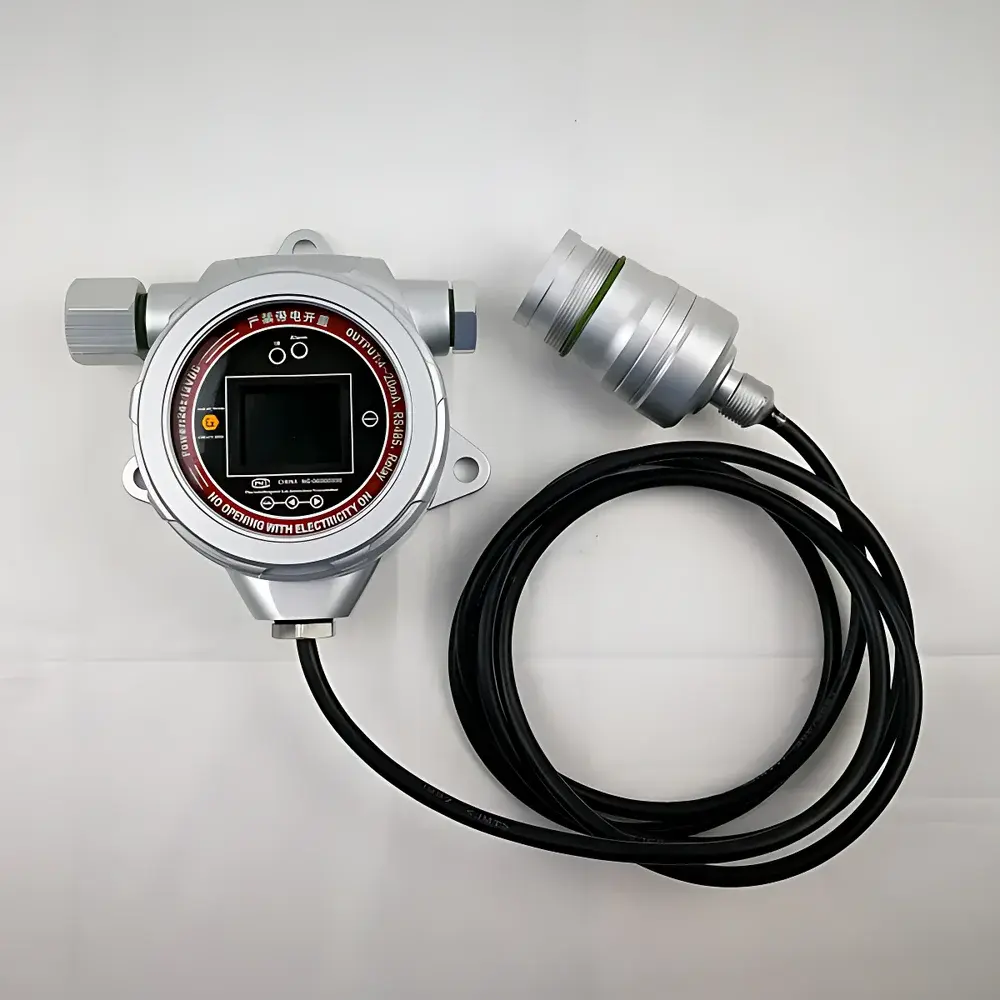
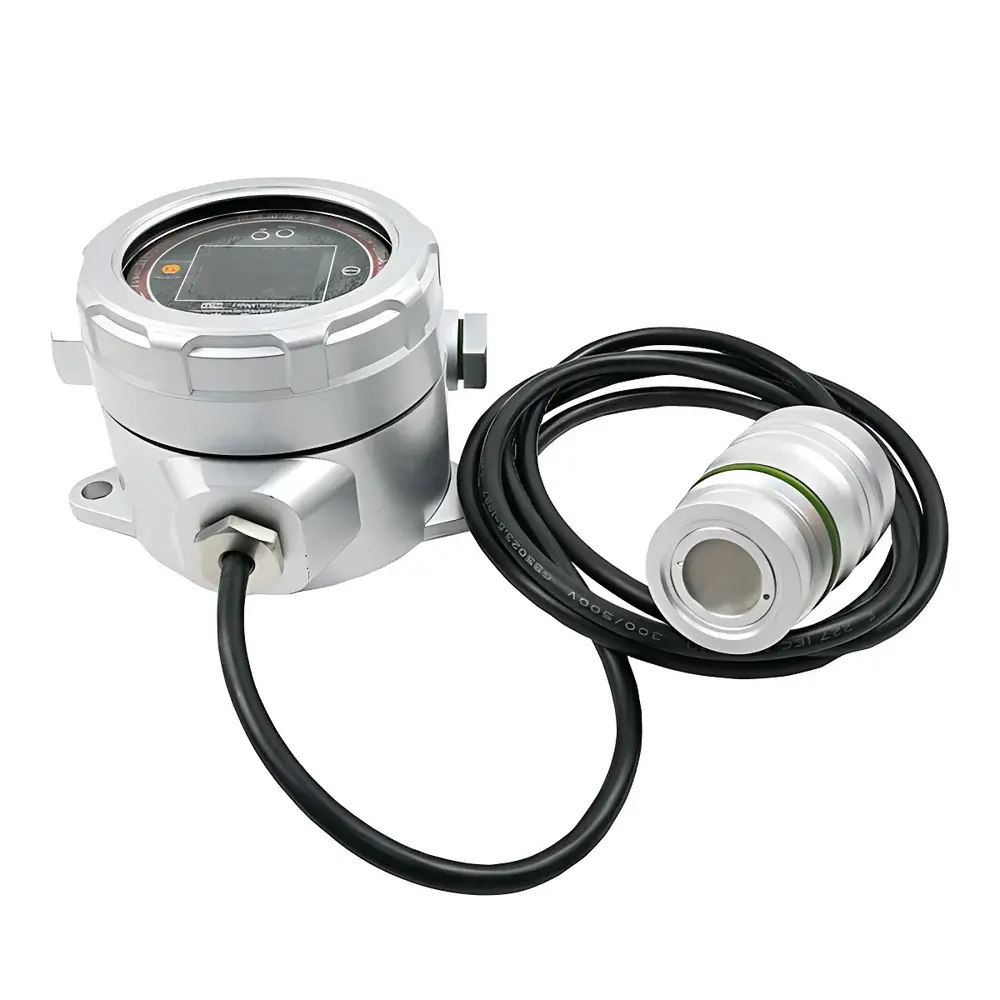
MIC-500S-MEK Fixed Butanone (MEK) Gas Detector
| Brand | Eranntex |
|---|---|
| Origin | Guangdong, China |
| Manufacturer Type | OEM/ODM Manufacturer |
| Country of Origin | China |
| Model | MIC-500S-MEK |
| Output Options | 4–20 mA (3-wire or 4-wire), 0–5/0–10 V, RS485 (Modbus RTU), Dual Relay Outputs |
| Communication | Wired, LAN, Internet, Wireless (433 MHz, GPRS, Wi-Fi, Custom RF) |
| Remote Operation | Infrared remote control (15 m range, intrinsically safe operation without opening enclosure) |
| Calibration | Auto-zero tracking, multi-point calibration support |
| Certifications | CPA Type Approval (China), Ex d IIC T6 Gb explosion-proof certification, EMC/EMI compliant (GB/T 18268, GB/T 17626 series), Anti-static & reverse-polarity protected |
| Sensor Options | Electrochemical, Catalytic Bead, NDIR, PID, Thermal Conductivity (selectable from Honeywell, Figaro, City Technology, Alphasense, Dynament, Membrapor) |
Overview
The MIC-500S-MEK is a fixed-point, continuous-duty gas detection system engineered for the reliable, long-term monitoring of methyl ethyl ketone (MEK) vapor concentrations in industrial environments. Designed to operate continuously in classified hazardous areas, it employs field-proven sensing technologies—including electrochemical, catalytic combustion, and infrared (NDIR)—to deliver stable, repeatable measurements across varying temperature, humidity, and pressure conditions. The detector’s core architecture follows the principle of selective gas-phase interaction with calibrated transducers, where target analyte concentration modulates an electrical signal proportional to MEK partial pressure. Its robust aluminum alloy housing meets IP66 ingress protection and flameproof enclosure requirements (Ex d IIC T6 Gb), enabling safe deployment in Zone 1 and Zone 2 classified locations per GB 3836.1–2010 and IEC 60079-0. The device is not a portable survey instrument but a permanently installed node within a broader gas safety infrastructure—integrated into plant-wide alarm logic, DCS/SCADA systems, or centralized environmental health and safety (EHS) dashboards.
Key Features
- Explosion-proof certified enclosure (Ex d IIC T6 Gb) with stainless-steel sensor housing and corrosion-resistant gaskets for chemical plant and solvent-handling facility deployment
- Dual redundancy in signal output: simultaneous 4–20 mA analog (3-wire or 4-wire configurable) and Modbus RTU over RS485 bus for seamless integration with PLCs, RTUs, and distributed control systems
- Two programmable relay outputs (SPDT, 250 VAC/3 A) for direct linkage to ventilation interlocks, shutdown valves, or audible/visual alarm strobes
- Intrinsically safe infrared remote interface enabling zero-contact configuration, span adjustment, and bump testing in live hazardous zones—no enclosure opening required
- Auto-zero tracking algorithm compensates for baseline drift induced by ambient temperature fluctuations or sensor aging; supports up to three-point calibration using certified MEK standard gas
- EMC-hardened design compliant with GB/T 17626 (IEC 61000-4) for surge immunity (±4 kV), ESD (±8 kV contact), and conducted/radiated RF immunity up to 10 V/m
- Flexible communication architecture: native support for wired Ethernet, local area network (LAN), cellular (GPRS/4G LTE), and sub-GHz wireless (433 MHz, customizable range up to 5 km line-of-sight)
Sample Compatibility & Compliance
The MIC-500S-MEK is validated for continuous measurement of MEK (C4H8O) in air across a typical range of 0–100 ppm (electrochemical) or 0–2000 ppm (catalytic/NDIR), depending on selected sensor module. It is compatible with mixed solvent vapors commonly found in paint manufacturing, adhesive formulation, pharmaceutical coating, and printed circuit board cleaning operations. All sensor variants undergo factory calibration traceable to NIM (National Institute of Metrology, China) standards. The unit holds mandatory Chinese certifications including CPA (China Metrology Accreditation) Type Approval Certificate and CCC-ex certification. While not CE-marked or UL-listed, its electrical and mechanical design aligns with functional safety principles referenced in IEC 61508 (SIL2-capable when integrated into a certified safety loop) and supports audit readiness for ISO 14001, OHSAS 18001, and enterprise-level GLP/GMP documentation workflows.
Software & Data Management
The detector operates as a field node within Eranntex’s optional MICS-Cloud platform or third-party SCADA/HMI environments via standard Modbus TCP/RTU or OPC UA gateways. Local data logging (optional SD card module) retains 30 days of 1-minute interval readings, including timestamped concentration values, relay status, fault codes, and calibration history. PC-based configuration software (Windows-compatible, no runtime license) enables full parameterization: alarm thresholds (pre-alarm, high alarm, fault), damping time, zero/span date stamps, and sensor lifetime counters. All configuration changes are logged with user ID and timestamp, supporting basic 21 CFR Part 11 compliance when deployed with domain-authenticated network access and write-protected audit trails. Export formats include CSV and PDF for regulatory reporting and trend analysis.
Applications
- Solvent recovery units in chemical processing plants where MEK is used as an extraction or cleaning agent
- Coating and laminating lines in flexible packaging facilities requiring real-time solvent vapor monitoring
- Pharmaceutical tablet film-coating booths subject to occupational exposure limits (OELs) per GBZ 2.1–2019
- Automotive refinishing bays and industrial paint mixing rooms governed by local VOC emission regulations
- Waste solvent storage tanks and transfer manifolds where vapor accumulation poses fire or inhalation risk
- Confined space entry pre-check systems integrated with permit-to-work (PTW) digital workflows
FAQ
What sensor technologies are supported for MEK detection?
Electrochemical (for low-range precision), catalytic bead (for broad flammability monitoring), NDIR (for selectivity in mixed VOC streams), and PID (for ultra-trace detection down to ppb levels)—each requiring model-specific firmware and calibration protocols.
Can the MIC-500S-MEK be integrated into a DCS with redundant communication paths?
Yes: dual-output capability (4–20 mA + RS485) allows primary/backup signal routing; Modbus RTU supports polling intervals as low as 100 ms for critical loops.
Is field calibration possible without specialized equipment?
Basic span adjustment can be performed using the IR remote and certified 50 ppm MEK span gas; full 3-point calibration requires PC software and gas delivery manifold.
Does the unit support HART protocol?
No—HART is not natively implemented; however, 4–20 mA output is HART-transparent when connected via a compatible smart transmitter interface.
What is the expected service life of the electrochemical sensor under continuous operation?
Typical operational lifetime is 24 months in ambient conditions ≤30 °C and <80% RH; accelerated degradation occurs above 40 °C or in high-H2S environments.
Related Products







