
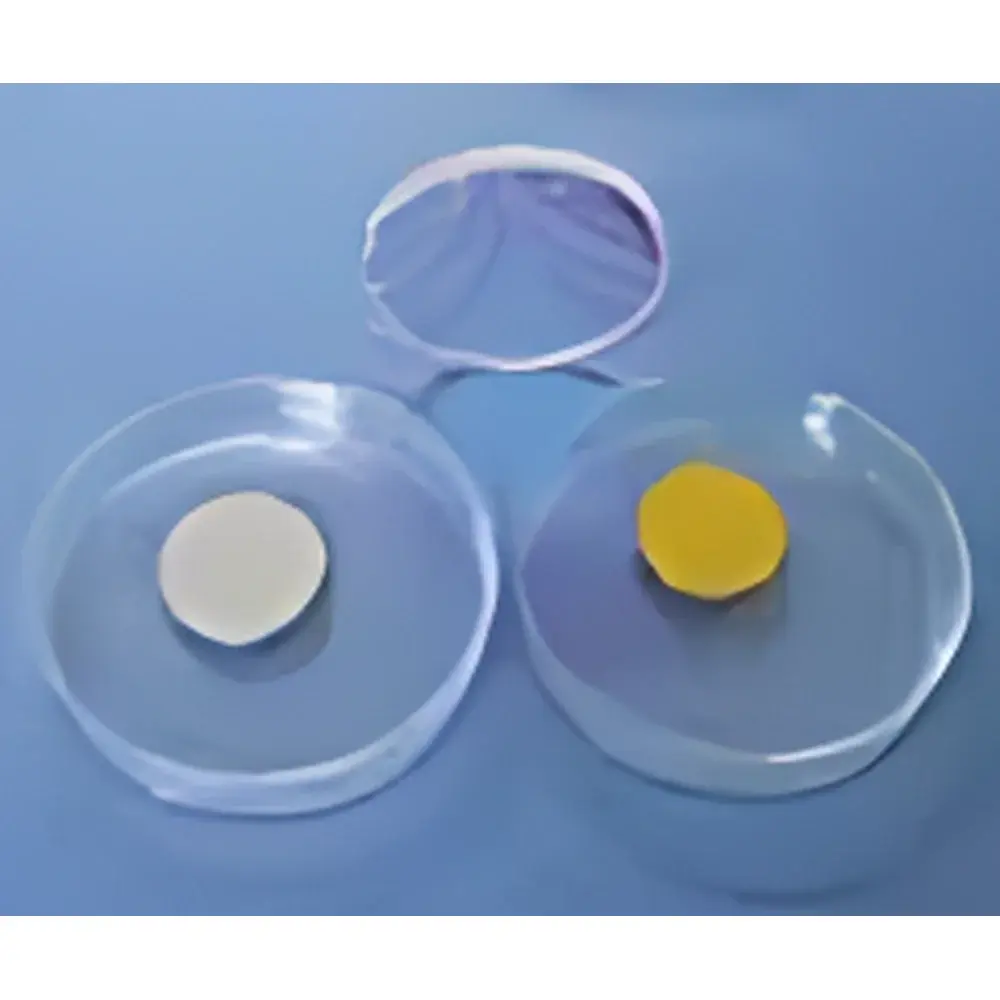
ZOLIX OML Series Dielectric Mirror
| Brand | ZOLIX |
|---|---|
| Model | OML Series |
| Substrate | BK7 |
| Surface Accuracy (pre-coating) | λ/10 (for OML25.4-355-6.35) |
| Diameter Options | 20 mm, 25 mm, 25.4 mm, 30 mm, 50 mm |
| Thickness Options | 4 mm, 5 mm, 6.35 mm |
| Design Wavelengths | 355 nm, 441 nm, 488 nm, 532 nm, 632.8 nm |
| Angle of Incidence | 45° ± 3° |
| Parallelism | ≤ 3 arcminutes |
| Coating Type | Multilayer dielectric stack |
| Laser Damage Threshold | High (optimized for CW and pulsed laser applications) |
| Compliance | ISO 10110-7 (surface form), ISO 14997 (laser damage testing methodology) |
Overview
The ZOLIX OML Series Dielectric Mirrors are high-performance optical components engineered for precision laser beam steering, cavity alignment, and spectral separation in demanding laboratory and industrial photonics systems. These mirrors utilize multilayer dielectric thin-film coatings deposited on optically polished BK7 substrates to achieve >99.5% reflectance at specified laser wavelengths—including 355 nm (UV), 441 nm (blue), 488 nm (blue–green), 532 nm (green), and 632.8 nm (red HeNe). Unlike metallic coatings (e.g., aluminum + MgF₂), dielectric stacks offer superior laser-induced damage threshold (LIDT), minimal absorption (<0.1%), and exceptional environmental stability under continuous-wave (CW) and nanosecond-pulsed irradiation. The OML series is designed for fixed-angle operation at 45° incidence, with surface flatness maintained at λ/10 (for UV-grade variants) or λ/4 (standard variants) *prior to coating*, ensuring wavefront fidelity in interferometric and resonator-critical applications.
Key Features
- Multilayer dielectric coating optimized for narrowband high-reflectance (R > 99.5%) at discrete laser lines
- BK7 optical glass substrate with surface accuracy certified to λ/10 (OML25.4-355-6.35) or λ/4 (all other standard models) before coating
- Tight angular tolerance: nominal incidence angle = 45° ± 3°, enabling reliable integration into folded optical paths
- Parallelism controlled to ≤ 3 arcminutes, minimizing beam deviation and astigmatism in multi-mirror assemblies
- Robust architecture suitable for Class 4 laser environments; LIDT values exceed ISO 21254-compliant thresholds for common nanosecond-pulsed lasers
- Standardized mechanical dimensions across the series—diameters from 20 mm to 50 mm and thicknesses of 4 mm, 5 mm, or 6.35 mm—facilitating drop-in replacement and mount compatibility
Sample Compatibility & Compliance
The OML Series mirrors are compatible with standard kinematic mirror mounts (e.g., Thorlabs KM100, Newport UMB series) and vacuum-compatible optical tables. All substrates meet ISO 10110-1 (surface quality) and ISO 10110-7 (surface form) specifications. Coating durability complies with MIL-C-48497A for adhesion and humidity resistance. While not FDA-regulated, the mirrors support instrumentation used in ISO/IEC 17025-accredited laboratories performing laser-based metrology, spectroscopy, and biophotonics. For applications requiring traceable calibration, optional NIST-traceable certification of reflectance spectra (350–700 nm) and surface flatness is available upon request.
Software & Data Management
No embedded firmware or software is integrated into the OML Series, as it is a passive optical component. However, ZOLIX provides downloadable spectral reflectance curves (CSV and PDF formats) for each model via its technical documentation portal. These datasets are compatible with optical design platforms including Zemax OpticStudio, CODE V, and FRED, enabling accurate system-level modeling of reflectance, phase shift, and polarization-dependent effects. All spectral data are acquired using a calibrated PerkinElmer Lambda 1050+ spectrophotometer with integrating sphere accessory, traceable to NIST SRM 2036.
Applications
- Laser cavity optics for DPSS, ion, and diode-pumped solid-state lasers
- Beam combining/splitting in multi-wavelength fluorescence microscopy (e.g., confocal, TIRF)
- Interferometer end mirrors in Michelson, Mach–Zehnder, and Fabry–Pérot configurations
- UV photolithography tool alignment subsystems (355 nm variants)
- Raman spectroscopy excitation path conditioning
- Optical coherence tomography (OCT) reference arm optics
- Quantum optics experiments requiring low-loss, polarization-preserving reflection
FAQ
What is the difference between λ/4 and λ/10 surface accuracy in the OML series?
Surface accuracy refers to peak-to-valley (PV) deviation from an ideal plane, measured *before* coating deposition. A λ/10 specification (e.g., OML25.4-355-6.35) corresponds to ≤33.5 nm PV error at 355 nm, while λ/4 implies ≤88.5 nm PV at 355 nm. Higher accuracy is critical for wavefront-sensitive applications such as interferometry.
Can these mirrors be used at angles other than 45°?
The dielectric stack is optimized for 45° incidence. Performance degrades significantly beyond ±3° due to polarization-dependent reflectance shifts and increased s/p splitting—consult ZOLIX application engineering for custom AOI designs.
Are custom wavelengths or substrates available?
Yes. ZOLIX offers OEM dielectric coating services on fused silica, CaF₂, and UV-grade fused quartz for deep-UV (193 nm, 248 nm) or high-power IR applications. Lead time and minimum order quantities apply.
Is there a warranty or lifetime specification?
ZOLIX provides a 24-month limited warranty against coating delamination or substrate fracture under normal handling and operational conditions. No degradation in reflectance is expected within 10⁸ laser shots (10 ns, 10 Hz, 532 nm, 1 J/cm²) when operated within specified thermal and vacuum limits.




