
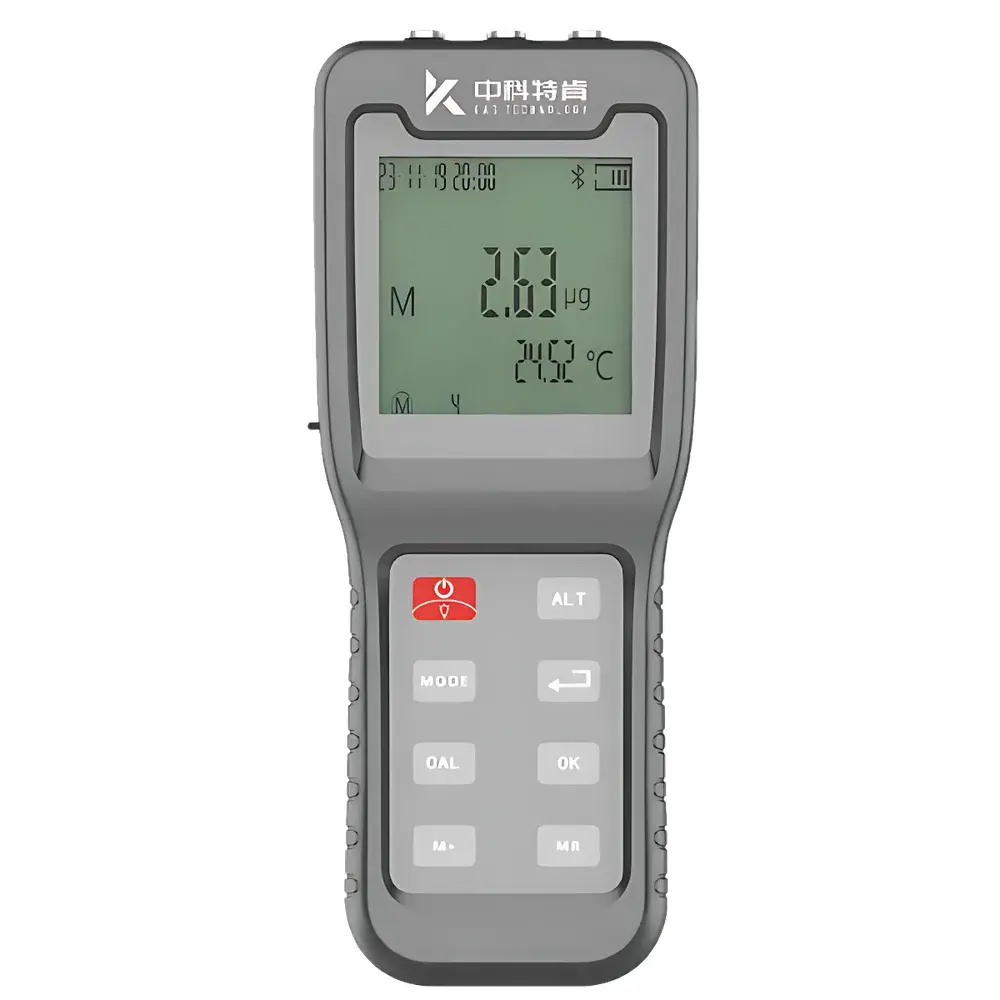
CAS TECHNOLOGY PC-300 Portable Multi-Parameter Water Quality Analyzer
| Brand | CAS TECHNOLOGY |
|---|---|
| Origin | Shandong, China |
| Model | PC-300 |
| Instrument Type | Portable/Handheld Water Quality Analyzer |
| Measurement Principle | Electrochemical Method |
| Measured Parameters | Conductivity, pH, Dissolved Oxygen (DO), Oxidation-Reduction Potential (ORP), Temperature |
| Enclosure Rating | IP67 (main unit), IP68 (electrodes) |
| Power Supply | AA batteries or USB-C external power |
| Calibration | Automatic electrode recognition, auto-calibration for pH, conductivity, and DO |
| Data Management | On-device storage, Bluetooth connectivity to companion mobile app |
| Compliance | Designed for field-deployable environmental monitoring in accordance with standard electrochemical measurement practices (ASTM D1129, ISO 7888, ISO 5814, ISO 10523, ISO 7888) |
Overview
The CAS TECHNOLOGY PC-300 Portable Multi-Parameter Water Quality Analyzer is an integrated, field-deployable electrochemical instrument engineered for simultaneous, real-time measurement of five critical water quality parameters: pH, electrical conductivity (EC), dissolved oxygen (DO), oxidation-reduction potential (ORP), and temperature. Built upon a modular sensor architecture, the analyzer employs standardized electrochemical transduction principles—potentiometric for pH and ORP, amperometric (Clark-type polarographic) for DO, and conductometric for EC—ensuring traceable, repeatable measurements across diverse aquatic environments. Its compact, ergonomic handheld form factor supports rapid deployment in rivers, lakes, wastewater treatment plants, aquaculture facilities, drinking water distribution networks, and regulatory field surveys. The device operates independently of fixed laboratory infrastructure, delivering lab-grade data integrity under ambient outdoor conditions without compromising analytical rigor.
Key Features
- Simultaneous five-parameter acquisition with synchronized timestamping and automatic parameter inter-compensation (e.g., DO compensation for temperature, salinity, and barometric pressure; pH and EC automatic temperature compensation)
- Intelligent electrode auto-recognition system that identifies connected sensor type (pH, DO, EC, ORP) and retrieves pre-stored calibration coefficients and configuration profiles
- On-device auto-calibration routines compliant with standard protocols: two-point pH calibration (4.01/7.00/10.01 buffers), single- or multi-point conductivity calibration (KCl standards), and zero-point + air-saturation DO calibration with ambient pressure and temperature input
- High-resolution display with adjustable backlight and auto-dimming functionality; optimized for daylight readability and low-power operation
- Dual-power architecture supporting both disposable alkaline AA batteries (up to 200 hours continuous operation) and regulated USB-C DC input (5 V / 1 A), enabling extended field use and benchtop charging flexibility
- Ruggedized housing rated IP67 (dust-tight and submersible up to 1 m for 30 min); electrodes rated IP68 (continuous submersion at 2 m depth); optional shock-absorbing carry case included for transport and storage
Sample Compatibility & Compliance
The PC-300 is validated for use with natural waters (freshwater, estuarine, brackish), treated effluents, potable supplies, and process streams within standard environmental sampling matrices. It meets functional requirements outlined in ASTM D1293 (pH), ASTM D5391 (conductivity), ASTM D888 (DO), and ISO 5814 (electrochemical DO). While not certified as a medical or pharmaceutical-grade device, its measurement traceability aligns with GLP-aligned field data collection workflows. Data logging adheres to internally auditable formats suitable for integration into LIMS or regulatory reporting systems. No internal memory encryption or FDA 21 CFR Part 11 electronic signature capability is implemented; users requiring audit-trail compliance must rely on external secure data transfer via the companion application.
Software & Data Management
The PC-300 communicates wirelessly via Bluetooth 5.0 to the proprietary CAS FieldLink mobile application (iOS and Android). The app enables remote configuration, real-time streaming visualization, batch export in CSV/Excel format, geotagging of measurement locations, and firmware updates over-the-air. On-device memory stores up to 5,000 measurement records with full metadata (date/time, GPS coordinates if enabled via smartphone, operator ID, calibration status flags). All stored data retain original sensor raw outputs and compensated values, facilitating post-acquisition reprocessing using updated compensation algorithms or alternative reference standards.
Applications
- Regulatory environmental monitoring programs (EPA Region 10, EU WFD field campaigns)
- Wastewater treatment plant influent/effluent QA/QC and process optimization
- Aquaculture health management and dissolved oxygen saturation control
- Drinking water source assessment and distribution system integrity verification
- Academic field hydrology studies and student laboratory training
- Emergency response teams conducting rapid contamination screening after spills or flooding events
FAQ
What electrochemical methods does the PC-300 use for each parameter?
It applies potentiometry for pH and ORP, polarographic amperometry for dissolved oxygen, and conductometry for electrical conductivity.
Does the device support GLP-compliant data handling?
While it logs full metadata and timestamps, it lacks built-in electronic signatures or audit-trail encryption; GLP compliance requires external validation of the full data chain from acquisition to archival.
Can the PC-300 be used in seawater?
Yes—the DO module compensates for salinity up to 45 ppt, and the conductivity range extends to 2000 mS/cm, covering full-strength seawater (≈53 mS/cm) and hypersaline conditions.
Is calibration verification traceable to NIST standards?
Calibration is user-performed using commercially available NIST-traceable buffer and standard solutions; the instrument itself does not hold NIST certification but supports metrologically sound calibration practices.
How often should electrodes be recalibrated during continuous field use?
For routine monitoring, daily calibration is recommended; for high-precision applications or after exposure to fouling matrices, calibration before each sampling session is advised per ISO 5667-3 guidelines.
Related Products







