
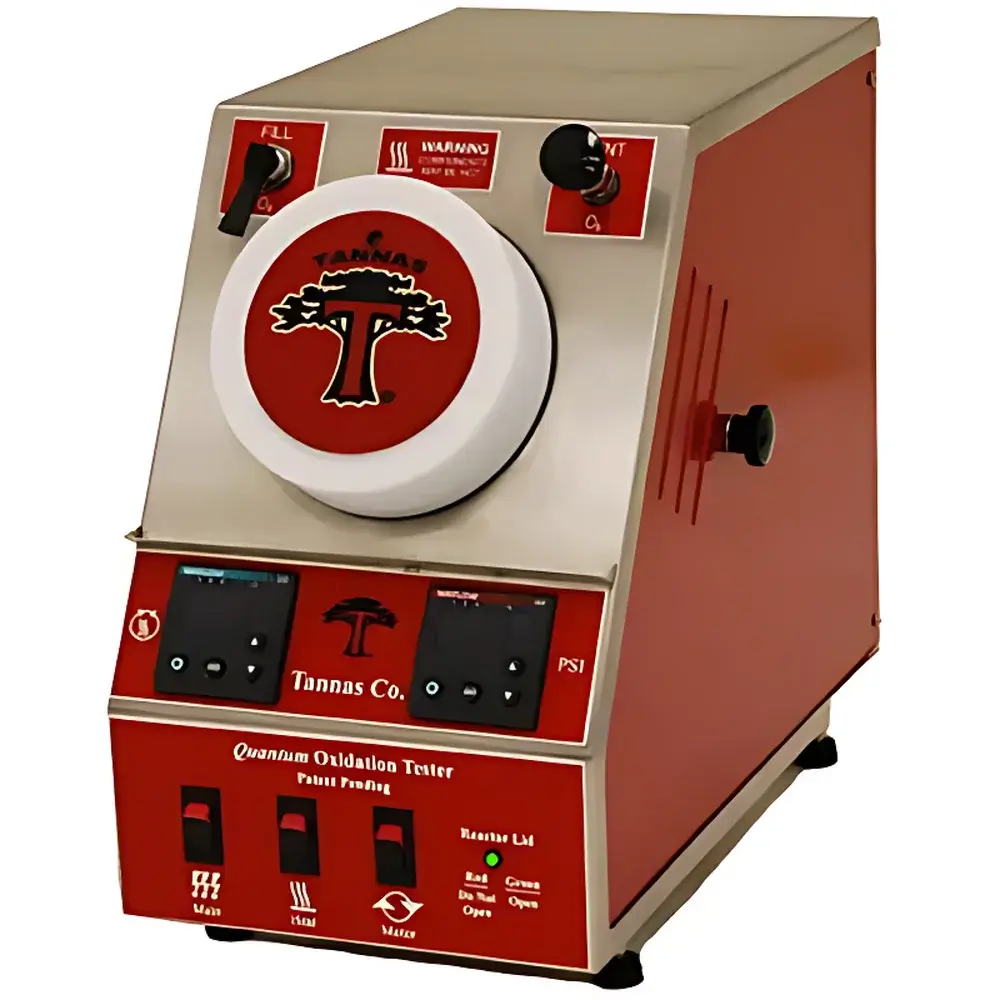
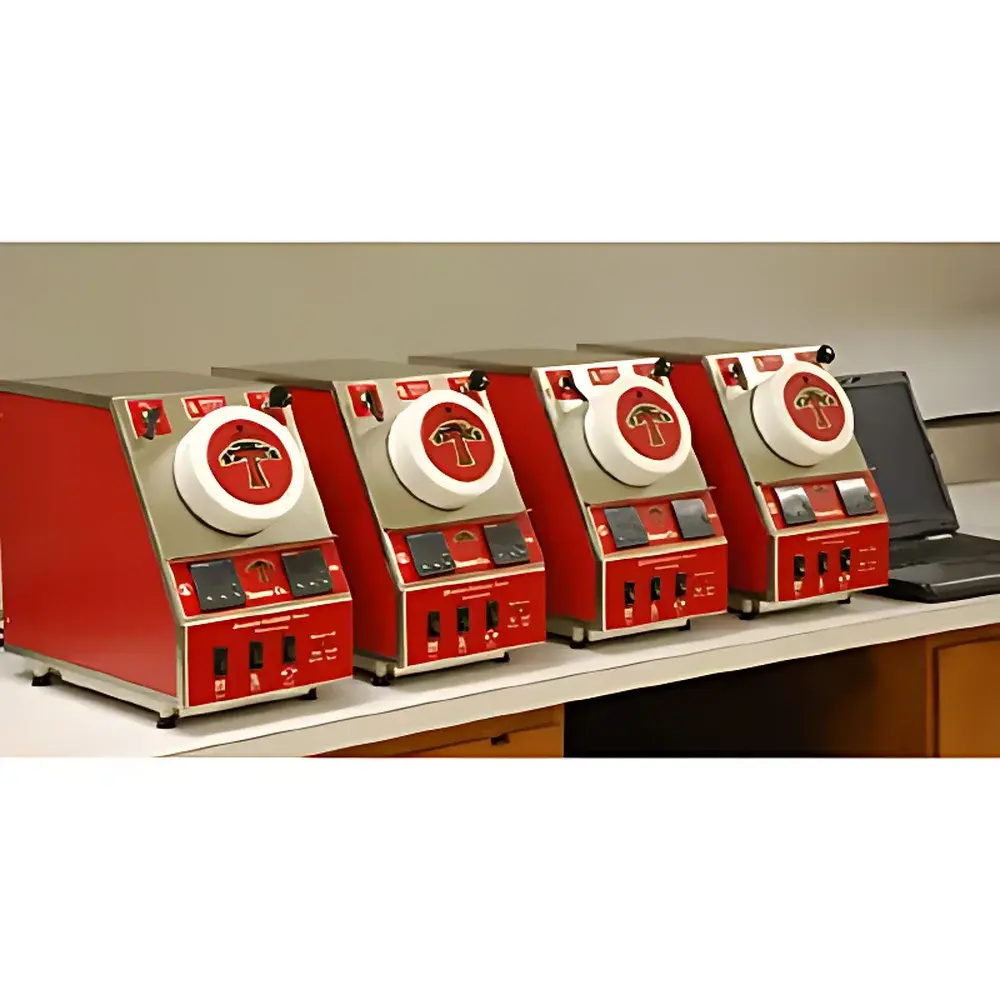
Tannas Quantum Dry-Bath Rotating Pressure Vessel Oxidation Tester (RPVOT)
| Brand | Tannas & King |
|---|---|
| Origin | USA |
| Manufacturer Status | Authorized Distributor |
| Origin Category | Imported |
| Model | Quantum |
| Pricing | Upon Request |
Overview
The Tannas Quantum Dry-Bath Rotating Pressure Vessel Oxidation Tester (RPVOT) is a rigorously validated, ASTM D2272-compliant instrument engineered for precise determination of oxidation stability in petroleum-based lubricants and functional fluids. Unlike conventional liquid-bath RPVOT systems, the Quantum employs a proprietary dry-heating thermal architecture—eliminating reliance on silicone oil or glycol baths—and operates under elevated oxygen pressure (typically 620 kPa) while rotating a standardized copper catalyst coil immersed in the test sample. This controlled oxidative stress accelerates degradation mechanisms representative of real-world service conditions, enabling quantification of induction period (in minutes) prior to rapid oxygen uptake—a key indicator of antioxidant depletion and base oil susceptibility. As the only commercially available dry-bath RPVOT system independently verified for compliance with ASTM D2272, D4742, and IP 229, the Quantum serves critical roles in lubricant formulation R&D, base stock qualification, and in-service oil condition monitoring—particularly for steam turbine oils, hydraulic fluids, insulating oils, and internal combustion engine oils.
Key Features
- Dry-heating thermal system: Solid-state resistive heating elements integrated into the sample chamber eliminate bath fluid maintenance, thermal stratification, and associated safety hazards (e.g., burns, spills, vapor inhalation)
- ASTM D2272–certified operation: Fully compliant with standard test method for oxidation stability of turbine oils and other lubricants using rotating pressure vessel apparatus
- Compact benchtop footprint: Requires no fume hood installation; exhaust gases and volatile byproducts vent via low-pressure polymeric tubing to external exhaust or activated carbon filtration
- Independent unit architecture: Each Quantum operates as a self-contained analytical station, supporting parallel testing across multiple units without cross-interference
- Integrated control software suite: PC-based application enables simultaneous or sequential control of up to four Quantum instruments, with automated data logging, alarm triggers, and timestamped event tracking
- Modular expansion capability: Optional accessories include real-time sample temperature sensor kits (IEC 60751 Class A Pt100) and programmable micro-sampling probes for in-situ extraction during test progression
Sample Compatibility & Compliance
The Quantum accommodates standard 50-mL stainless-steel sample vessels per ASTM D2272 specifications and supports a broad matrix of oxidatively stressed petroleum products—including Group I–III mineral base oils, PAOs, ester-based synthetics, turbine oils (ISO L-TGA/L-TGB), hydraulic fluids (ISO L-HM), insulating oils (IEC 60296), and gasoline engine oils (API SP/ILSAC GF-6). Its measurement methodology aligns with internationally recognized protocols governing oxidative stability assessment, including ASTM D2272 (RPVOT), ASTM D4742 (TFOUT—turbine oil oxidation test), and IP 229 (oxidation stability of lubricating oils). The system’s software architecture supports audit-ready data integrity through configurable user access levels, electronic signature capture, and optional 21 CFR Part 11–compliant electronic records when deployed in regulated environments (e.g., power generation asset management, aerospace lubricant certification).
Software & Data Management
The Quantum Control Suite is a Windows-native application designed for laboratory-grade data governance. It provides real-time graphical display of pressure decay curves, temperature profiles, and rotational status; automatically calculates induction time endpoints per ASTM D2272 Annex A1; and exports results in CSV, PDF, and XML formats compatible with LIMS integration. All test sequences are timestamped with system clock synchronization, and raw sensor data (pressure, temperature, rotation speed) are archived at user-defined intervals (default: 1-second resolution). Audit trails record operator logins, parameter modifications, calibration events, and report generation actions—ensuring full traceability for GLP, GMP, or ISO/IEC 17025 accreditation requirements.
Applications
- Baseline comparison of antioxidant package efficacy across competing base oil formulations
- In-service monitoring of steam turbine oil oxidation state to support predictive maintenance scheduling
- Quality assurance screening of incoming lubricant batches against OEM specifications
- Accelerated aging studies for lubricant life modeling and remaining useful life (RUL) estimation
- Supporting ASTM D943 (TOST) and ASTM D2893 (RBOT) correlation studies in lubricant development labs
- Validation of re-refined base oil oxidative performance prior to blending
FAQ
Is the Quantum suitable for testing used oils with high sediment or sludge content?
Yes—the dry-heating design avoids bath contamination risks common in liquid-bath RPVOT systems; however, samples must be pre-filtered to ≤5 µm to prevent blockage of the pressure transducer line.
Does the system require routine calibration verification?
Per ASTM D2272 Section 7.2, users must verify pressure transducer accuracy annually using NIST-traceable deadweight testers; temperature sensor drift checks are recommended quarterly.
Can the Quantum operate unattended overnight?
Yes—fully autonomous test execution is supported, with automatic shutdown upon endpoint detection and configurable email/SNMP alerts for abnormal pressure deviations or power loss.
What is the typical lifetime of the copper catalyst coil?
Each coil is rated for ≥500 test cycles under standard operating conditions; replacement coils are supplied with individual calibration certificates.
Is remote diagnostics supported?
The Control Suite includes secure remote desktop access capability for technical support, subject to customer network policy approval and firewall configuration.
Related Products






