
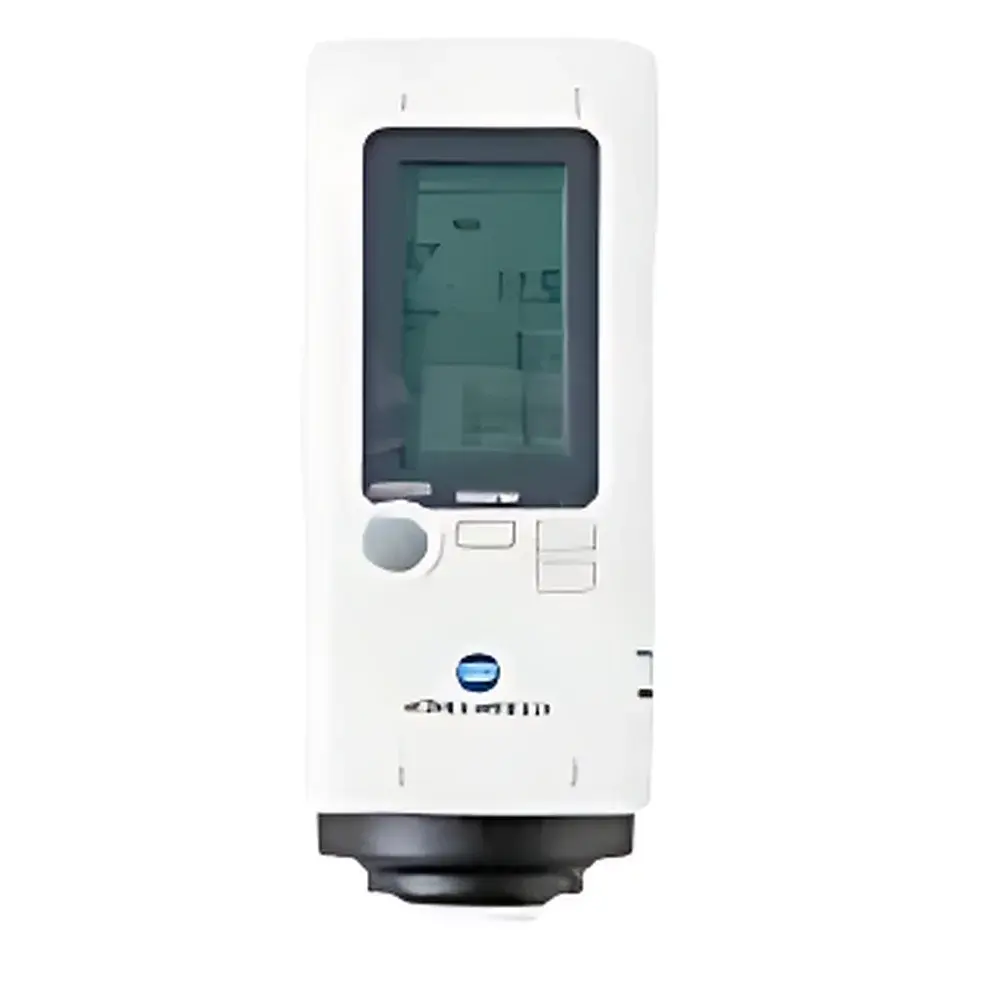
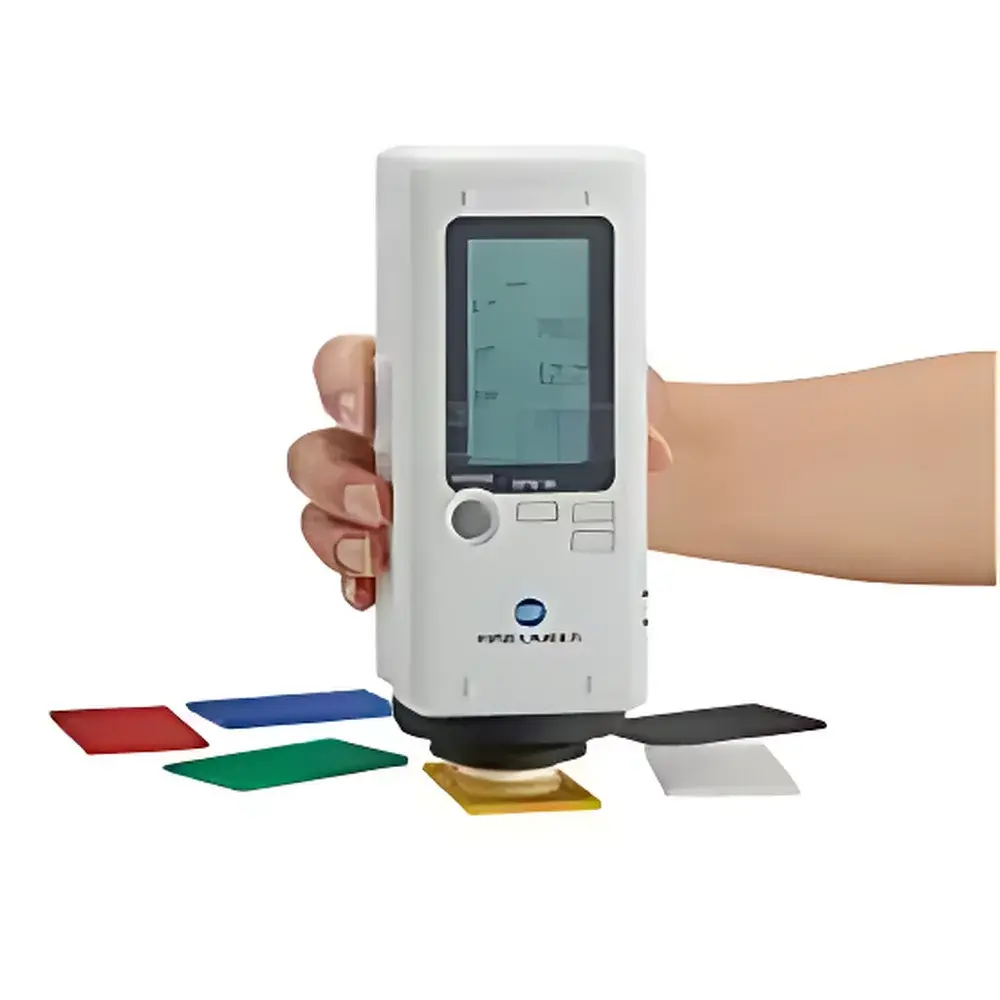
Konica Minolta CR-20 Portable Color Difference Meter
| Brand | Konica Minolta |
|---|---|
| Origin | Japan |
| Model | CR-20 |
| Instrument Type | Portable |
| Optical Geometry | d/8° integrating sphere (with specular component included) |
| Light Source | Pulsed Xenon Lamp |
| Spectral Range | 360–750 nm |
| Repeatability | ΔE*ab ≤ 0.1 (std. dev., 30 measurements on white calibration tile at 10-sec intervals) |
| Aperture | Ø8 mm |
| Observer Angle | 10° |
| Illuminant | D65 |
| Display | Backlit LCD |
| Data Storage | Up to 1,000 measurement sets (including reference) |
| Interface | USB 2.0 |
| Power | 4 × AA alkaline/Ni-MH batteries, USB bus power, or AC adapter (optional) |
| Dimensions | 66 × 159.5 × 85 mm |
| Weight | 420 g (without batteries) |
| Compliance | DIN 5033-7, JIS Z 8722 Condition d, ISO 7724-1, CIE No. 15, ASTM E1164 |
Overview
The Konica Minolta CR-20 is a compact, portable color difference meter engineered for rapid, repeatable color assessment in production environments, quality control laboratories, and field applications. Based on the d/8° integrating sphere optical geometry—including specular component (SCI)—the instrument conforms to international standards including ISO 7724-1, CIE No. 15, ASTM E1164, and JIS Z 8722 Condition d. It employs a pulsed xenon lamp as its broadband light source, delivering stable spectral output across the visible range (360–750 nm), enabling accurate tristimulus value calculation under standardized D65 illumination and 10° observer conditions. Designed as the successor to the CR-11/CR-13/CR-14 series, the CR-20 retains high portability while introducing enhanced data management capabilities via integrated USB connectivity and onboard memory—making it suitable for routine pass/fail verification, supplier evaluation, batch consistency monitoring, and in-process color validation without requiring constant PC dependency.
Key Features
- Three-step operation workflow: Power-on → White calibration → Sample measurement — optimized for operator efficiency and minimal training requirements.
- Multi-color-space reporting: Simultaneous display of results in L*a*b*, L*C*h, Yxy, XYZ, Munsell (D65), and industry-specific indices including Whiteness Index (WI per CIE/ASTM E313-96), Yellowness Index (YI per ASTM E313-96), and Tint (CIE/ASTM E313-96).
- Averaging function: Supports up to 999-point averaging for heterogeneous samples such as textured surfaces, powders, pastes, or granular materials—critical for non-uniform substrates common in plastics, coatings, food, and pharmaceutical manufacturing.
- Ergonomic design: Compact housing (66 × 159.5 × 85 mm), lightweight construction (420 g), tactile grip contouring, and large backlit LCD ensure readability and fatigue-free use during extended shifts or mobile inspections.
- Integrated pass/fail feedback: Programmable tolerance thresholds trigger visual (LED color coding) and audible (distinctive beep patterns) alerts—enabling real-time go/no-go decisions independent of external software.
- Protective target mask: Sapphire-coated aperture window safeguards the 8-mm measurement port against abrasion, contamination, and physical damage when measuring rough, viscous, or particulate-laden samples.
Sample Compatibility & Compliance
The CR-20 accommodates solid, semi-solid, and particulate samples—including molded plastics, painted panels, textiles, ceramic tiles, foodstuffs, and pharmaceutical tablets—without requiring sample preparation or contact pressure adjustment. Its d/8° SCI configuration ensures consistent measurement of both matte and glossy surfaces by capturing total reflectance (diffuse + specular). Regulatory alignment includes full traceability to CIE standard illuminants and observers, with documented compliance to DIN 5033-7, ISO 7724-1, and ASTM E1164. While not inherently 21 CFR Part 11 compliant out-of-the-box, audit-ready data export (via USB) supports integration into validated quality systems operating under GLP or GMP frameworks when paired with controlled documentation procedures.
Software & Data Management
The CR-20 features embedded firmware supporting local storage of up to 1,000 measurement records—including reference standards and associated metadata (date/time stamp, operator ID if entered manually). Data transfer occurs via USB 2.0 to Windows-based Konica Minolta proprietary software (CM-S100w), enabling export to CSV, PDF, or Excel formats for trending, SPC analysis, and report generation. The device operates autonomously for threshold-based judgment; no PC is required for basic operation or pass/fail evaluation. Optional accessories include thermal printers for on-site hardcopy output and AC adapters for benchtop continuity—facilitating deployment across lab, line-side, and warehouse settings.
Applications
- Automotive interior trim color matching across injection-molded components and fabric overlays.
- Paint and coating formulation QC in R&D labs and production lines, verifying batch-to-batch consistency against master standards.
- Food processing quality assurance—monitoring browning in baked goods, pigment stability in dairy products, or uniformity in confectionery glazes.
- Pharmaceutical tablet appearance control per USP and ICH Q5C guidelines, where hue, chroma, and lightness deviations may indicate excipient variability or degradation.
- Plastics recycling sorting verification, distinguishing polymer grades based on spectral signature differences within the visible band.
- Textile dye lot approval in apparel manufacturing, ensuring shade consistency across cutting lots and dye houses.
FAQ
What standards does the CR-20 comply with for color measurement?
It meets ISO 7724-1, CIE No. 15, ASTM E1164, JIS Z 8722 Condition d, and DIN 5033-7 for geometric and photometric performance.
Can the CR-20 measure translucent or textured surfaces accurately?
Yes—the d/8° integrating sphere with included specular component ensures reliable readings on gloss-varied and micro-textured surfaces when used with proper sample presentation and averaging.
Is the CR-20 suitable for regulated industries like pharmaceuticals or medical devices?
It provides metrologically sound data traceable to CIE standards; however, full compliance with FDA 21 CFR Part 11 requires procedural controls around data handling, user access, and audit trail documentation—not built-in firmware features.
How many measurements can be stored internally without connecting to a PC?
Up to 1,000 complete measurement sets—including reference values, date/time stamps, and user-defined IDs—are retained in non-volatile memory.
Does the CR-20 require annual recalibration?
Konica Minolta recommends periodic verification using certified white and black calibration tiles; formal recalibration by an authorized service center is advised every 12–24 months depending on usage intensity and environmental exposure.





