
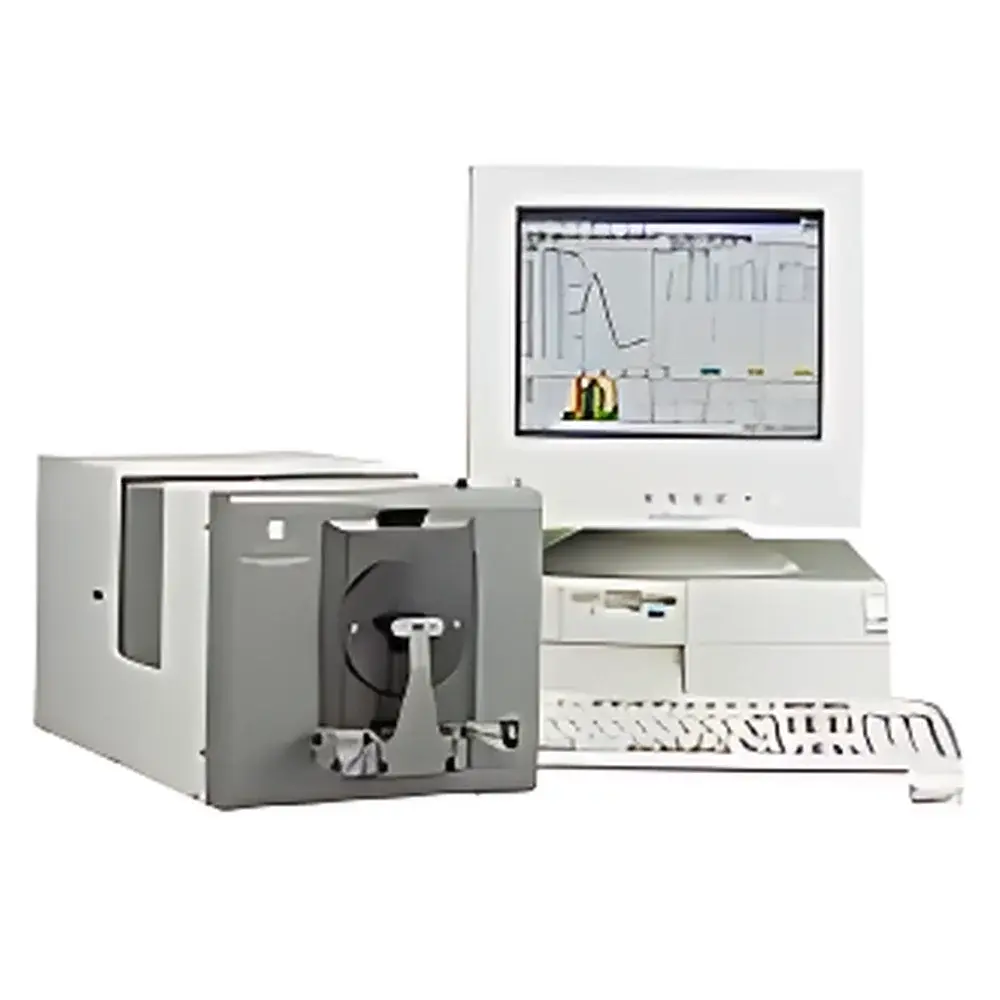
Konica Minolta CM-3700d Spectrophotometer
| Brand | Konica Minolta |
|---|---|
| Origin | Shanghai, China |
| Model | CM-3700d |
| Illumination/Viewing Geometry | d/8° (diffuse illumination / 8° viewing), switchable SCI (Specular Component Included) / SCE (Specular Component Excluded) |
| Transmission Mode | d/0° |
| Wavelength Range | 360–740 nm |
| Wavelength Interval | 10 nm |
| FWHM | ~14 nm (average) |
| Photometric Range | 0–200% |
| Resolution | 0.001% |
| Light Source | Pulsed Xenon Arc Lamp |
| Measurement Time | 0.6–0.8 s (to data output) |
| Apertures (Reflectance) | LAV (Φ28 mm illum. / Φ25.4 mm meas.), MAV (Φ11 mm / Φ8 mm), SAV (5×7 mm / 3×5 mm) |
| Aperture (Transmittance) | ~Φ20 mm |
| Repeatability (White Tile, 30 measurements @ 10 s intervals) | ΔE*ad ≤ 0.005 |
| Repeatability (Black Tile, BCRA Series II, 1% R) | ΔE*ad ≤ 0.05 |
| Instrument Error (LAV, BCRA Series II 12-tile avg.) | ΔE*ad ≤ 0.08 (typical) |
| Temperature Drift | Spectral Reflectance ±0.10%/°C |
| UV Adjustment | PC-controlled, continuously variable (1000-step) |
| Sample Thickness Limit (Transmittance) | < 50 mm |
| Interface | RS-232C (1200–9600 bps) |
| Power Supply | AC 100/120/230 V, 50/60 Hz |
| Operating Environment | 13–33 °C, ≤80% RH (non-condensing) |
| Storage Environment | 0–40 °C, ≤80% RH (non-condensing) |
| Dimensions (W×H×D) | 271×259×500 mm |
| Weight | 18 kg |
Overview
The Konica Minolta CM-3700d is a high-precision benchtop spectrophotometer engineered for metrology-grade color measurement in industrial quality control, R&D laboratories, and standardized color management systems. It operates on the principle of diffuse/8° (d/8°) sphere geometry with dual-beam spectral acquisition, enabling absolute reflectance and transmittance quantification across the visible spectrum (360–740 nm). Its optical architecture—featuring a large integrating sphere, dual flat-field holographic gratings, and a silicon photodiode array—exceeds the performance thresholds defined by ISO 7724-1, CIE No. 15, ASTM E308, DIN 5033, and JIS Z 8722. The instrument supports both Specular Component Included (SCI) and Specular Component Excluded (SCE) measurement modes, allowing users to decouple surface texture effects from intrinsic color properties—a critical capability for pigment formulation, substrate matching, and appearance standardization under GLP/GMP-aligned workflows.
Key Features
- Optical design compliant with ISO 7724-1, CIE 15:2018, ASTM E308-22, and DIN 5033-7 for d/8° geometry and d/0° transmittance mode
- Dual flat-field holographic grating system coupled with silicon photodiode array ensures high signal-to-noise ratio and minimal stray light—critical for accurate dark-tone and low-reflectance measurement (e.g., black plastics, anodized metals)
- Switchable SCI/SCE modes: SCI enables material-intrinsic color evaluation independent of surface gloss; SCE approximates visual assessment under directional lighting without specular contribution
- Three interchangeable apertures (LAV, MAV, SAV) support flexible sampling—from large-area batch validation to micro-area defect analysis on printed circuits or textile yarns
- Computer-controlled, 1000-step UV irradiance adjustment enables precise D65-equivalent illumination for fluorescent sample characterization (e.g., optical brighteners in paper, detergents, coatings)
- Thermal stability optimized to ≤0.05 ΔE*ab/°C drift, supporting operation in non-climate-controlled production environments without recalibration cycles
- Pulsed xenon arc lamp provides stable, flash-based illumination with no warm-up time and negligible spectral aging over >1 million flashes
Sample Compatibility & Compliance
The CM-3700d accommodates solid, liquid, and translucent specimens up to 50 mm thick in transmittance mode—including films, glass substrates, polymer sheets, aqueous solutions, and suspension media. Reflectance measurements support matte, glossy, textured, and structured surfaces across industries including automotive OEM paint shops, packaging converters, textile mills, and pharmaceutical film-coating facilities. All measurement protocols align with regulatory expectations for traceability and audit readiness: spectral data include full wavelength-by-wavelength reflectance/transmittance values (360–740 nm at 10 nm intervals), enabling retrospective reprocessing per updated tolerancing standards (e.g., CMC, ΔE00). The instrument’s calibration traceability extends to NIST-traceable ceramic tiles (BCRA Series II), and its error profile (ΔE*ad ≤ 0.08 typical, ≤0.3 max) satisfies ISO 13655:2017 requirements for Class I spectrophotometers used in print and packaging certification.
Software & Data Management
Controlled via SpectraMagic NX software (sold separately), the CM-3700d supports full spectral data export in CSV, XML, and CxF/X3 formats—compatible with enterprise color management platforms (e.g., X-Rite Color iMatch, Datacolor Match Textile). The software enforces FDA 21 CFR Part 11 compliance through user-level access control, electronic signatures, and immutable audit trails for all calibration events, measurement sessions, and report generation. Batch reporting includes statistical process control (SPC) charts (X̄/R, Cp/Cpk), tolerance mapping against Munsell, RAL, Pantone, or custom standards, and deviation heatmaps for spatially heterogeneous samples. Raw spectral files retain metadata such as aperture selection, UV setting, measurement date/time, operator ID, and environmental conditions—ensuring full reproducibility under ISO/IEC 17025-accredited laboratory practices.
Applications
- Automotive: Paint chip verification, interior trim color consistency, headlight lens haze/yellowing quantification
- Plastics & Polymers: Masterbatch dispersion uniformity, recycled resin color drift monitoring, additive migration analysis
- Printing & Packaging: Spot color validation, inkjet/carbon toner gamut mapping, substrate metamerism screening
- Textiles & Apparel: Dye lot conformance, fabric shade sorting, fluorescence compensation in whitened cotton
- Pharmaceuticals: Film-coated tablet hue uniformity, excipient color stability testing per USP
- Food & Beverage: Powdered ingredient batch release, liquid concentrate transparency grading, label ink fade resistance
FAQ
Does the CM-3700d meet ISO/IEC 17025 calibration requirements?
Yes—the instrument’s factory calibration is traceable to NIST SRM 2020 and BCRA Series II reference tiles, and its documented repeatability and inter-instrument agreement comply with ISO/IEC 17025 Clause 6.4.1 for measurement equipment.
Can it measure fluorescent materials under D65 illumination?
Yes—its programmable UV adjustment enables continuous spectral tuning to replicate the UV component of CIE Illuminant D65, essential for evaluating optical brightening agents in paper, textiles, and detergents.
Is transmittance measurement supported for colored liquids?
Yes—using optional cuvette holders (2 mm, 10 mm, 20 mm pathlength) and glass/plastic cells, the CM-3700d delivers linear absorbance data compliant with Beer-Lambert law applications in QC labs.
What spectral resolution does the CM-3700d provide?
It acquires spectra at 10 nm intervals across 360–740 nm with an average full width at half maximum (FWHM) of ~14 nm—sufficient to resolve narrow-band pigments and interference filters while maintaining robust signal integrity.
How is thermal drift mitigated during extended operation?
Internal temperature sensors feed real-time compensation algorithms to the spectral engine; combined with low-drift optics and pulsed xenon illumination, this limits chromatic shift to ≤0.05 ΔE*ab per °C across the operational range.



